
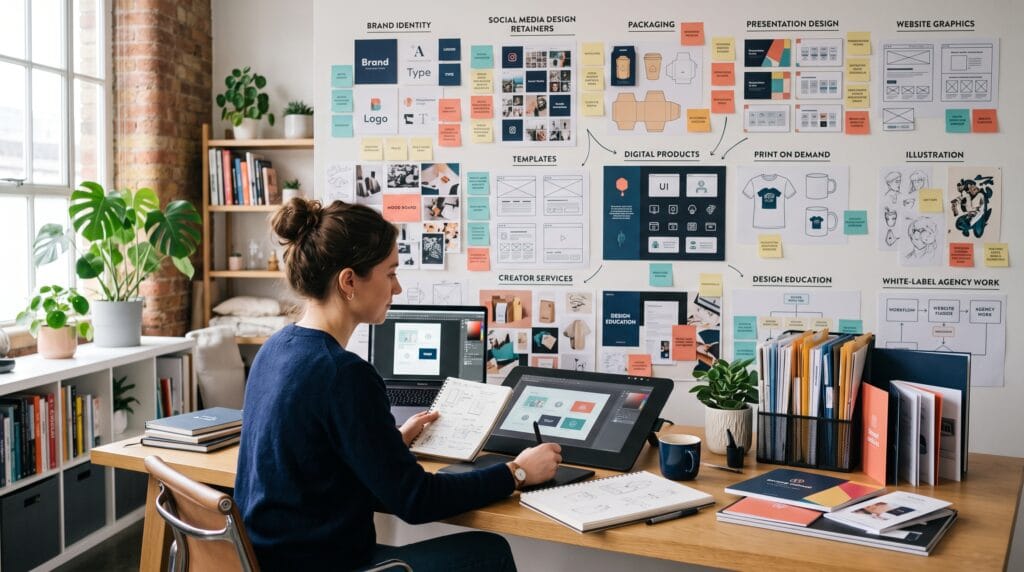
Graphic design can become more than a creative skill. With the right offer, audience, pricing, and delivery process, it can become a flexible service business, digital-product company, niche studio, or recurring-revenue operation. Exploring graphic design business ideas helps freelancers and beginners understand that they do not need to compete for every possible design project.
A designer can specialize in logos, packaging, social media, presentations, websites, event campaigns, templates, merchandise, or educational products. Each option has different startup costs, client expectations, sales cycles, profit margins, and growth potential.
The best opportunity is rarely the idea with the highest advertised income. It is the one that matches your current skills, portfolio, tools, network, available time, and willingness to communicate with clients.
Beginners can start with a focused service that generates revenue quickly. More experienced freelancers can productize their process, add retainers, build a small team, or create assets that sell repeatedly.
This guide explains 22 practical graphic design business ideas for freelancers and beginners. It also covers pricing models, startup requirements, niche selection, client acquisition, validation, portfolio strategy, contracts, recurring revenue, and common mistakes.
Why Graphic Design Is a Flexible Business
Graphic design supports nearly every industry because organizations need visual communication for:
- Branding
- Marketing
- Sales
- Packaging
- Websites
- Social media
- Presentations
- Events
- Education
- Publishing
- Internal communication
- Products and merchandise
A design business can begin with limited equipment. Many freelancers start with:
- A capable computer
- Design software
- Cloud storage
- Video-call tools
- A simple portfolio
- Proposal and invoice templates
- Reliable communication
The business can remain a solo practice or grow into a studio with designers, writers, strategists, developers, photographers, and production partners.
How to Choose Between Graphic Design Business Ideas
Before selecting an offer, evaluate five factors.
1. Skill Fit
Choose a service you can deliver reliably or learn within a practical timeframe.
2. Market Demand
Look for buyers who already spend money solving the problem.
3. Portfolio Proof
Clients need to see relevant work. A focused fictional project can help when paid examples are unavailable.
4. Delivery Complexity
A logo package is different from a monthly content retainer. Understand revisions, meetings, production, and approval requirements.
5. Revenue Potential
Consider whether the idea supports:
- One-time projects
- Recurring retainers
- Licensing
- Digital-product sales
- Subscriptions
- White-label partnerships
The strongest graphic design business ideas often combine a clear service with a repeatable process.
1. Brand Identity Design Packages
Brand identity design is one of the most established freelance design services.
Possible Deliverables
- Primary logo
- Secondary logo
- Brand mark
- Color palette
- Typography
- Basic brand guidelines
- Social profile graphics
- Business card
- Email signature
Ideal Customers
- Startups
- Local businesses
- Consultants
- Creators
- Restaurants
- Online stores
Revenue Model
Charge a fixed package price based on scope, complexity, strategy, and usage.
Beginner Advantage
You can create strong fictional case studies for specific industries before approaching clients.
Main Risk
Clients may expect unlimited concepts or revisions. Define scope, revision rounds, and deliverables in writing.
2. Logo Design for a Specific Niche
Instead of offering logos to everyone, specialize in one market.
Potential Niches
- Real estate
- Beauty
- Education
- Technology
- Food businesses
- Fitness
- Construction
- Personal brands
- Children’s products
- Professional services
Why Specialization Helps
A niche portfolio makes it easier for clients to recognize relevance.
You can build:
- Industry-specific questionnaires
- Faster research methods
- Better presentation templates
- More accurate recommendations
- Referral networks
Revenue Model
Offer tiered logo packages with optional identity extensions.
3. Social Media Design Retainers
Many businesses need consistent visual content but do not need a full-time designer.
Deliverables May Include
- Feed posts
- Carousels
- Stories
- Advertisements
- Event graphics
- Promotional banners
- Thumbnail templates
- Campaign variations
Revenue Model
Charge a monthly retainer based on the number of assets, platforms, revision rounds, and turnaround time.
Why It Works
Recurring work improves income predictability.
Main Risk
Daily requests can become difficult to manage. Use a content calendar, request form, and defined monthly capacity.
Also Read: 10 Best Ways to Advertise Your Freelance Graphic Design Business
4. Presentation Design Service
Businesses often need help turning complex information into clear, persuasive presentations.
Common Projects
- Sales decks
- Investor presentations
- Training slides
- Conference talks
- Reports
- Webinar decks
- Company profiles
- Proposal presentations
Skills Required
- Information hierarchy
- Typography
- Data visualization
- Story structure
- Template systems
- Brand consistency
Revenue Model
Charge per slide, per project, or through a monthly business-support retainer.
Beginner Opportunity
Start with redesign projects that show before-and-after improvements.
5. Packaging Design Studio
Packaging design combines branding, hierarchy, production knowledge, and product storytelling.
Potential Clients
- Food brands
- Beverage companies
- Skincare businesses
- Supplements
- Household products
- Artisan goods
- Subscription boxes
Deliverables
- Labels
- Boxes
- Pouches
- Bottles
- Dieline artwork
- Product-family systems
- Retail displays
- Ecommerce images
Revenue Model
Charge per product, collection, or packaging system.
Main Risk
Printing mistakes are expensive. Confirm specifications with the printer and state responsibility for production approval.
6. Restaurant and Hospitality Design
Restaurants, cafés, hotels, food trucks, and event venues need many connected design assets.
Services
- Identity
- Menus
- Signage
- Packaging
- Table materials
- Reservation graphics
- Social content
- Promotional campaigns
- Delivery-app images
Revenue Model
Combine a launch package with ongoing seasonal or social-media support.
Why It Works
Hospitality brands frequently need updates for menus, events, promotions, and locations.
7. Website Graphics and Landing Page Design
Designers can provide visual direction and page layouts without offering full development.
Services
- Website art direction
- Landing page mockups
- Hero graphics
- Icon systems
- Section layouts
- Ecommerce banners
- Lead-magnet pages
- Image direction
Revenue Model
Charge by page, project, or website package.
Partnership Opportunity
Partner with developers, copywriters, and marketing consultants who need reliable design support.
8. Ecommerce Creative Design
Online sellers need a continuous supply of conversion-focused visual assets.
Possible Services
- Product listing images
- Store banners
- Comparison graphics
- Promotion graphics
- Email visuals
- Product infographics
- Lifestyle composites
- Advertisement variations
Ideal Customers
- Direct-to-consumer brands
- Marketplace sellers
- Subscription businesses
- Small manufacturers
- Digital-product sellers
Revenue Model
Offer fixed launch packages and monthly optimization retainers.
9. Print Design for Local Businesses
Local organizations still need professionally prepared print materials.
Products
- Flyers
- Brochures
- Menus
- Posters
- Business cards
- Signage
- Event programs
- Direct mail
- Product catalogs
Revenue Model
Charge design fees separately from printing and production costs.
Growth Strategy
Build relationships with local printers, photographers, sign makers, and marketing consultants.
10. Event and Conference Design
Events require coordinated visual systems across physical and digital formats.
Deliverables
- Event identity
- Main poster
- Speaker graphics
- Schedule
- Tickets
- Badges
- Stage screens
- Signage
- Social media
- Presentation templates
Revenue Model
Charge a project fee with optional event-day or campaign support.
Main Risk
Deadlines are fixed. Use approval milestones and rush-fee policies.
11. Editorial and Publication Design
Editorial design is suitable for designers who enjoy typography, grids, and long-form content.
Potential Projects
- Magazines
- Ebooks
- Annual reports
- Research reports
- White papers
- Workbooks
- Company profiles
- Lookbooks
- Catalogs
Revenue Model
Charge by page, publication, or recurring issue.
Business Opportunity
Partner with writers, publishers, agencies, consultants, and nonprofit organizations.
12. Infographic and Data Visualization Service
Businesses often have useful information but struggle to present it clearly.
Deliverables
- Infographics
- Data reports
- Charts
- Process diagrams
- Timelines
- Comparison graphics
- Dashboard visuals
- Presentation graphics
Ideal Customers
- Consultants
- Researchers
- Healthcare organizations
- Financial firms
- SaaS companies
- Nonprofits
- Educators
Revenue Model
Charge by graphic, series, or report.
Competitive Advantage
Designers who can understand data and communicate it accurately can serve higher-value business needs.
13. YouTube Thumbnail and Creator Design Service
Creators need recognizable visual systems across video, social media, newsletters, and products.
Services
- Thumbnails
- Channel banners
- Podcast covers
- Episode graphics
- Sponsorship slides
- Media kits
- Merchandise
- Launch campaigns
Revenue Model
Monthly packages based on volume and turnaround.
Main Risk
Fast content schedules can create pressure. Define request deadlines and maximum revisions.
14. Podcast Branding Studio
Podcast creators need more than a square cover.
Deliverables
- Podcast identity
- Cover artwork
- Episode templates
- Guest cards
- Audiograms
- YouTube thumbnails
- Newsletter graphics
- Sponsorship graphics
- Website banners
Revenue Model
Sell a launch package plus recurring episode support.
15. Template Design Business
Templates can be sold repeatedly or created as a custom service.
Template Categories
- Social media
- Presentations
- Proposals
- Resumes
- Media kits
- Workbooks
- Brand guidelines
- Email graphics
- Printable planners
- Business documents
Revenue Models
- Marketplace sales
- Own-store sales
- Template membership
- Custom template projects
- Licensing
Main Risk
Generic templates compete heavily on price. Focus on one audience and outcome.
16. Digital Product Design Shop
A designer can create assets that customers buy without direct service delivery.
Product Ideas
- Icon sets
- Fonts
- Brushes
- Textures
- Mockups
- Illustration packs
- Presentation themes
- Social templates
- Printable products
- Design systems
- Prompt packs
Advantages
- Global distribution
- Repeated sales
- Flexible working hours
- Strong portfolio value
Risks
- Marketing dependence
- Piracy
- Customer support
- Platform fees
- Product maintenance
Also Read: 50 Unique Digital Product Ideas for Creators & Entrepreneurs
17. Print-on-Demand Design Brand
Create designs for apparel, stationery, wall art, accessories, or niche merchandise.
Business Models
- Sell through a marketplace
- Build an independent store
- License artwork to sellers
- Create merchandise for creators
- Produce limited collections
Why It Appeals to Beginners
Production and shipping can be handled by a supplier.
Main Risk
Low barriers create heavy competition. Success requires a focused niche, original work, strong product presentation, and consistent marketing.
18. Illustration and Character Design Service
Illustration can become a specialized freelance business.
Possible Markets
- Publishing
- Packaging
- Advertising
- Children’s education
- Games
- Animation
- Editorial media
- Mascot design
- Merchandise
Revenue Model
Charge per illustration, collection, campaign, or license.
Important Contract Terms
Define:
- Usage
- Territory
- Duration
- Exclusivity
- Revisions
- Source files
- Credit
- Licensing fees
19. White-Label Design for Agencies
Marketing, web, public relations, and development agencies often need additional design capacity.
Services
- Campaign production
- Social graphics
- Presentations
- Landing pages
- Reports
- Brand applications
- Advertisement variations
- Client revisions
Advantages
- Less direct client acquisition
- Repeat work
- Clear production needs
- Opportunity for retainers
Main Risk
Margins can be lower. Price according to turnaround, availability, and complexity.
20. Design Subscription Service
A design subscription gives clients ongoing access to a defined amount of design work.
Common Structure
- Monthly fee
- One active request at a time
- Defined turnaround
- Specific service list
- Pause or cancellation rules
- Separate complex-project pricing
Ideal Customers
- Startups
- Marketing teams
- Content businesses
- Agencies
- Ecommerce brands
Main Risk
Unlimited language can create unrealistic expectations. Set capacity and scope clearly.
21. Design Education and Workshops
Designers can teach beginners, business owners, students, or internal teams.
Products
- Live workshops
- Recorded courses
- Short tutorials
- Corporate training
- Critique sessions
- Portfolio reviews
- Software classes
- Design-principles programs
Revenue Model
- Ticket sales
- Course sales
- Membership
- Institutional contracts
- Private coaching
Why It Works
Teaching can strengthen authority while creating a second revenue stream.
22. Niche Creative Studio
A freelancer can build a studio around one industry or outcome.
Niche Examples
- Branding for wellness businesses
- Packaging for food startups
- Presentations for consultants
- Social design for real estate
- Design for education companies
- Ecommerce creative for beauty brands
- Visual identity for restaurants
- Reports for nonprofit organizations
Advantages
- Clear positioning
- Relevant portfolio
- Faster referrals
- Repeatable process
- Higher perceived expertise
Growth Path
Begin solo, then add trusted specialists as demand increases.
Also Read: Freelancing Tutorial Roadmap for Better Client Communication
Graphic Design Business Ideas Comparison Table
| Business Idea | Startup Cost | Revenue Pattern | Scalability | Best For |
|---|---|---|---|---|
| Brand identity packages | Low | Project | Medium | Strategic designers |
| Social design retainers | Low | Recurring | Medium | Fast production |
| Presentation design | Low | Project or retainer | Medium | Information design |
| Packaging studio | Medium | Project | Medium | Production-focused designers |
| Ecommerce creative | Low | Project and recurring | High | Marketing designers |
| Editorial design | Low | Project or issue | Medium | Typography specialists |
| Creator design service | Low | Recurring | Medium | Fast digital work |
| Template shop | Low | Product sales | High | System designers |
| Digital product shop | Low | Product sales | High | Asset creators |
| Print on demand | Low to medium | Product sales | Medium | Niche illustrators |
| White-label agency work | Low | Recurring | Medium | Reliable production |
| Design subscription | Low | Recurring | High | Process-driven freelancers |
| Design education | Low | Course and service | High | Strong communicators |
| Niche studio | Low to medium | Mixed | High | Specialists |
Service Business vs Product Business
Service Business
A service business exchanges expertise and delivery for payment.
Advantages:
- Faster route to revenue
- Direct customer feedback
- Low initial cost
- Easier validation
Limitations:
- Capacity depends on time
- Client management is required
- Revenue may fluctuate
- Scope must be controlled
Product Business
A product business sells templates, assets, merchandise, or educational materials repeatedly.
Advantages:
- Repeated sales
- Global access
- Flexible delivery
- Higher scaling potential
Limitations:
- Requires marketing
- Sales may begin slowly
- Products need support and updates
- Piracy may occur
Many designers use a hybrid model: services create cash flow while products build long-term leverage.
How to Select a Profitable Design Niche
A niche is useful when it helps buyers understand your relevance.
Evaluate the Market
Ask:
- Does the audience regularly buy design?
- Is the problem urgent?
- Can buyers afford professional help?
- Are projects repeated?
- Can you reach decision makers?
- Do you understand the industry?
Evaluate Your Fit
Consider:
- Existing skills
- Portfolio
- Interests
- Network
- Work style
- Software
- Production knowledge
- Communication ability
Test Before Committing
Create one focused offer and approach a small group of relevant prospects.
A niche is a starting point, not a permanent restriction.
How to Package Graphic Design Services
Productized services are easier to explain, sell, and deliver.
Example Startup Identity Package
Include:
- Discovery questionnaire
- One strategic direction
- Logo suite
- Color palette
- Typography
- Five applications
- Basic guidelines
- Two revision rounds
Example Monthly Social Design Package
Include:
- Twelve feed graphics
- Four story sets
- Two advertisement sizes
- One monthly planning call
- Two revision rounds
- Five-business-day turnaround
Define What Is Not Included
Clarify:
- Copywriting
- Printing
- Photography
- Development
- Unlimited revisions
- Rush work
- Stock licenses
- Editable source files
Clarity protects both the client and designer.
Pricing Models for Graphic Design Businesses
Fixed Project Pricing
Use for projects with clear scope and deliverables.
Advantages
- Easy for clients to understand
- Rewards efficient work
- Supports value-based thinking
Risks
- Scope creep
- Underestimated complexity
- Delayed feedback
Hourly Pricing
Useful for uncertain tasks, consulting, production support, or revisions beyond scope.
Advantages
- Simple tracking
- Protects against expanding work
Risks
- Penalizes efficiency
- Creates budget uncertainty
Retainer Pricing
Clients pay monthly for defined access or deliverables.
Advantages
- Predictable revenue
- Long-term relationships
- Better planning
Risks
- Capacity pressure
- Unused or excessive requests
- Need for clear boundaries
Value-Based Pricing
Price is connected to the importance and value of the outcome.
This works best when:
- The business problem is significant.
- The client has a clear budget.
- The designer provides strategic value.
- Results can be understood.
Licensing
Use licensing for illustration, fonts, templates, photography, and reusable assets.
Pricing may depend on:
- Usage
- Duration
- Territory
- Audience size
- Exclusivity
- Media
How to Find Your First Design Clients
1. Start With a Focused Portfolio
Show projects that match the service you want to sell.
2. Contact Existing Connections
Tell former colleagues, classmates, local businesses, and community members what you offer.
3. Use Direct Outreach
Write a short personalized message based on a real business need.
4. Build Partnerships
Connect with:
- Developers
- Copywriters
- Marketers
- Printers
- Photographers
- Business consultants
- Event planners
5. Use Freelance Platforms Selectively
Platforms can provide early opportunities, but competition and fees vary. Build direct relationships in parallel.
6. Publish Helpful Content
Share:
- Before-and-after redesigns
- Case studies
- Design tips
- Process videos
- Industry observations
- Short audits
Helpful content demonstrates expertise before a sales conversation.
How to Validate a Graphic Design Business Idea
1. Define One Customer
Avoid “any business that needs design.”
2. Identify One Expensive Problem
Examples:
- Inconsistent brand materials
- Slow marketing production
- Weak sales presentations
- Confusing packaging
- Poor product-listing graphics
3. Create a Small Offer
Build the simplest package that delivers a useful result.
4. Show Relevant Proof
Create one case study or sample.
5. Contact Potential Buyers
Speak directly with ten to twenty suitable prospects.
6. Charge for a Pilot
A paid pilot validates demand better than compliments.
7. Improve the Process
Document repeated steps, questions, files, and decisions.
Basic Business Systems Every Freelancer Needs
A professional design business should have:
- Inquiry form
- Discovery questionnaire
- Proposal
- Contract
- Deposit policy
- Invoice process
- Project timeline
- Feedback method
- File-delivery process
- Backup system
- Client offboarding
- Testimonial request
Protect the Project With a Contract
A contract should address:
- Scope
- Deliverables
- Timeline
- Payment
- Revisions
- Cancellation
- Usage rights
- Source files
- Client responsibilities
- Portfolio permission
Obtain qualified legal guidance for contracts used in your location and business model.
Common Graphic Design Business Mistakes
1. Offering Everything
A broad service list makes positioning difficult.
2. Charging Without Understanding Scope
Ask detailed questions before quoting.
3. Starting Work Without a Deposit
A deposit confirms commitment and supports cash flow.
4. Allowing Unlimited Revisions
Set revision rounds and define additional fees.
5. Copying Competitor Pricing
Your price should reflect your costs, experience, scope, market, and value.
6. Depending on One Client
Client concentration creates financial risk.
7. Ignoring Administration
Contracts, invoices, backups, and schedules are part of the service.
8. Building Products Without Marketing
A template does not sell itself.
9. Using AI Without Quality Control
AI can support research, concepts, production, and automation, but clients still pay for judgment, accuracy, originality, and responsibility.
10. Failing to Track Profit
Revenue is not profit. Measure software, tax, subcontractors, revisions, marketing, and unpaid time.
Graphic Design Business Ideas Launch Checklist
Use this graphic design business ideas checklist before launching:
- A specific customer is defined.
- One clear problem is identified.
- The main service or product is focused.
- Deliverables are documented.
- Revision limits are clear.
- Pricing covers costs and time.
- A relevant portfolio example exists.
- A proposal and contract are ready.
- Payment terms are defined.
- The project process is repeatable.
- Client files are backed up.
- Usage rights are explained.
- A marketing channel is selected.
- Outreach is scheduled.
- Revenue and expenses will be tracked.
- The offer can be improved after the first projects.
Frequently Asked Questions
1. What Graphic Design Business Is Best for Beginners?
Logo packages, social media design, presentation design, local print work, and creator graphics can be accessible starting points because they require limited equipment and can be demonstrated through personal projects.
2. Can a Beginner Start a Graphic Design Business Without a Degree?
Yes. Clients usually evaluate portfolio quality, communication, reliability, problem solving, and professional process. Education can help, but it is not the only route.
3. How Much Money Is Needed to Start?
A service business can begin with a capable computer, software, internet access, and a portfolio. Product businesses may require additional marketplace, advertising, printing, or production costs.
4. Should Freelancers Charge Hourly or Per Project?
Fixed pricing works well when scope is clear. Hourly pricing is useful for uncertain work or additional revisions. Many freelancers combine both.
5. How Many Services Should a New Designer Offer?
Start with one primary service and one or two related add-ons. Expand when demand and delivery capacity are clear.
6. Can Graphic Designers Earn Recurring Income?
Yes. Social media retainers, design subscriptions, white-label agency work, template memberships, licensing, and ongoing campaign support can create recurring revenue.
7. Is Print on Demand a Good Design Business?
It can work when the designer has a focused niche, original products, strong presentation, and consistent marketing. Generic designs face intense competition.
Conclusion on Graphic Design Business Ideas
The best graphic design business ideas turn a useful creative skill into a focused offer for a specific customer.
Freelancers and beginners can start with brand identity, social media, presentations, packaging, ecommerce graphics, print design, event campaigns, creator services, or editorial work. Designers who want more scalable income can explore templates, digital products, licensing, print on demand, subscriptions, and education.
Choose one idea that matches your skills and market access. Build a relevant sample, package the offer clearly, contact potential buyers, charge for a small pilot, and improve the process after each project.
A successful design business is not built only on creative talent. It grows through positioning, communication, reliable delivery, financial discipline, and a clear understanding of the value clients are buying.
For high-quality fonts to boost your income, check out Letter Crafted. Our professional fonts are perfect for branding, marketing, and content creation. So, don’t miss this opportunity.