
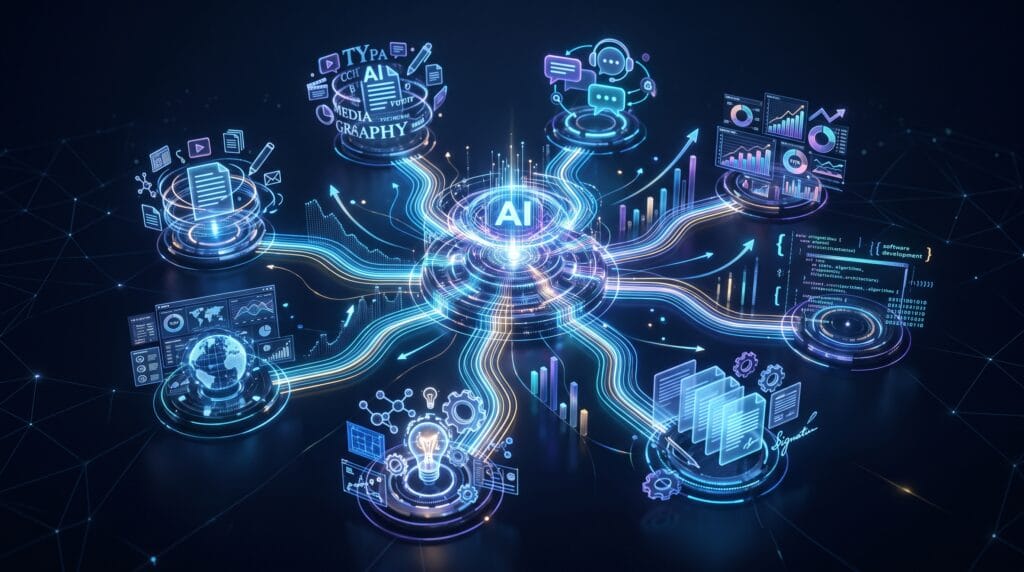
Generative AI technology is becoming a practical business tool for companies that want to create content faster, support employees, analyze information, improve customer communication, and automate repetitive knowledge work. Unlike traditional software that follows fixed rules, generative AI can create new text, images, code, summaries, ideas, and other outputs based on instructions and business context.
For growing companies, the biggest opportunity is not simply replacing manual work. It is helping small teams accomplish more without adding complexity at the same rate as the business expands.
However, successful adoption requires clear goals. Companies should identify specific problems, choose appropriate tools, protect sensitive information, and keep human review in important workflows.
The most valuable generative AI technology use cases usually improve an existing business process rather than introducing AI simply because it is popular.
This guide explores practical applications for marketing, sales, customer service, operations, research, product development, and other areas where growing businesses can benefit.
What Is Generative AI Technology?
Generative AI refers to artificial intelligence systems capable of producing new content based on patterns learned from large amounts of data.
Depending on the system, generative AI can produce:
- Text
- Images
- Code
- Audio
- Video
- Summaries
- Reports
- Presentations
- Data explanations
Businesses can interact with these systems through natural-language instructions, commonly called prompts.
Modern business platforms are also increasingly integrating AI directly into email, documents, spreadsheets, meetings, research, coding, and internal workflows. Google, for example, has embedded Gemini features across Workspace applications, while OpenAI positions ChatGPT for business use across writing, research, analytics, sales, operations, design, and engineering.
Why Generative AI Technology Matters for Growing Companies
Growing companies often need to increase output before they can expand headcount significantly.
This creates pressure across marketing, customer service, operations, sales, and administration.
Useful generative AI technology can help teams:
- Draft content faster
- Summarize information
- Research topics
- Generate ideas
- Analyze documents
- Support customer communication
- Create visual concepts
- Assist with coding
- Organize internal knowledge
- Automate repetitive tasks
The goal should be improved productivity and decision support rather than removing human judgment.
AI works best when employees understand the business context and can evaluate whether the generated result is accurate, appropriate, and useful.
1. Generative AI Technology for Content Marketing
Content creation is one of the most accessible business applications.
Marketing teams can use AI to assist with:
- Blog outlines
- Article drafts
- Social media ideas
- Email campaigns
- Landing page copy
- Product descriptions
- Advertising concepts
- Video scripts
For example, a small ecommerce company could generate several headline directions for a product campaign before a marketer chooses and refines the strongest option.
Use AI as a Starting Point
Avoid publishing every generated draft immediately.
AI-generated content still needs:
- Fact checking
- Brand voice editing
- Original examples
- SEO refinement
- Human judgment
Content-focused generative AI technology is most valuable when it reduces repetitive writing and brainstorming while leaving strategy and final quality control to people.
2. Generative AI for Social Media
Social media teams constantly need fresh ideas.
AI can help transform one campaign theme into multiple formats.
A company could begin with one product launch and generate ideas for:
This makes content repurposing more efficient.
However, every platform has different audience expectations.
A professional LinkedIn post should not automatically use the same language as a short TikTok caption.
Human editing remains important.
3. Generative AI Technology for Email Marketing
Email campaigns often involve repeated writing tasks.
Businesses can use AI to create:
- Subject line variations
- Welcome emails
- Abandoned cart messages
- Product announcements
- Customer education
- Re-engagement campaigns
AI can also help rewrite messages for different tones.
For example, the same announcement could be adapted to sound more professional, friendly, concise, or promotional.
This allows small marketing teams to test more messaging variations without writing everything from scratch.
4. AI for Sales Prospecting and Research
Sales representatives spend significant time researching prospects.
Generative AI technology can help summarize publicly available information about a company, industry, or account before outreach.
Sales teams may use AI for:
- Account research
- Meeting preparation
- Prospect summaries
- Outreach drafts
- Follow-up messages
- Proposal outlines
The representative should still verify important information.
Incorrect details in sales outreach can damage credibility quickly.
AI should accelerate research, not eliminate validation.
5. Generative AI Technology for Sales Proposals
Creating proposals can involve repeating similar structures while customizing the content for each client.
AI can help generate first drafts containing:
- Client objectives
- Problem summaries
- Proposed solutions
- Deliverables
- Project phases
- Frequently asked questions
Teams can then refine pricing, timelines, commitments, and strategic recommendations manually.
This can be particularly useful for agencies, consultants, software companies, and service businesses.
6. Generative AI for Customer Service
Customer support teams regularly answer similar questions.
Generative AI can help draft responses to common inquiries such as:
- Shipping questions
- Account issues
- Product guidance
- Returns
- Troubleshooting
- Feature explanations
AI can also summarize long customer conversations before an employee takes over.
Keep Humans Available
Complex complaints, billing disputes, sensitive situations, and unusual problems should have clear paths to human support.
Automated responses should make service faster without trapping customers inside an unhelpful system.
7. Generative AI Technology for Internal Knowledge
As companies grow, information becomes scattered across documents, email, chat, project tools, and cloud storage.
AI-supported knowledge systems can help employees find answers more quickly.
For example, a staff member might ask:
“What is our current refund policy?”
Instead of searching manually through several folders, an AI system connected to approved business documents may provide a summarized answer based on those sources.
OpenAI currently offers company-knowledge capabilities that can use connected organizational context, while Google positions Gemini and related Workspace tools as AI assistance grounded in workplace applications and business data.
Knowledge-focused generative AI technology becomes increasingly valuable as the organization creates more documentation.
8. AI for Meeting Summaries
Meetings produce information that can easily be forgotten.
AI-assisted tools can help generate:
- Meeting summaries
- Action items
- Decisions
- Follow-up notes
- Project updates
This reduces the need for someone to manually capture every detail.
However, meeting summaries should still be reviewed when decisions involve contracts, finances, personnel, or other high-impact matters.
Also Read: Best Technology for Creators to Work Smarter and Faster
9. Generative AI Technology for Data Analysis
Business data often exists in spreadsheets, reports, dashboards, and exports.
Generative AI can help users ask questions about data in more natural language.
Examples include:
- “Which product category grew fastest?”
- “Summarize the biggest changes this month.”
- “Identify unusual sales patterns.”
- “Explain why this metric may have declined.”
AI can also help create formulas, organize datasets, and explain analytical results.
The actual numbers should still be verified before major business decisions.
Data-focused generative AI technology is useful because it can make analysis more accessible to employees who are not professional data analysts.
10. Generative AI for Market Research
Businesses frequently need information about competitors, audiences, products, and industries.
AI can help organize research by:
- Summarizing reports
- Comparing competitors
- Grouping customer feedback
- Identifying recurring themes
- Creating research questions
- Structuring findings
For example, a company could upload survey responses and ask the AI to identify repeated complaints or requested features.
This can reveal patterns that deserve closer human analysis.
11. Generative AI Technology for Product Development
Product teams can use AI during early ideation.
Possible applications include:
- Product concept brainstorming
- Feature ideas
- User story drafts
- Customer scenario development
- Naming exploration
- Product documentation
AI is especially useful for generating many possible directions quickly.
The product team can then evaluate those ideas against customer research, costs, feasibility, and business strategy.
AI should expand options rather than decide automatically what the company should build.
12. AI for Customer Feedback Analysis
Growing companies may receive feedback through:
- Reviews
- Support tickets
- Surveys
- Social media
- Sales calls
Reading every response manually can become difficult.
Generative AI can help group feedback into themes such as:
- Pricing
- Product quality
- Delivery
- User experience
- Customer service
- Missing features
This allows teams to see recurring patterns more quickly.
Still, important customer quotes and edge cases should be reviewed directly rather than relying only on summaries.
13. Generative AI Technology for Design Ideation
Design teams can use AI to explore early visual concepts.
Possible applications include:
- Mood boards
- Campaign concepts
- Packaging directions
- Illustration ideas
- Advertising layouts
- Storyboards
- Visual references
AI-generated imagery is especially useful during concept exploration when teams need to compare several directions quickly.
Final production work still requires designers to consider typography, accessibility, branding, copyright, printing requirements, and visual consistency.
14. AI for Presentations and Reports
Creating presentations can require significant time even when the underlying information already exists.
AI can help turn:
- Research notes
- Meeting documents
- Data
- Reports
- Project updates
into structured presentation outlines.
It can suggest:
- Slide titles
- Key points
- Executive summaries
- Visual concepts
- Speaker notes
This makes generative AI technology useful for sales, leadership, finance, marketing, and operations teams.
Human review is still necessary to ensure that the presentation accurately represents business data.
15. Generative AI Technology for Software Development
Developers can use AI as a coding assistant.
Common uses include:
- Generating code
- Explaining code
- Debugging
- Writing tests
- Creating documentation
- Refactoring
- Reviewing code
OpenAI currently positions Codex and its broader business platform for coding, debugging, documentation, code review, and engineering workflows.
AI-generated code should still go through normal testing, security review, and engineering processes.
Automatically generated code can contain errors or introduce vulnerabilities if accepted without review.
16. Generative AI for Business Documentation
Growing companies need documentation as responsibilities become distributed across more employees.
AI can help create first drafts of:
- Standard operating procedures
- Training guides
- Process documentation
- Internal FAQs
- Project summaries
- Onboarding materials
For example, a manager can provide notes about how a recurring process works and ask AI to organize them into a structured SOP.
The team should then verify every step.
Documentation-focused generative AI technology can reduce the amount of administrative writing required to keep internal knowledge current.
17. AI for Employee Onboarding
New employees often need answers to many repeated questions.
AI-supported internal knowledge tools can help explain:
- Company processes
- Tools
- Policies
- Team structures
- Internal terminology
- Common workflows
This does not replace managers or structured onboarding programs.
Instead, it provides employees with another way to find information independently.
The result can be fewer repetitive questions and faster access to documented knowledge.
Also Read: Modern Digital Technology Examples You See Every Day
18. Generative AI Technology for Operations
Operations teams often work with large amounts of recurring information.
AI can help with:
- Weekly summaries
- Project status updates
- Process documentation
- Vendor comparisons
- Risk lists
- Scheduling drafts
- Operational reports
The value comes from converting scattered information into structured summaries.
Growing companies can use this to improve visibility without requiring every manager to manually prepare lengthy reports.
19. AI for Recruitment and HR Administration
Generative AI can assist with administrative HR work such as:
- Job description drafts
- Interview question ideas
- Onboarding materials
- Training content
- Employee communication
However, companies should be cautious about using AI to make employment decisions automatically.
Hiring, evaluation, compensation, termination, and other high-impact decisions require appropriate human judgment and legal consideration.
Use AI to support administrative work rather than replace accountable decision-making.
20. Generative AI for Translation and Localization
Companies expanding into new markets may need content adapted into multiple languages.
AI can assist with first-pass translation for:
- Product descriptions
- Internal documents
- Marketing drafts
- Support materials
Professional review remains important for public-facing, legal, technical, or culturally sensitive content.
Translation involves more than replacing words.
Tone, cultural meaning, and local expectations also matter.
Helpful Generative AI Technology Tools for Businesses
Growing companies can choose from several AI platforms depending on their existing workflows.
ChatGPT
ChatGPT can support writing, research, analysis, document creation, sales, marketing, operations, design, and other everyday business work. OpenAI also offers business-oriented workspace and governance features for organizations.
Google Gemini
Gemini is integrated across Google Workspace tools such as Gmail, Docs, Sheets, Meet, and other workplace applications, making it useful for organizations already operating heavily inside the Google ecosystem.
Microsoft Copilot
Microsoft Copilot can be useful for businesses working primarily with Microsoft productivity applications and business workflows.
Adobe Firefly
Adobe Firefly can support generative visual creation and creative workflows for marketing and design teams.
Specialized AI Tools
Businesses may also use specialized platforms for:
- Customer support
- Coding
- Meeting summaries
- Video generation
- Research
- Marketing automation
Choose tools according to the specific workflow rather than purchasing multiple AI platforms simply because they are available.
Build a Generative AI Technology Policy
Companies should establish clear internal rules before AI usage becomes widespread.
A basic policy can cover:
- Approved AI tools
- Sensitive information
- Customer data
- Confidential documents
- Human review
- Fact checking
- Copyright
- Security
- Responsible use
Employees should know what information can and cannot be entered into public AI systems.
For business accounts, review vendor privacy, data retention, security, administrative controls, and training policies.
Google states that Workspace commercial customers receive business data protections for Gemini, while OpenAI provides business workspace controls and organizational data features for its business offerings.
Start With Low-Risk AI Use Cases
Companies do not need to automate important workflows immediately.
Start with relatively low-risk activities such as:
- Brainstorming
- Drafting
- Summarizing
- Formatting
- Internal research
- Meeting notes
Then evaluate whether the tool saves meaningful time.
Once teams understand the limitations, they can gradually expand to more complex generative AI technology use cases.
This approach makes adoption easier to control.
Measure the Business Value of Generative AI
AI projects should have measurable objectives.
Track outcomes such as:
- Time saved
- Content production speed
- Support response time
- Lead follow-up speed
- Employee adoption
- Error rates
- Customer satisfaction
- Cost per task
Do not measure success simply by how often employees use AI.
High usage does not automatically mean high value.
A useful implementation produces a meaningful improvement in a business process.
Common Generative AI Technology Mistakes
Using AI Without a Clear Problem
Start with the workflow, not the technology.
Trusting Every Output
Generative AI can produce incorrect information.
Verify important results.
Uploading Sensitive Information Carelessly
Understand privacy and data-handling policies before sharing business information.
Publishing AI Content Without Editing
Human review helps maintain quality, accuracy, and brand voice.
Automating High-Risk Decisions
Keep appropriate human oversight for important business, employment, legal, financial, and customer decisions.
Buying Too Many AI Tools
A smaller set of well-integrated tools is often easier to manage.
Generative AI Technology Checklist for Growing Companies
Before implementing generative AI, confirm that:
- The business problem is clearly defined.
- The expected benefit is measurable.
- An approved tool has been selected.
- Data privacy has been reviewed.
- Sensitive information rules are documented.
- Employees understand how to use the tool.
- Human review is included.
- Important outputs are fact-checked.
- Security requirements are considered.
- Customer information is protected.
- Copyright concerns are reviewed.
- Performance is measured.
- Workflows are tested before expansion.
- AI supports employees rather than creating unnecessary complexity.
- Internal policies are updated as usage grows.
Also Read: Top 20 Mobile Technology Trends to Watch This Year
Final Thoughts
The strongest generative AI technology use cases are practical rather than flashy.
Growing companies can use AI to assist with content, sales research, customer support, data analysis, design ideation, documentation, software development, internal knowledge, and operational reporting.
The technology can help small teams produce more and process information faster, but it still requires responsible implementation.
Start with a specific business problem.
Choose one workflow where AI could reduce repetitive work or improve access to information. Test it with a small group, measure the outcome, and refine the process before expanding.
Protect sensitive data and keep people involved in important decisions.
As AI platforms continue to become integrated into everyday business software, companies that develop clear workflows and governance practices will be in a stronger position to benefit from them.
Used thoughtfully, generative AI technology can become a practical productivity layer across a growing company, helping teams work faster while keeping strategy, judgment, and accountability firmly in human hands.
For high-quality fonts to boost your income, check out Letter Crafted. Our professional fonts are perfect for branding, marketing, and content creation. So, don’t miss this opportunity.