
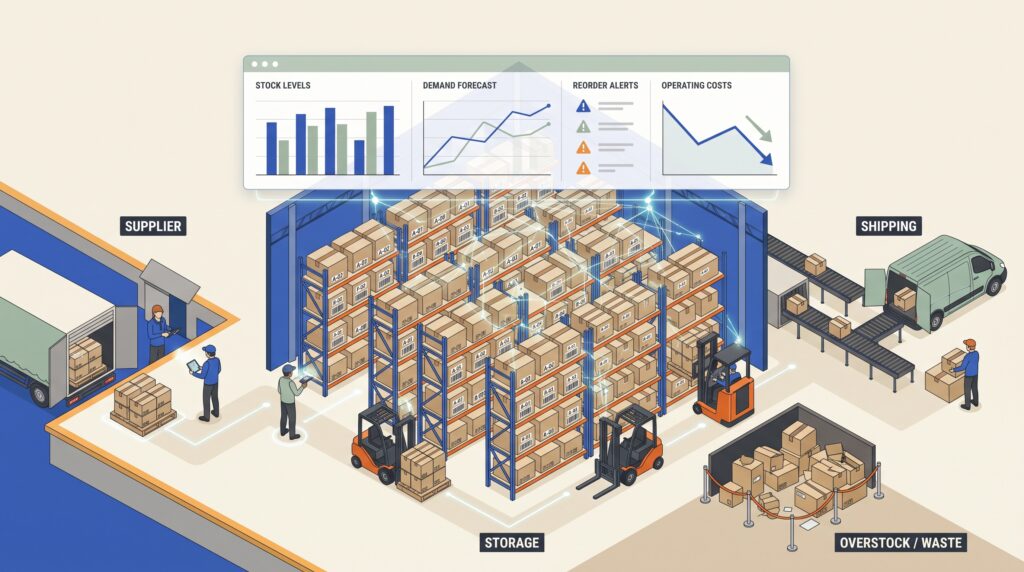
Business cost reduction through inventory management begins with understanding what you own, where it is, and how quickly it moves. Excess stock can tie up money and occupy valuable space, while shortages may interrupt sales or operations. Better inventory decisions help managers address both problems without assuming that buying less is always the right answer.
Inventory expenses extend beyond the purchase price. Storage, handling, damage, emergency ordering, and repeated administrative work can all affect the cost of maintaining stock.
This guide explains practical ways to review those expenses and improve the processes behind them. Start with reliable information, then make changes that fit your products, demand, and service commitments.
Start Business Cost Reduction With Accurate Stock Records
Inventory decisions become difficult when records do not match what is physically available.
A purchasing team may order an item that is already in storage. Alternatively, a salesperson may promise stock that has been damaged or allocated elsewhere.
Both situations create avoidable work.
Establish a Clear Inventory Starting Point
Record the item name, identifier, quantity, location, and relevant condition.
Distinguish available stock from items reserved, damaged, returned, or awaiting inspection.
Choose one reliable place for the current information rather than maintaining several conflicting lists.
Effective business cost reduction starts with visibility. Before changing order quantities, make sure the team can identify what the business actually has and whether it is ready to use or sell.
Identify Where Inventory Creates Extra Costs
A stock purchase is only one part of the expense.
Products may need storage space, handling time, protective materials, or special conditions. Some items also lose usefulness or appeal while they wait.
Review these costs separately.
Map the Cost of Holding and Moving Stock
Consider:
- Space occupied.
- Time spent receiving and locating items.
- Damage or spoilage.
- Repeated counting.
- Unnecessary transfers.
- Urgent replacement orders.
- Obsolete products or components.
Look for recurring patterns rather than treating every incident as an isolated mistake.
For business cost reduction, the useful question is where inventory repeatedly creates extra expense. That gives you a specific problem to address instead of a broad instruction to reduce stock.
Support Business Cost Reduction by Separating Inventory Priorities
Not every item needs the same level of attention.
A frequently used component that can stop production deserves different treatment from a low-cost item that is easy to replace.
Review importance alongside purchasing value.
Group Items According to Practical Risk
Consider how often the item moves, how difficult it is to obtain, and what happens if it becomes unavailable.
Also examine whether it has special storage needs or a limited usable life.
Use these differences to determine review frequency and purchasing oversight.
Thoughtful business cost reduction avoids a single rule for the entire inventory. Reducing a slow-moving item may be sensible, while reducing a critical component could create larger operational expenses.
Review Slow-Moving Stock Before Ordering More
Stock that remains untouched can occupy space and hide purchasing mistakes.
However, low movement does not automatically mean an item is unnecessary. It may support a seasonal period, a repair need, or a specific customer commitment.
Investigate before deciding.
Ask Why the Item Is Still There
Check whether demand changed, the product was difficult to find, or the original order exceeded a realistic requirement.
Confirm whether the item remains usable.
Then decide whether to retain it, change purchasing, transfer it to another suitable use, or consider an appropriate selling strategy.
For business cost reduction, preventing another unnecessary order may be more valuable than rushing to remove existing stock without understanding its purpose.
Also Read: Business Management Framework for Better Decisions and Results
Base Replenishment on Demand and Lead Time
Reordering only when someone notices an empty shelf can produce shortages and urgent purchasing.
Ordering whenever stock looks low can create the opposite problem.
A clearer replenishment process considers expected usage and the time needed to receive more.
Use a Reorder Calculation as a Starting Point
Suppose an item has a planning estimate of 10 units used per day and takes five days to replenish.
That suggests 50 units may be needed during the lead time.
If the business chooses a 20-unit buffer for relevant uncertainty, an illustrative reorder point would be 70 units.
These are hypothetical planning figures, not a universal recommendation.
Business cost reduction depends on reviewing such assumptions. Demand, delivery reliability, incoming orders, and existing commitments may change what quantity is appropriate.
Evaluate Bulk Buying Beyond the Unit Price
A lower price per item can make a large order look attractive.
However, the saving may be offset by additional storage, handling, waste, or stock that remains unused.
Compare the complete purchasing decision.
Review the Total Effect of the Order
Ask how long the quantity is likely to last and whether demand supports it.
Consider the money committed upfront, the space required, and the risk that the item becomes unsuitable before it is used.
Compare the larger order with smaller, more frequent deliveries where those are available.
For business cost reduction, a discount is useful only when the overall arrangement fits the business. A low unit price does not make an unnecessary quantity inexpensive.
Improve Receiving and Storage Processes
Inventory costs can begin as soon as a delivery arrives.
Unrecorded shortages, unclear locations, and damaged items placed with usable stock can cause problems later.
A consistent receiving routine makes the information more dependable.
Create a Simple Stock-Handling Sequence
Check the delivery against the order, inspect relevant condition details, and record discrepancies.
Assign a storage location before the items are put away.
Keep identification clear enough that staff do not need to open several containers to find the right product.
These steps support business cost reduction by limiting repeated searches, preventable confusion, and delayed discovery of receiving problems.
The process should be practical enough to follow during busy periods.
Reduce Waste With Appropriate Stock Rotation
When older usable stock is overlooked, newer deliveries may be used first while earlier items remain in storage.
This can matter especially for products with a limited usable life.
Choose a rotation approach that suits the item.
Make the Intended Sequence Visible
Arrange storage so the relevant stock is easy to access.
Where expiry dates matter, make them visible and prioritize according to those dates rather than assuming arrival order is sufficient.
Keep damaged or questionable items separate from stock ready for use.
For business cost reduction, rotation works best when it is part of the physical setup. Staff should be able to follow the sequence without relying on memory or extensive searching.
Also Read: Passive Income Ideas for New and Experienced Entrepreneurs
Use Stock Counts to Investigate Differences
Counting can reveal a mismatch, but it does not explain the cause by itself.
A difference may result from delayed records, receiving errors, misplaced stock, or unrecorded use.
Treat the count as evidence for investigation.
Choose a Manageable Counting Routine
Review important or frequently moving items more closely, then cover the remaining inventory according to a practical schedule.
Check relevant transactions before correcting the record.
If the same item repeatedly shows a difference, examine how it is received, stored, selected, and recorded.
Useful business cost reduction comes from preventing the recurring problem. Repeatedly adjusting the quantity without addressing its cause leaves the process unchanged.
Make Inventory Responsibilities Clear
An inventory system becomes less useful when nobody knows who should update it.
Assign responsibility for receiving, recording usage, approving purchases, and investigating discrepancies.
Keep the arrangement understandable.
Give the Team Practical Instructions
Explain when updates should happen and how to report damaged or missing items.
Use consistent item names so staff do not create duplicate records for the same product.
Provide a clear way to ask questions about unusual situations.
Good business cost reduction includes the time required to maintain accurate processes. A simple system used consistently may be more useful than a complicated setup the team struggles to follow.
Measure Business Cost Reduction Alongside Availability
Lower stock levels are not automatically evidence of improvement.
A reduction could coincide with more shortages, delayed orders, or emergency purchases.
Review cost and service outcomes together.
Track a Small Set of Relevant Measures
Depending on the business, consider:
- Inventory value.
- Slow-moving stock.
- Damage or waste.
- Stock discrepancies.
- Frequency of shortages.
- Emergency purchasing.
- Time spent locating items.
Establish a starting point before making major changes.
Compare results over a suitable period and note other factors that changed. Seasonal demand or a new product range may affect the figures.
A useful improvement lowers avoidable expense while keeping inventory capable of supporting the business.
Also Read: Business Tools for Small Teams That Want Better Systems
Conclusion – Turn Better Inventory Decisions Into Lasting Savings
Business cost reduction through inventory management requires more than reducing orders.
Accurate records, thoughtful replenishment, practical storage, and clear responsibilities help managers understand where money and time are being lost.
Begin with one recurring issue, record its current effect, and test a focused adjustment.
Then review the outcome before expanding the change.
The goal is inventory that serves a clear purpose, available when needed, manageable to maintain, and less likely to create expenses the business could prevent.
For high-quality fonts to boost your income, check out Letter Crafted. Our professional fonts are perfect for branding, marketing, and content creation. So, don’t miss this opportunity.