
Good packaging design for food delivery protects more than the meal. It protects temperature, texture, presentation, customer trust, and the restaurant’s brand. A dish that looks perfect in the kitchen can arrive soggy, cold, crushed, or leaking if the container is not designed for the journey.
Food delivery has different packaging requirements from dine-in service. Meals may spend 20, 30, or 60 minutes inside bags, travel over uneven roads, sit beside hot or cold items, and pass through several hands before reaching the customer.
That means packaging needs to be treated as part of the product experience rather than an afterthought.
The best packaging design for food delivery balances food safety, structure, ventilation, convenience, sustainability, cost, and branding. It should help the meal arrive as close as possible to the condition customers would expect inside the restaurant.
This guide explains how restaurants, cafes, cloud kitchens, and food businesses can create packaging that performs better while reinforcing a stronger brand.
Why Packaging Design for Food Delivery Matters
Delivery customers experience the restaurant differently from dine-in customers.
They do not see the dining room, tableware, music, lighting, or staff interactions. In many cases, packaging becomes one of the most important physical expressions of the brand.
Strong packaging design for food delivery can help:
- Keep food fresher
- Maintain temperature
- Prevent leaks
- Reduce spills
- Protect presentation
- Improve portion organization
- Strengthen brand recognition
- Support sustainability goals
- Improve customer satisfaction
- Encourage repeat orders
Packaging failures can damage customer perception even when the food itself is good.
A leaking sauce container or crushed dessert may become the customer’s main memory of the order.
Start Food Delivery Packaging With the Menu
Do not choose one generic container for every dish.
Start by analyzing the menu.
Different foods behave differently during delivery.
Consider:
- Temperature
- Moisture
- Oil content
- Sauce
- Crispness
- Shape
- Portion size
- Weight
- Required ventilation
- Delivery time
A burger has different packaging needs from soup.
Fried chicken needs different conditions from sushi.
Good packaging design for food delivery begins with the food itself.
1. Match the Container to the Food
Choose packaging according to what the meal needs during transportation.
For example:
Fried Foods
Fried foods need ventilation because trapped steam can quickly soften crispy surfaces.
Soups and Curries
Liquids require strong seals and containers that resist deformation when hot.
Salads
Cold ingredients need packaging that protects delicate leaves and keeps dressings separate when necessary.
Desserts
Cakes and pastries may require rigid structures that prevent movement and pressure from surrounding orders.
Using the same container style for every menu item may simplify inventory, but it can reduce food quality.
2. Keep Hot Food Hot
Temperature has a major effect on delivery satisfaction.
Insulated packaging can slow heat loss, but the container should also suit the food.
Materials commonly used for hot food include:
- Paperboard
- Corrugated paper
- Molded fiber
- Suitable food-grade plastics
- Foil-lined containers
Avoid creating packages that trap excessive condensation.
Heat retention should be balanced with ventilation depending on the meal.
Effective packaging design for food delivery protects temperature without sacrificing texture.
3. Keep Cold Food Separate
Hot and cold items should not always travel inside the same enclosed space.
A cold dessert placed beside hot soup may arrive partially warmed.
When practical, separate:
- Drinks
- Desserts
- Salads
- Frozen items
- Hot meals
Restaurants can use separate inner bags, compartments, or clearly divided delivery packaging.
This simple operational decision can improve quality without requiring expensive custom packaging.
4. Control Moisture and Steam
Steam is one of the biggest challenges in food delivery.
When hot food releases moisture inside a sealed container, condensation forms on the lid and falls back onto the meal.
This can make:
- Fries soggy
- Fried chicken soft
- Bread damp
- Pizza crust less crisp
Add Ventilation Where Appropriate
Small vents can allow excess steam to escape.
This works particularly well for fried foods and baked products.
However, vent holes are not appropriate for soups, sauces, or meals where liquid containment matters more.
The right packaging design for food delivery responds to the behavior of the food rather than following one universal rule.
5. Prevent Leaks and Spills
Leak prevention should be tested before any packaging system is widely adopted.
Check:
- Lid fit
- Corner strength
- Seams
- Sauce containers
- Cup lids
- Bag stability
A container that looks secure while sitting on a table may behave differently on a motorbike or delivery vehicle.
Perform Real Delivery Tests
Fill the container with the actual food.
Then:
- Tilt it
- Shake it gently
- Stack it
- Carry it in a delivery bag
- Test realistic travel times
Observe whether liquid reaches the lid or escapes.
Practical testing is more valuable than judging packaging only from samples.
6. Separate Sauces and Wet Ingredients
Not every part of a meal should be combined before delivery.
Keeping sauces separate can protect texture.
For example:
- Salad dressing
- Gravy
- Dipping sauce
- Syrup
- Chili sauce
- Condiments
This gives customers more control and prevents ingredients from becoming oversaturated during transportation.
Separate containers should still fit neatly inside the main package.
Good packaging design for food delivery considers the complete meal system, not only the largest container.
7. Use Compartments for Multi-Component Meals
Meals containing several components may benefit from divided containers.
Compartments can prevent:
- Rice mixing with sauce
- Crispy ingredients becoming wet
- Side dishes combining
- Strong flavors transferring
This is useful for:
- Bento meals
- Rice dishes
- Breakfast sets
- Combo meals
- Healthy meal plans
However, avoid creating unnecessary compartments that increase packaging size and material use.
Every division should serve a practical purpose.
8. Choose Durable Food Delivery Packaging
Packaging needs enough structural strength to survive handling and stacking.
Weak lids may collapse when several orders are placed in one delivery bag.
Thin containers may deform when exposed to heat.
Evaluate:
- Compression strength
- Edge strength
- Lid rigidity
- Stackability
- Heat resistance
- Grease resistance
Durability is especially important for restaurants handling high delivery volumes.
Reliable packaging design for food delivery reduces the risk of replacement orders and customer complaints.
Also Read: How to Keep Packaging Design Consistency Across Product Lines
9. Design Packaging for Easy Stacking
Stackable packaging makes delivery more efficient.
Containers should sit securely on top of each other without sliding.
Similar footprints can help restaurants organize orders and maximize space inside delivery bags.
Stackability can also reduce pressure on delicate foods when weight is distributed properly.
Consider testing different container combinations instead of evaluating each package separately.
The entire order needs to travel as one system.
10. Make Food Delivery Packaging Easy to Open
Customers should not struggle to access their food.
Avoid packaging that requires excessive tearing or creates spills during opening.
A good package should be easy to:
- Identify
- Carry
- Open
- Close if needed
- Dispose of
Convenience is part of the experience.
Complicated packaging can make a premium meal feel frustrating.
11. Use Tamper-Evident Packaging
Delivery orders pass through more people than dine-in meals.
Tamper-evident features can give customers greater confidence that the food has remained closed during transportation.
Options include:
- Security stickers
- Sealed bags
- Tamper strips
- Locking tabs
The system should show clearly if the package has been opened.
This feature can also become part of the branding.
A well-designed sticker, for example, can combine security with logo visibility.
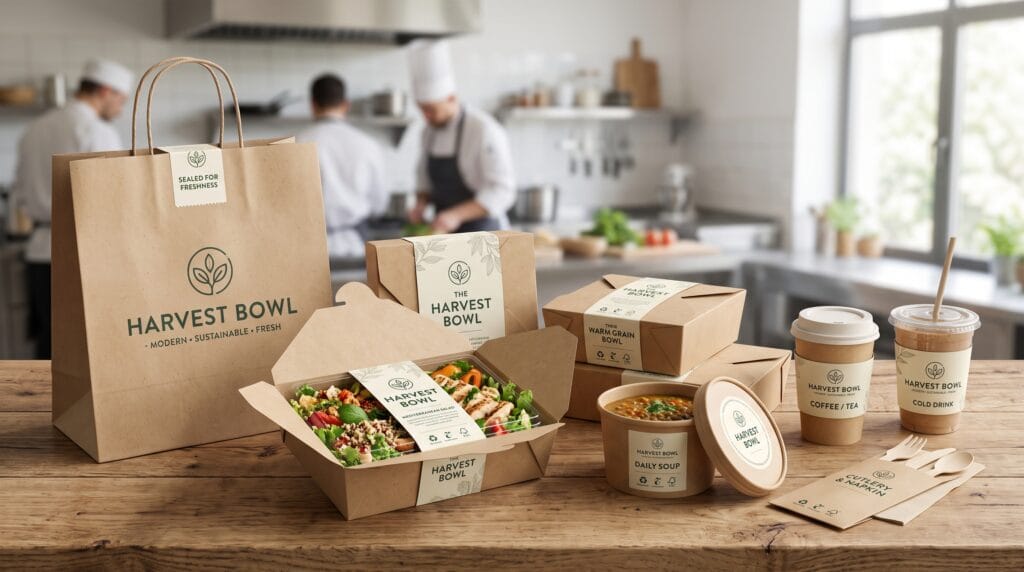
12. Build Branding Into Packaging Design for Food Delivery
Branding should not interfere with function.
Start with a strong basic package, then add recognizable brand elements.
These might include:
- Logo
- Brand colors
- Typography
- Patterns
- Stickers
- Illustrations
- Short messages
A simple kraft box with a recognizable sticker can sometimes work better than expensive full-color packaging.
Focus Branding Where Customers Notice It
The most visible areas are often:
- Top of the box
- Delivery bag
- Security seal
- Cup sleeve
- Napkin packaging
- Sauce label
Branded packaging design for food delivery helps replace some of the visual experience customers would normally receive inside the restaurant.
13. Use Typography Clearly
Typography needs to remain readable under practical conditions.
Packaging may contain:
- Restaurant name
- Menu item
- Order number
- Customer name
- Heating instructions
- Allergy information
- Storage instructions
Avoid decorative typography for essential information.
A branded display font may work for the restaurant name, while a simpler supporting typeface can handle functional details.
Strong hierarchy prevents important information from being overlooked.
14. Create a Consistent Color System
Color can help identify different products or categories.
For example:
- Red sticker for spicy meals
- Green for vegetarian
- Blue for cold items
- Yellow for desserts
However, never rely only on color for critical information.
Combine colors with clear text or icons.
A consistent palette also strengthens brand recognition across boxes, bags, labels, social content, and menus.
15. Consider Sustainable Food Delivery Packaging
Many customers pay increasing attention to packaging waste.
Restaurants can explore materials such as:
- Recycled paperboard
- Molded fiber
- Bagasse
- Recyclable paper bags
- Compostable materials
- Reduced-plastic systems
However, sustainability claims should be accurate.
A package described as compostable may require specific industrial conditions rather than breaking down in ordinary household waste.
Reduce Material Before Adding More
Sustainable packaging design for food delivery does not always require a completely new material.
Businesses can also reduce waste by:
- Removing unnecessary layers
- Eliminating oversized bags
- Avoiding unnecessary cutlery
- Offering utensils only when requested
- Using fewer individual containers
Reducing material can also lower costs.
16. Design Packaging for Delivery Bags
Individual containers need to work inside the final delivery bag.
Consider how containers fit together.
A bag that is too wide may allow items to move during travel.
A bag that is too small may compress boxes.
Test complete orders inside the bags used by delivery drivers.
If drinks are frequently delivered, consider whether they require separate carriers or stabilizing inserts.
The outer bag is part of packaging design for food delivery, not simply a final wrapper.
17. Add Useful Labels
Labels can reduce confusion for both restaurant staff and customers.
Useful information may include:
- Customer name
- Order number
- Menu item
- Spice level
- Dietary category
- Preparation time
- Reheating instructions
A clear labeling system can also reduce order mistakes during busy periods.
Keep labels visually simple so staff can identify information quickly.
18. Include Reheating Instructions When Needed
Some foods are designed to be enjoyed immediately.
Others may benefit from reheating.
If reheating can improve the experience, provide simple instructions.
For example:
“Remove lid and heat for two minutes.”
Instructions should reflect safe food-handling practices appropriate to the product.
This small detail can help customers enjoy the meal closer to the restaurant’s intended quality.
Also Read: Modern Snack Packaging Design Trends for Better Branding
19. Consider Delivery Distance
Packaging that works for a 10-minute journey may perform poorly after 45 minutes.
Test quality over realistic delivery distances.
Evaluate:
- Temperature
- Condensation
- Texture
- Leakage
- Packaging strength
- Presentation
Longer delivery zones may require different packaging or menu decisions.
Some foods may simply not travel well.
A restaurant does not need to make every menu item available for delivery.
20. Test the Complete Customer Experience
Do not evaluate packaging design for food delivery only at the packing station.
Place a normal order and experience the process as a customer.
Observe:
- How the bag arrives
- Whether items are organized
- Whether labels are clear
- How easily packages open
- Whether food looks attractive
- How much waste remains afterward
Take photos after the delivery test.
This often reveals problems that are difficult to notice inside the restaurant.
Food Delivery Packaging for Burgers
Burger packaging should protect structure while allowing some steam to escape.
A rigid clamshell or well-designed paper box can help prevent crushing.
Consider:
- Burger height
- Sauce volume
- Ventilation
- Grease resistance
Do not make the box so large that the burger moves excessively.
Packaging Design for Pizza Delivery
Pizza packaging needs heat management and ventilation.
Corrugated boxes are common because they provide structure and some insulation.
Ventilation can help prevent condensation.
The box should also remain strong enough when stacked.
For smaller pizzas, avoid oversized boxes that waste material and allow unnecessary movement.
Food Delivery Packaging for Fried Food
Crispness is the primary challenge.
Use packaging that allows steam to escape while containing grease.
Avoid tightly sealing very hot fried foods immediately if the design provides no ventilation.
Test the food after typical delivery periods rather than immediately after packing.
Packaging Design for Soup and Liquid Meals
Soup requires excellent leak resistance.
Use containers with secure lids that remain stable when hot.
Always test them while filled.
Consider using secondary bags or seals for high-risk liquids.
Sauces and soups are among the areas where cutting packaging costs too aggressively can lead to expensive delivery failures.
Packaging for Desserts and Bakery Items
Desserts often require protection from movement and pressure.
Cakes, pastries, and decorated products may need:
- Rigid boxes
- Inserts
- Dividers
- Non-slip bases
Transparent windows can improve presentation where appropriate.
Avoid packaging that touches delicate toppings.
Helpful Tools for Packaging Design for Food Delivery
Several tools can help restaurants and designers develop packaging systems.
Adobe Illustrator
Illustrator is useful for creating:
- Labels
- Dielines
- Logos
- Patterns
- Print-ready artwork
It is particularly useful when working with packaging suppliers.
Adobe Photoshop
Photoshop can help create realistic mockups and edit packaging photography.
Restaurants can preview branded boxes, cups, bags, and stickers before production.
Pacdora
Pacdora provides packaging dielines and 3D visualization tools that can help designers explore box structures and presentations.
Canva
Canva can be useful for simple label designs, stickers, promotional inserts, and small restaurant branding materials.
Figma
Figma can help teams organize visual systems, label hierarchies, and packaging presentation concepts collaboratively.
Blender
Blender can be used for detailed custom 3D packaging visualization when more advanced product presentation is required.
Always confirm final dielines and technical specifications with the packaging manufacturer before printing.
Common Food Delivery Packaging Mistakes
Choosing Containers Based Only on Price
Cheap packaging may become expensive if it creates complaints or replacement orders.
Sealing Fried Food Too Tightly
Trapped steam can destroy crispness.
Ignoring Real Delivery Conditions
Always test packaging during realistic transportation.
Using Oversized Containers
Too much empty space increases movement and material waste.
Adding Too Much Packaging
Extra layers increase cost and waste without always improving protection.
Making Branding More Important Than Function
A beautiful leaking box is still bad packaging.
Using Confusing Labels
Operational labels should be easy for staff and customers to read.
Making Unclear Sustainability Claims
Be specific about recyclability or compostability.
Packaging Design for Food Delivery Checklist
Before approving a packaging system, confirm that:
- The container suits the food type.
- Temperature retention has been tested.
- Ventilation is appropriate.
- Liquids do not leak.
- Sauces are separated when necessary.
- Containers stack securely.
- Packaging survives realistic travel.
- Food presentation remains attractive.
- Branding is visible but not excessive.
- Typography is readable.
- Labels are easy to understand.
- Tamper evidence is available when needed.
- Materials match sustainability goals.
- Delivery bags fit complete orders properly.
- Packaging cost works with menu margins.
- Suppliers can maintain consistent quality.
Also Read: Modern Minimalist Packaging Ideas for Better Branding
Final Thoughts
Better packaging design for food delivery begins with understanding what happens to food after it leaves the kitchen.
A package must protect temperature, moisture, texture, structure, and presentation while surviving real transportation conditions. Fried food may require ventilation, soup needs reliable sealing, and delicate desserts require structural protection.
Once function is working well, branding can make the experience more memorable.
Use logos, typography, colors, stickers, and packaging messages consistently, but avoid sacrificing performance for appearance.
Test everything with real meals and realistic delivery times.
Customer feedback can also reveal recurring problems that internal testing misses.
The strongest packaging design for food delivery makes the customer experience feel intentional from the moment the order arrives to the moment the meal is opened.
When food quality, structural performance, sustainability, convenience, and branding work together, delivery packaging becomes more than a container. It becomes an important part of how customers experience and remember the restaurant.
For high-quality fonts to boost your income, check out Letter Crafted. Our professional fonts are perfect for branding, marketing, and content creation. So, don’t miss this opportunity.