
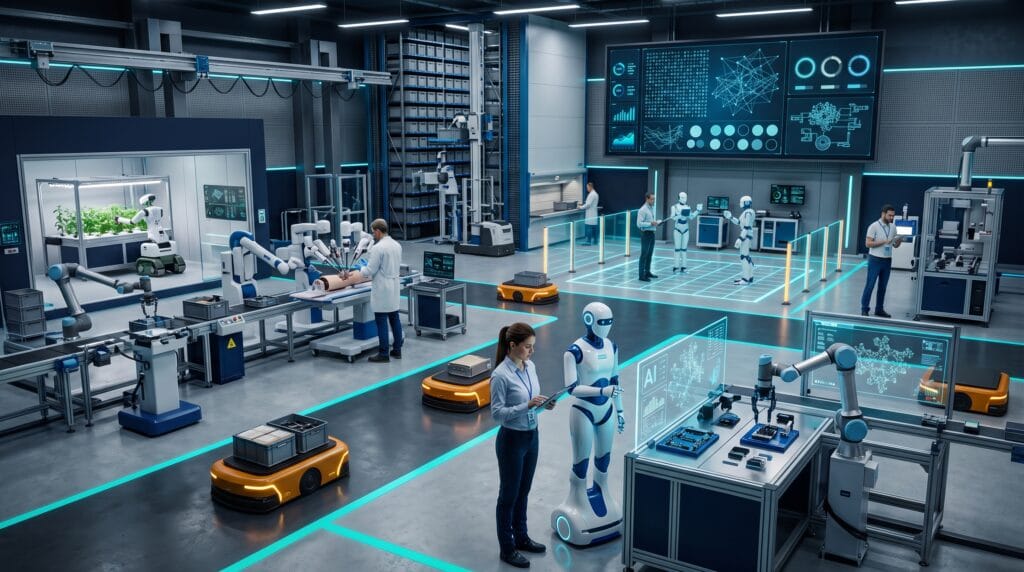
Factories, hospitals, warehouses, farms, laboratories, construction sites, and service businesses are adopting machines that can sense their surroundings, interpret data, and perform physical tasks with increasing precision. Modern robotics technology is moving beyond fixed industrial arms toward intelligent systems that can collaborate with people, navigate changing environments, learn from data, and adapt to new conditions.
Robotics is not a single machine category. It combines mechanical engineering, electronics, sensors, control systems, artificial intelligence, computer vision, software, connectivity, and human-centered design. The result is a growing range of robots that can assemble products, transport materials, inspect infrastructure, support surgery, harvest crops, assist customers, and work in hazardous locations.
The future of intelligent automation will not be defined only by machines replacing manual tasks. It will also involve robots extending human capability. People will continue to provide judgment, creativity, empathy, accountability, and contextual understanding, while robots handle repetitive, dangerous, precise, or physically demanding work.
This guide explains how robotics technology works, where it is being applied, which benefits it offers, what risks organizations must manage, and how leaders can prepare for a more automated future.
What Is Robotics Technology?
Robotics technology is the design and use of programmable machines that can perceive, decide, move, and perform tasks in the physical world.
A robot commonly includes:
- Mechanical structure
- Motors and actuators
- Sensors
- Control systems
- Power supply
- Software
- Communication systems
- Safety mechanisms
- User interface
Traditional industrial robots follow predefined instructions in controlled environments. Intelligent robots add capabilities such as:
- Computer vision
- Machine learning
- Natural-language interaction
- Autonomous navigation
- Object recognition
- Predictive maintenance
- Adaptive motion
- Collaborative behavior
The combination of robotics and artificial intelligence creates systems that can respond to changing inputs rather than repeating one fixed sequence.
How Robotics Technology Supports Intelligent Automation
Intelligent automation combines physical machines with software and data.
A complete system may include:
- Sensors that collect information
- AI models that interpret the information
- Control software that selects an action
- Actuators that perform the action
- Feedback systems that measure the result
- Human oversight that monitors performance and exceptions
For example, a warehouse robot may use cameras and distance sensors to map an aisle, software to select a safe route, motors to move, and a fleet-management platform to coordinate with other robots.
Intelligent automation becomes valuable when the system improves speed, quality, safety, capacity, or consistency.
Core Components of Modern Robotics Technology
Sensors and Perception
Robots need information about their environment.
Common sensors include:
- Cameras
- Depth sensors
- LiDAR
- Radar
- Ultrasonic sensors
- Force sensors
- Temperature sensors
- Pressure sensors
- Proximity sensors
- Inertial measurement units
Computer Vision
Computer vision helps robots identify:
- Objects
- People
- Defects
- Barcodes
- Shapes
- Positions
- Movement
- Safety boundaries
Accurate perception is essential for robots operating outside tightly controlled environments.
Artificial Intelligence and Machine Learning
AI supports:
- Object classification
- Path planning
- Speech recognition
- Anomaly detection
- Quality inspection
- Predictive maintenance
- Grasp selection
- Task optimization
Machine learning can improve performance when sufficient data and validation are available.
Human review remains important, especially in healthcare, safety, legal, and high-impact decisions.
Actuators and Motion Systems
Actuators convert energy into movement.
Examples include:
- Electric motors
- Hydraulic systems
- Pneumatic systems
- Linear actuators
- Servo motors
The correct motion system depends on speed, load, precision, environment, and safety requirements.
Control Software
Control software coordinates sensing, decision-making, and movement.
It may manage:
- Position
- Speed
- Force
- Timing
- Collision avoidance
- Task sequence
- Emergency stops
Connectivity and Cloud Systems
Connected robots can share:
- Status
- Performance
- Location
- Maintenance data
- Task assignments
- Software updates
Cloud and edge computing allow organizations to analyze robot fleets while keeping time-sensitive control close to the machine.
Major Types of Robotics Technology
Industrial Robots
Industrial robots perform tasks such as:
- Welding
- Painting
- Assembly
- Material handling
- Cutting
- Packaging
- Palletizing
They are valuable in high-volume environments where precision and consistency matter.
Collaborative Robots
Collaborative robots, often called cobots, are designed to operate near people.
They may support:
- Machine tending
- Inspection
- Screwdriving
- Picking
- Packaging
- Laboratory handling
Cobots can be easier to redeploy than traditional fixed systems, but every application still requires a proper safety assessment.
Autonomous Mobile Robots
Autonomous mobile robots move through facilities without following one fixed track.
They are used for:
- Material transport
- Order fulfillment
- Inventory movement
- Hospital supplies
- Hotel delivery
- Facility inspection
Unlike simple automated guided vehicles, mobile robots can often calculate alternate routes around obstacles.
Service Robots
Service robots support people outside traditional manufacturing.
Applications include:
- Cleaning
- Food delivery
- Customer assistance
- Security patrol
- Education
- Hospitality
- Home support
Medical Robots
Medical robotics can assist with:
- Surgery
- Rehabilitation
- Patient movement
- Pharmacy operations
- Laboratory automation
- Disinfection
- Remote examination
Medical robotics requires strict safety, validation, cybersecurity, and regulatory controls.
Agricultural Robots
Agricultural robots support:
- Seeding
- Weeding
- Crop monitoring
- Harvesting
- Spraying
- Soil analysis
- Livestock monitoring
Precision systems can reduce waste and help address labor shortages.
Inspection and Maintenance Robots
Robots can enter environments that are dangerous or difficult for people.
Examples include:
- Pipelines
- Power plants
- Offshore facilities
- Sewers
- Bridges
- Mines
- Disaster areas
Humanoid Robots
Humanoid robots are designed with body structures or interactions that resemble human activity.
Potential uses include:
- Logistics
- Manufacturing support
- Research
- Customer service
- Elder care assistance
- Hazardous environments
Humanoid design may be useful when facilities, tools, and workflows were originally built for people. However, reliability, cost, safety, battery life, and useful task performance remain important constraints.
Robotics Technology in Manufacturing
Manufacturing remains one of the largest areas for robotics.
Common Applications
- Assembly
- Welding
- Surface finishing
- Machine loading
- Quality inspection
- Material handling
- Packaging
- Palletizing
Benefits
Robots can provide:
- Repeatability
- Higher throughput
- Lower defect rates
- Safer handling
- Consistent production
- Extended operating hours
Flexible Manufacturing
Modern systems can support smaller production batches through:
- Reprogrammable cobots
- AI vision
- Quick-change grippers
- Digital twins
- Modular cells
- Automated inspection
This makes automation more accessible beyond very large factories.
Also Read: Best Technology Automation Ideas That Save Time and Money
Robotics Technology in Warehousing and Logistics
Warehouses use robots to move, sort, pick, scan, and prepare goods.
Common Systems
- Autonomous mobile robots
- Robotic picking arms
- Automated storage systems
- Sorting equipment
- Inventory-scanning robots
- Packaging systems
Business Benefits
Robotics can improve:
- Order speed
- Inventory accuracy
- Ergonomics
- Space utilization
- Peak-season capacity
- Traceability
Human-Robot Workflows
A robot may bring shelves or containers to a worker, while the person handles complex identification and exception decisions.
This division of work reduces walking while preserving human judgment.
Robotics Technology in Healthcare
Healthcare robotics is expanding across clinical and operational tasks.
Surgical Robotics
Robotic systems can support precision, stability, visualization, and minimally invasive procedures.
The clinician remains responsible for planning and control.
Rehabilitation Robotics
Exoskeletons and robotic therapy devices can support repeated movement and measurable rehabilitation programs.
Hospital Logistics
Mobile robots may deliver:
- Medicines
- Linen
- Meals
- Laboratory samples
- Equipment
Laboratory Automation
Robots can support repetitive handling, testing, and sample preparation.
Responsible Adoption
Healthcare organizations must evaluate:
- Patient safety
- Clinical evidence
- Staff training
- Data protection
- Maintenance
- Cybersecurity
- Human oversight
- Regulation
Robotics Technology in Agriculture
Agriculture presents a complex environment because weather, soil, plants, terrain, and lighting change constantly.
Robotic applications include:
- Vision-guided weeding
- Precision spraying
- Autonomous tractors
- Fruit harvesting
- Drone monitoring
- Livestock systems
- Greenhouse automation
Potential Advantages
- Lower chemical use
- More precise inputs
- Better crop data
- Reduced repetitive labor
- Improved timing
- Higher resource efficiency
Challenges
Agricultural robots must be durable, affordable, repairable, and reliable in uncertain conditions.
Robotics Technology in Construction
Construction robotics may support:
- Bricklaying
- Drilling
- Surveying
- Site scanning
- Material transport
- Demolition
- Prefabrication
- Safety inspection
Why Adoption Is Difficult
Construction sites change frequently. Floors, lighting, weather, people, and materials may differ every day.
Successful systems usually begin with one repeatable task and a controlled operating zone.
Robotics Technology in Retail and Hospitality
Robotics can assist with:
- Shelf scanning
- Cleaning
- Food preparation
- Room delivery
- Inventory checks
- Customer guidance
- Security patrol
Customer Experience Matters
A robot should not be added only for novelty.
The system should improve:
- Speed
- Availability
- Consistency
- Convenience
- Accessibility
- Staff capacity
Human assistance must remain available when customers need empathy, context, or exception handling.
Robotics Technology in Hazardous Environments
Robots can reduce human exposure to:
- Radiation
- Toxic materials
- Explosive environments
- Extreme heat
- Deep water
- Unstable structures
- Contaminated zones
Remote-controlled and autonomous systems can inspect, map, sample, and manipulate equipment.
Safety benefits are strongest when the robot is reliable and the remote operator has clear situational awareness.
Artificial Intelligence and the Future of Robotics
AI is making robots more capable in environments that are not fully predictable.
Generative AI Interfaces
Natural-language interfaces may allow operators to describe tasks more easily.
Example:
Inspect the marked storage area, photograph damaged packaging, and report any blocked exits.
The robot would still need structured permissions, verified maps, safety limits, and human approval.
Foundation Models for Robotics
Researchers are developing models that connect language, vision, and action.
Potential capabilities include:
- Understanding instructions
- Identifying objects
- Learning from demonstrations
- Transferring skills
- Planning multi-step tasks
Simulation and Synthetic Data
Simulators allow robots to practice tasks without risking equipment or people.
Synthetic data can support:
- Vision training
- Edge-case testing
- Navigation
- Grasping
- Safety validation
Edge AI
Edge computing processes data close to the robot.
Benefits include:
- Faster response
- Lower latency
- Reduced bandwidth
- Improved resilience
- Better privacy control
Also Read: Top 20 Mobile Technology Trends to Watch This Year
Benefits of Robotics Technology
Organizations may adopt robotics to achieve:
- Higher productivity
- Improved quality
- Safer work
- Greater consistency
- Better traceability
- Lower waste
- Faster delivery
- Extended capacity
- More precise data
- Improved ergonomics
The value depends on the task, utilization, integration, maintenance, and workforce adoption.
Limitations and Challenges
High Initial Cost
Expenses may include:
- Robot
- End-of-arm tooling
- Sensors
- Safety systems
- Integration
- Facility changes
- Training
- Maintenance
- Software
- Support
Integration Complexity
A robot must connect with existing:
- Machines
- Data
- Workflows
- Enterprise software
- Safety procedures
- Production schedules
Unstructured Environments
Robots perform best when tasks and environments are predictable.
Clutter, weather, lighting, irregular objects, and unexpected human behavior increase difficulty.
Maintenance Requirements
Robots need:
- Inspection
- Calibration
- Spare parts
- Software updates
- Battery management
- Technical support
Workforce Concerns
Employees may worry about job loss, surveillance, deskilling, or safety.
Leaders should communicate early and involve workers in workflow design.
Cybersecurity Risks
Connected robots may create risks involving:
- Unauthorized control
- Stolen data
- Disrupted operations
- Manipulated sensors
- Unsafe movement
- Supply-chain vulnerabilities
Security must be included from design through retirement.
Human-Robot Collaboration
The future of intelligent automation will involve shared work.
Robots Are Strong At
- Repetition
- Precision
- Heavy lifting
- Consistency
- Continuous monitoring
- Hazardous tasks
Humans Are Strong At
- Judgment
- Creativity
- Empathy
- Ethics
- Context
- Adaptation
- Responsibility
Design the Workflow, Not Only the Robot
A successful implementation defines:
- Robot tasks
- Human tasks
- Handoffs
- Exceptions
- Escalation
- Safety zones
- Performance measures
Workforce Impact and New Skills
Robotics may reduce some tasks while creating new responsibilities.
Emerging roles include:
- Robot operator
- Automation technician
- Systems integrator
- Fleet manager
- Robotics safety specialist
- Maintenance technician
- Data analyst
- AI quality reviewer
- Human-robot interaction designer
- Simulation engineer
Reskilling Priorities
Employees may need training in:
- System operation
- Troubleshooting
- Data interpretation
- Safety
- Process improvement
- Digital tools
- Exception handling
Organizations should provide training before systems are deployed at scale.
Safety and Governance
Robotics governance should cover the full lifecycle.
Risk Assessment
Evaluate:
- Collision
- Pinch points
- Unexpected motion
- Load failure
- Sensor failure
- Human access
- Power loss
- Software faults
Safety Controls
Possible controls include:
- Guards
- Light curtains
- Speed limits
- Emergency stops
- Safe zones
- Redundant sensors
- Access controls
- Warning systems
Accountability
Define who is responsible for:
- Approval
- Operation
- Maintenance
- Software updates
- Incident response
- Performance monitoring
- Decommissioning
Cybersecurity for Robotics Technology
A robotics security program should include:
- Device identity
- Network segmentation
- Encryption
- Access controls
- Secure updates
- Logging
- Backup
- Vulnerability management
- Supplier review
- Incident response
Robots should not be connected to business networks without clear architecture and ownership.
How to Evaluate a Robotics Investment
Before purchasing a robot, define the business case.
Measure the Current Process
Document:
- Cycle time
- Labor hours
- Defects
- Safety incidents
- Downtime
- Scrap
- Demand variability
Calculate the Full Cost
Include:
- Equipment
- Integration
- Tooling
- Facility changes
- Maintenance
- Energy
- Software
- Training
- Support
- Downtime
Estimate Benefits
Potential benefits include:
- Labor reallocation
- Higher throughput
- Lower defects
- Lower injury risk
- Improved uptime
- Reduced waste
- Extended operating hours
Consider Flexibility
A lower-cost robot may become expensive if it cannot be adapted to future products or tasks.
Robotics Technology Comparison Table
| Robot Type | Typical Environment | Main Strength | Major Challenge |
|---|---|---|---|
| Industrial robot | Structured factory | Speed and precision | Limited flexibility |
| Collaborative robot | Shared work cell | Easier human collaboration | Lower payload or speed |
| Mobile robot | Warehouse or hospital | Flexible navigation | Fleet coordination |
| Service robot | Public or commercial space | Customer or facility support | Unpredictable environments |
| Medical robot | Clinical environment | Precision and assistance | Regulation and safety |
| Agricultural robot | Farm or greenhouse | Targeted field automation | Weather and terrain |
| Inspection robot | Hazardous infrastructure | Reduced human exposure | Communication reliability |
| Humanoid robot | Human-designed spaces | General physical interaction | Cost and reliability |
How to Implement Robotics Technology
1. Select a Valuable Task
Choose a task that is:
- Repetitive
- Measurable
- Dangerous
- Physically demanding
- Difficult to staff
- Prone to error
2. Observe the Real Workflow
Do not rely only on written process documents.
Watch:
- Variations
- Interruptions
- Edge cases
- Human workarounds
- Material flow
3. Define Success Metrics
Use metrics such as:
- Cycle time
- Throughput
- Defect rate
- Safety
- Uptime
- Cost per unit
- Worker satisfaction
4. Assess Safety and Infrastructure
Review space, power, network, flooring, lighting, access, and emergency procedures.
5. Run a Pilot
Begin with one location, shift, product, or workflow.
6. Train the Workforce
Include operators, technicians, supervisors, safety teams, and maintenance staff.
7. Measure Real Performance
Compare the system with the baseline.
8. Improve the Workflow
Adjust layout, tooling, software, staffing, and handoffs.
9. Scale Proven Applications
Expand only after performance, safety, and support are stable.
Common Robotics Adoption Mistakes
1. Automating a Poor Process
Improve the workflow before adding robotics.
2. Choosing Technology Before the Task
Start with the problem and performance requirement.
3. Ignoring End-of-Arm Tooling
The gripper or tool often determines whether the robot can perform the task.
4. Underestimating Integration
The robot must work with people, materials, software, and machines.
5. Skipping Workforce Involvement
Operators often understand the real process better than project teams.
6. Measuring Only Labor Savings
Quality, safety, throughput, uptime, and flexibility may be equally important.
7. Neglecting Cybersecurity
Connected machines require secure architecture and updates.
8. Scaling Too Early
A successful demonstration is not the same as reliable production.
Robotics Technology Checklist
Use this robotics technology checklist before implementation:
- A valuable task has been selected.
- The current process has been measured.
- Environmental variation is understood.
- Safety risks have been assessed.
- Human and robot responsibilities are defined.
- The correct sensors and tooling are available.
- Integration requirements are documented.
- Cybersecurity controls are planned.
- Maintenance ownership is clear.
- Workforce training is funded.
- A pilot scope has been defined.
- Success metrics have decision thresholds.
- Full lifecycle cost has been calculated.
- Supplier support has been evaluated.
- Scaling will begin only after stable results.
Frequently Asked Questions
1. What Is Robotics Technology?
Robotics technology combines mechanical systems, sensors, electronics, software, control systems, and artificial intelligence to create machines that can perform physical tasks.
2. How Is AI Used in Robotics?
AI helps robots interpret images, recognize objects, plan routes, detect anomalies, understand instructions, and adapt to changing conditions.
3. Will Robots Replace Human Workers?
Robots may automate specific tasks, particularly repetitive, dangerous, or physically demanding work. Many systems also create new technical, supervisory, maintenance, and analytical roles.
4. Which Industries Use Robotics Technology?
Major users include manufacturing, logistics, healthcare, agriculture, construction, retail, hospitality, energy, mining, and infrastructure inspection.
5. What Is the Difference Between Automation and Robotics?
Automation is the use of technology to perform processes with limited human intervention. Robotics is a form of automation involving machines that act in the physical world.
6. Are Collaborative Robots Safe?
Cobots include features designed for shared environments, but safety depends on the complete application, tooling, speed, load, workspace, risk assessment, and operating procedures.
7. What Is the Future of Robotics Technology?
The future will include more flexible robots, stronger AI perception, easier programming, connected fleets, autonomous navigation, simulation, and closer human-robot collaboration.
Conclusion on Robotics Technology
Robotics technology is becoming a central part of intelligent automation because it connects digital intelligence with physical action.
Industrial robots, cobots, mobile systems, medical devices, agricultural machines, inspection platforms, and emerging humanoid robots are expanding what organizations can automate. The greatest value appears when robotics improves safety, quality, speed, capacity, and worker experience.
Successful adoption requires more than purchasing equipment. Organizations must select the right task, understand the real workflow, involve employees, calculate lifecycle economics, manage cybersecurity, validate safety, and scale only after performance is stable.
The future of automation will not be purely human or purely robotic. It will be built around carefully designed systems in which people and machines contribute their strongest capabilities.
For high-quality fonts to boost your income, check out Letter Crafted. Our professional fonts are perfect for branding, marketing, and content creation. So, don’t miss this opportunity.