
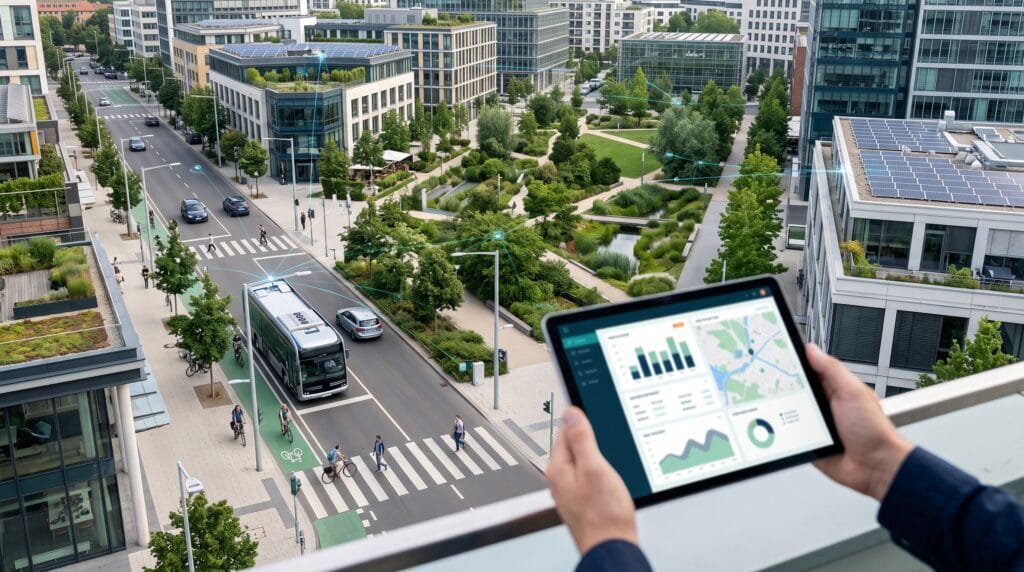
Smart city technology helps cities use connected devices, digital services, and data to improve infrastructure and everyday public services. From identifying water leaks to sharing bus arrival information, these tools can help local authorities understand problems and respond more effectively. However, meaningful progress depends on how well the technology serves residents, supports city workers, and fits existing systems.
Growing cities face pressure on roads, utilities, housing, and public facilities. Meanwhile, residents expect clear information and dependable services. Digital tools can support these needs, but they still require maintenance, funding, and responsible management.
This guide explains practical applications, common challenges, and ways to turn technology investment into measurable improvements.
What Is Smart City Technology?
Smart city technology combines physical infrastructure with systems that collect, share, and analyze information. Its main purpose is to help cities deliver useful services and make informed decisions.
For example, a water sensor might detect unusual pressure. The system sends an alert, and a maintenance team investigates a possible leak.
Common components include:
- Sensors that monitor infrastructure conditions.
- Communication networks that transmit information.
- Platforms that organize data.
- Dashboards that help staff interpret results.
- Digital channels that connect residents with services.
The International Telecommunication Union describes connected devices as supporting monitoring and service improvements across areas such as traffic and energy. It also emphasizes a people-centered approach to urban transformation.
Why Smart City Technology Matters for Infrastructure
Infrastructure problems are easier to manage when cities have reliable information about asset condition and service demand.
Smart city technology can support earlier investigation of faults, better maintenance planning, and clearer coordination between departments. For instance, monitoring a pump may reveal a change that warrants inspection before the equipment stops working.
Nevertheless, an alert only helps if someone receives it and knows what to do. Cities need defined responsibilities, practical response procedures, and enough staff to act.
The strongest projects connect information with action. Their success is measured through outcomes such as shorter outages, fewer unresolved faults, or improved access to services.
1. Smart City Technology for Transportation
Transportation is a visible application of smart city technology because residents experience delays, unreliable schedules, and difficult journeys directly.
Traffic monitoring can help transport teams understand congestion patterns. Connected signals may support adjustments where traffic conditions and safety requirements allow.
Meanwhile, vehicle location systems can provide estimated bus arrival times. These estimates need regular updates and clear communication when services are disrupted.
Connected Transport for Easier Journeys
Useful applications include:
- Public transport arrival information.
- Accessible journey-planning services.
- Parking availability updates.
- Monitoring of busy intersections.
- Tools for reporting damaged transport facilities.
Cities should assess benefits for pedestrians, cyclists, and public transport users alongside drivers. A faster vehicle journey is only one part of a better transport system.
2. Smart City Technology for Water and Energy
Water and energy networks require continuous monitoring and careful maintenance. Smart city technology can help operators identify unusual conditions and prioritize investigation.
Water meters and pressure sensors may help locate potential losses. However, abnormal readings need verification because faulty equipment can also produce misleading data.
In public buildings, energy monitoring can reveal when heating, cooling, or lighting runs unnecessarily. Facilities teams can then investigate schedules and equipment settings.
Smart Utility Monitoring for Targeted Maintenance
A practical approach combines digital monitoring with inspections and maintenance records.
Start by identifying a measurable issue, such as frequent pump failures or high overnight electricity use. Then choose suitable monitoring points and establish a baseline.
Track whether the intervention reduces waste or improves reliability. Equipment installation alone does not demonstrate a service improvement.
Also Read: Smart Technology Ideas for a More Sustainable Future
3. Smart City Technology for Waste Management
Waste collection depends on reliable routes, appropriate capacity, and quick responses to recurring problems.
Smart city technology can support planning through collection records, location information, and fill-level sensors where they are useful.
For example, monitoring heavily used public bins could help teams identify locations that overflow regularly. Staff can then adjust collection frequency or bin placement.
However, sensors are not necessary everywhere. Historical collection data and resident reports may already provide enough information for some neighborhoods.
A useful pilot should compare missed collections, overflowing bins, travel distance, and maintenance costs. Route changes must also account for worker safety, road access, and vehicle capacity.
4. Smart City Technology for Digital Public Services
Digital public services can reduce unnecessary travel and make routine requests easier to track.
With smart city technology, residents may be able to report a broken streetlight, book an appointment, or check the status of an application through a shared portal.
The service needs a clear process behind it. A convenient form achieves little if requests enter an unmonitored inbox.
Accessible Digital Services for Residents
Effective service portals should offer:
- Clear instructions and plain language.
- Accessible forms and navigation.
- Confirmation that a request was received.
- Status updates and contact options.
- Appropriate language support.
Keep telephone and in-person assistance available. Residents have different devices, abilities, and levels of digital confidence, so access should not depend entirely on a smartphone.
5. Smart City Technology for Environmental Monitoring
Environmental sensors can help cities understand conditions such as air pollution, heat, noise, or changing water levels.
Smart city technology makes these observations easier to organize across locations. However, sensor placement, calibration, and maintenance affect the quality of the results.
A reading from one street should not automatically represent an entire district. Staff need to interpret measurements within their local context.
Urban Monitoring That Supports Action
Monitoring is most useful when a city defines how findings will influence decisions.
For example, repeated heat measurements could help planners investigate locations for shade improvements. Flood monitoring could support established response procedures when readings reach defined thresholds.
Share information in understandable formats, explain limitations, and maintain clear responsibility for urgent alerts.
6. Smart City Technology and Digital Twins
A digital twin is a digital representation of a physical asset or system that can be updated with relevant information.
Cities may use this approach to explore infrastructure conditions or compare planning scenarios. For example, a model could help investigate how drainage changes might affect water movement.
The ITU includes digital twins among the technologies relevant to digital transformation in cities.
However, smart city technology models are only as useful as their data and assumptions. An attractive visual display does not guarantee an accurate prediction.
Start with a specific question, document uncertainty, and validate model behavior before using it to support major decisions.
Also Read: Digital Technology Trends Entrepreneurs Should Watch in 2026
Challenges of Implementing Smart City Technology
Cities need to consider long-term operations alongside initial equipment purchases.
Smart City Technology Costs and Maintenance
Budgets should cover installation, connectivity, staff training, software fees, repairs, and replacement equipment.
A small pilot can help reveal these costs before expansion. Assign responsibility for routine checks so devices do not become neglected assets.
Connected City Systems and Data Sharing
Departments often use systems that cannot easily exchange information. NIST identifies closed applications and limited interoperability as challenges for smart city infrastructure.
Ask suppliers about documented interfaces, data export, and compatibility with existing systems. This helps preserve flexibility as needs change.
Privacy and Security in Smart City Technology
Collect only the information needed for a defined service. Use access controls, retention rules, software updates, and appropriate protection for sensitive data.
Residents should understand what is collected and why. Projects involving identifiable information require particularly careful review and clear accountability.
How to Plan a Smart City Technology Project
A successful project starts with a service problem residents and staff can describe.
- Define the problem. Choose a specific issue, such as repeated streetlight outages.
- Record the baseline. Measure current repair times, complaint volumes, and operating costs.
- Consult users. Include residents, maintenance staff, and relevant departments.
- Run a limited pilot. Test the approach in a manageable area.
- Review the outcome. Compare results with the baseline before expanding.
Include a fallback process for connection failures or unreliable readings. Essential services need to continue when the digital system is unavailable.
Document lessons from the pilot so future teams can understand both the benefits and the difficulties.
Measuring the Benefits of Smart City Technology
Measure service outcomes alongside technical performance.
Useful indicators might include:
- Average time to resolve reported faults.
- Frequency and duration of utility outages.
- Reliability of public transport information.
- Completion rates for online applications.
- Resident satisfaction and accessibility.
Also assess whether improvements reach different neighborhoods and groups. A citywide average can hide uneven results.
NIST has published a framework for measuring smart city and community performance, reinforcing the importance of structured evaluation.
Review results regularly and adjust the project when evidence shows that its original approach needs improvement.
Also Read: Smart Healthcare Technology for Safer and More Connected Care
Conclusion – Build Better Services With Smart City Technology
Smart city technology can help cities maintain infrastructure, improve transport information, manage resources, and make public services easier to access.
Its value depends on reliable data, trained staff, accessible services, and clear responsibility. Cities also need realistic budgets and systems that can work together.
Start with a practical problem, test a focused solution, and measure the effect on everyday life. When residents experience more dependable services and easier access to help, technology investment has a clear purpose.
For high-quality fonts to boost your income, check out Letter Crafted. Our professional fonts are perfect for branding, marketing, and content creation. So, don’t miss this opportunity.