
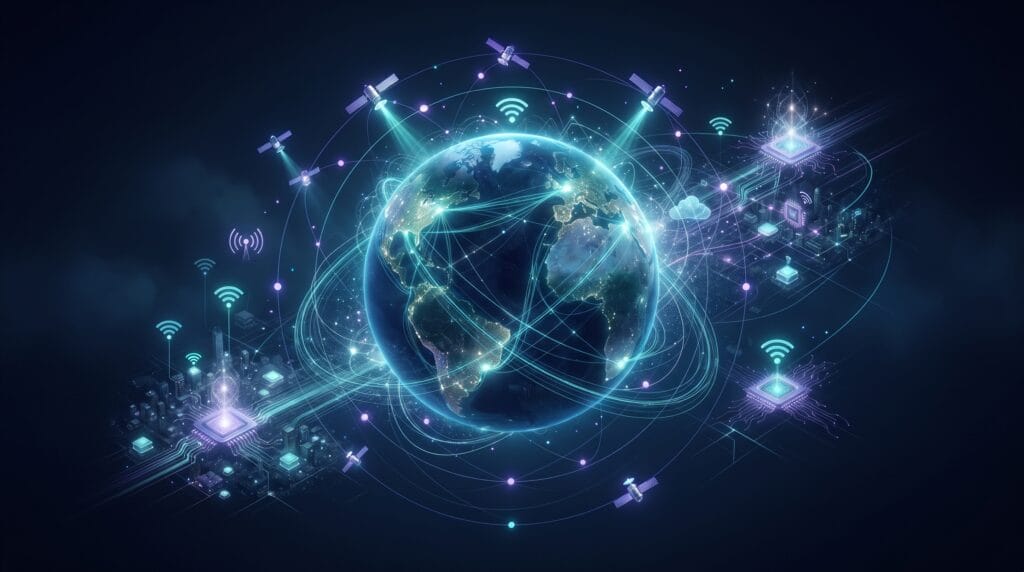
Future internet technologies are developing far beyond the goal of simply giving users faster downloads. The next generation of the internet is being shaped around wider coverage, intelligent networks, lower latency, edge computing, artificial intelligence, satellites, stronger security, and enormous numbers of connected devices. Together, these developments could change how people communicate, how businesses operate, and how machines exchange information.
Some technologies are already being introduced today, while others remain in research, testing, or standardization.
For example, HTTP/3 is already standardized and deployed, while 6G remains a future-generation mobile standard currently being defined through the IMT-2030 framework. Quantum networking is even earlier in its development.
This means the future internet will probably not arrive as one dramatic replacement for today’s network.
Instead, future internet technologies will gradually become part of the infrastructure people already use.
Why Future Internet Technologies Matter
Internet infrastructure now supports much more than websites and personal computers.
Modern connectivity supports:
- Artificial intelligence
- Cloud computing
- Industrial systems
- Connected vehicles
- Smart buildings
- Internet of Things devices
- Video collaboration
- Digital commerce
- Remote healthcare
- Automated machines
Future applications will create even greater demands.
Networks will increasingly need to provide:
- Higher reliability
- Lower latency
- Greater device capacity
- Better geographic coverage
- Stronger security
- More efficient energy use
- Intelligent traffic management
The ITU’s current IMT-2030 work reflects this broader direction. Its proposed 6G usage scenarios include immersive communication, highly reliable low-latency communication, massive connectivity, ubiquitous coverage, AI-integrated communication, and integrated sensing.
Future Internet Technologies and 6G Connectivity
6G is expected to become one of the most influential future internet technologies over the next decade.
5G remains the current generation being expanded around the world, but technical work toward its successor is already well underway.
The International Telecommunication Union refers to the next generation as IMT-2030.
Rather than focusing exclusively on faster smartphones, 6G is being developed around a much broader range of network capabilities.
Potential areas include:
- Immersive communication
- Massive device connectivity
- AI-assisted networking
- Integrated sensing
- Highly reliable communications
- Wider geographic coverage
In March 2026, the ITU reported agreement on technical performance requirements for IMT-2030 radio interfaces, representing another major stage in global 6G standardization.
What Could 6G Enable?
Future 6G networks could support applications such as:
- Advanced robotics
- Smart factories
- Autonomous transportation
- Extended reality
- Real-time digital twins
- Precision positioning
- Intelligent infrastructure
However, commercial 6G should still be considered an emerging technology rather than something consumers need immediately.
Future Internet Technologies for Satellite Connectivity
Satellite communications are becoming increasingly connected with traditional mobile networks.
One important development is direct-to-device connectivity.
Instead of requiring a specialized satellite phone, future systems may allow compatible consumer devices to communicate through satellites when terrestrial network coverage is unavailable.
This could improve connectivity in:
- Rural areas
- Mountain regions
- Oceans
- Remote highways
- Disaster zones
- Underserved communities
The ITU has described direct-to-device satellite services as part of a broader move toward converged terrestrial and space networks as the industry moves toward 6G around 2030.
Seamless Networks Across Land and Sky
One long-term possibility is a device moving between:
Wi-Fi → Cellular → Satellite
with much less visible interruption.
That could make future internet technologies more valuable not simply because they are faster, but because they make connectivity available in more places.
Future Internet Technologies and Edge Computing
Traditional cloud computing often sends data to large centralized data centers.
Edge computing moves some processing closer to where information is produced.
That location might be:
- A factory
- A telecommunications site
- A vehicle
- A retail store
- A local server
- A smart device
Reducing the physical distance between data and computing can help applications respond more quickly.
For example, an industrial robot may not want to wait for information to travel to a distant cloud data center before making a time-sensitive decision.
Edge computing can therefore complement centralized cloud infrastructure.
Edge AI as a Future Internet Technology
Artificial intelligence is also moving closer to users and devices.
Edge AI allows machine-learning models to perform some tasks locally rather than sending every piece of raw information to a remote server.
Applications could include:
- Smart cameras
- Industrial sensors
- Smartphones
- Vehicles
- Retail analytics
- Medical devices
Potential advantages include:
- Faster responses
- Reduced bandwidth usage
- Offline functionality
- Better privacy for selected workloads
The combination of AI, edge computing, and connectivity could become one of the most practical future internet technologies for developers and businesses.
Future Internet Technologies With AI-Native Networks
AI will not only run applications across the internet.
It could increasingly help operate the network itself.
Modern networks must continuously manage:
- Traffic
- Capacity
- Failures
- Security
- Devices
- Energy consumption
- Quality of service
AI-assisted network management may help operators predict traffic, allocate resources, detect faults, and respond to unusual conditions.
Possible applications include:
- Network optimization
- Predictive maintenance
- Automated configuration
- Traffic forecasting
- Security monitoring
- Energy management
AI and communications are explicitly included together in the IMT-2030 framework, demonstrating how intelligence is becoming part of the network architecture rather than only an application running on top of it.
Also Read: Top 20 Mobile Technology Trends to Watch This Year
Future Internet Technologies for the Internet of Things
The Internet of Things already connects sensors, appliances, cameras, vehicles, industrial equipment, and wearable devices.
Future networks may need to support much larger numbers of them simultaneously.
This could accelerate applications such as:
- Smart agriculture
- Factory monitoring
- Logistics tracking
- Environmental sensors
- Smart homes
- Connected transportation
- Intelligent buildings
The challenge is not simply connecting more objects.
Those devices also need:
- Security
- Efficient power use
- Reliable connectivity
- Interoperability
- Manageable data flows
Massive communication is one of the scenarios included in the current IMT-2030 framework.
Future Internet Technologies With Integrated Sensing
Future wireless networks may eventually do more than transmit information.
The same infrastructure could also help sense aspects of the physical environment.
This concept is known as integrated sensing and communication.
Potential applications could include:
- Location awareness
- Motion detection
- Industrial monitoring
- Transportation systems
- Mapping
- Infrastructure management
Integrated sensing and communication is one of the six usage scenarios included in the ITU’s current IMT-2030 framework.
That could blur the traditional boundary between a communication network and a sensing system.
Future Internet Technologies and Quantum Networking
Quantum networking represents a more experimental direction.
Unlike normal internet connections, quantum networks involve technologies based on principles of quantum physics.
Potential long-term applications may include:
- Connecting quantum computers
- Distributed quantum computing
- Quantum sensing
- Specialized secure communications
However, a large-scale quantum internet remains a research challenge.
It should not be viewed as something that will replace today’s web in the immediate future.
Instead, quantum networking may develop alongside conventional internet infrastructure for specialized tasks.
Future Internet Technologies Need Post-Quantum Security
Quantum computing also creates a different challenge for today’s internet.
A sufficiently powerful future quantum computer could threaten several forms of public-key cryptography that protect modern digital communication.
This has already led to practical action.
NIST finalized its first three principal post-quantum cryptography standards in August 2024, covering quantum-resistant key establishment and digital signatures. NIST recommends organizations begin preparing for migration rather than waiting for cryptographically relevant quantum computers to arrive.
Post-quantum cryptography may therefore become one of the least visible but most important future internet technologies.
Users may continue visiting websites normally while the cryptographic systems underneath them change significantly.
Future Internet Technologies for Immersive Experiences
The internet is primarily experienced today through:
- Text
- Images
- Audio
- Video
- Interactive applications
Future connectivity could support more immersive environments through:
- Extended reality
- Spatial computing
- 3D collaboration
- Digital twins
- Interactive virtual environments
These experiences can require very low latency because digital information must respond quickly to physical movement.
Even a small delay can make an immersive application feel uncomfortable or unnatural.
Immersive communication is another major scenario included in IMT-2030 development.
Future Internet Technologies and Smarter Protocols
Not every internet improvement requires completely new hardware.
Protocols also continue evolving.
HTTP/3, for example, represents an important modern evolution of the web transport stack.
It operates over QUIC rather than using the traditional TCP-based approach associated with earlier HTTP generations.
This can improve areas such as connection establishment and handling multiple streams of data.
The IETF standardized HTTP/3 as RFC 9114.
Protocol development demonstrates how future internet technologies can improve the online experience underneath familiar websites and applications without requiring users to understand the technical changes.
Also Read: Smart Technology Ideas for a More Sustainable Future
Future Internet Technologies for More Resilient Networks
Connectivity is becoming critical infrastructure.
Hospitals, companies, transportation, financial systems, governments, and emergency services increasingly depend on networks.
Future infrastructure therefore needs more than speed.
It needs resilience.
Possible improvements include:
- Multiple communication paths
- Satellite backup
- Distributed computing
- Automated recovery
- Intelligent routing
- Local edge processing
A more resilient network could continue providing essential services even when one part of the infrastructure fails.
Security and resilience are also among the key principles guiding IMT-2030 development.
Sustainable Future Internet Technologies
The future internet will require significant computing and network infrastructure.
That creates energy challenges.
Researchers and operators are therefore focusing on areas such as:
- Efficient network hardware
- Intelligent resource allocation
- Lower-power connected devices
- More efficient data centers
- Smarter traffic management
Sustainability is specifically identified as a guiding principle for IMT-2030.
The fastest network is not automatically the best network if operating it requires unsustainable levels of energy and infrastructure.
How Future Internet Technologies Could Change Business
Businesses may benefit from these developments even when they never manage the underlying network directly.
Possible benefits include:
- Better remote connectivity
- Faster cloud applications
- More reliable communication
- Smarter automation
- Better IoT infrastructure
- Improved real-time analytics
- New immersive experiences
- Stronger digital security
Developers may increasingly build applications that combine several technologies.
For example:
AI + Edge Computing + IoT + 6G
could support intelligent manufacturing.
Meanwhile:
Satellite Connectivity + Edge Computing + AI
could support applications in agriculture, transportation, or remote environments.
The value will increasingly come from combining technologies rather than using each one independently.
Challenges Facing Future Internet Technologies
New connectivity also introduces difficult problems.
Security
More connected devices can create a larger attack surface.
Privacy
Networks and sensors capable of processing more contextual information require stronger privacy safeguards.
Infrastructure Costs
6G, satellite systems, edge infrastructure, and new data centers require significant investment.
Global Standards
Devices and networks need common standards to work together effectively.
Digital Divide
New technology provides limited benefit if large communities still lack affordable basic connectivity.
Energy Consumption
Network capacity and computing demand must increase without making digital infrastructure unnecessarily inefficient.
These challenges will influence how quickly different future internet technologies become practical.
Future Internet Technologies Worth Watching
The most important areas to watch include:
- 6G and IMT-2030
- Direct-to-device satellite connectivity
- Edge computing
- Edge AI
- AI-native networking
- Massive IoT
- Integrated sensing and communication
- Quantum networking
- Post-quantum cryptography
- Immersive connectivity
- New internet protocols
- Resilient networks
- Energy-efficient infrastructure
These technologies will not mature at the same pace.
Some are already being deployed, while others may require many years of research and investment.
Also Read: Education Technology Guide for Better Teaching and Learning
Final Thoughts
Future internet technologies are likely to make connectivity more intelligent, distributed, secure, resilient, and deeply connected with the physical world.
6G may eventually connect enormous numbers of devices while bringing artificial intelligence, communication, and sensing closer together.
Satellite systems could fill gaps where terrestrial networks struggle to reach.
Edge computing and edge AI could move intelligence closer to users and machines.
Quantum networking may eventually create specialized new forms of communication, while post-quantum cryptography is already changing how organizations prepare to secure conventional networks.
At the same time, protocols, IoT, cloud computing, cybersecurity, and network infrastructure will continue improving behind the applications people use every day.
There probably will not be one invention that suddenly creates the future internet.
Instead, many future internet technologies will develop together.
Wireless networks will connect with satellites.
Cloud systems will work alongside edge computing.
AI will both use networks and help operate them.
Security will evolve as computing capabilities change.
For technology readers, developers, and businesses, following future internet technologies now provides an early look at how digital connectivity could evolve in the coming years and how today’s internet may gradually become a much more intelligent and connected global system.
For high-quality fonts to boost your income, check out Letter Crafted. Our professional fonts are perfect for branding, marketing, and content creation. So, don’t miss this opportunity.