
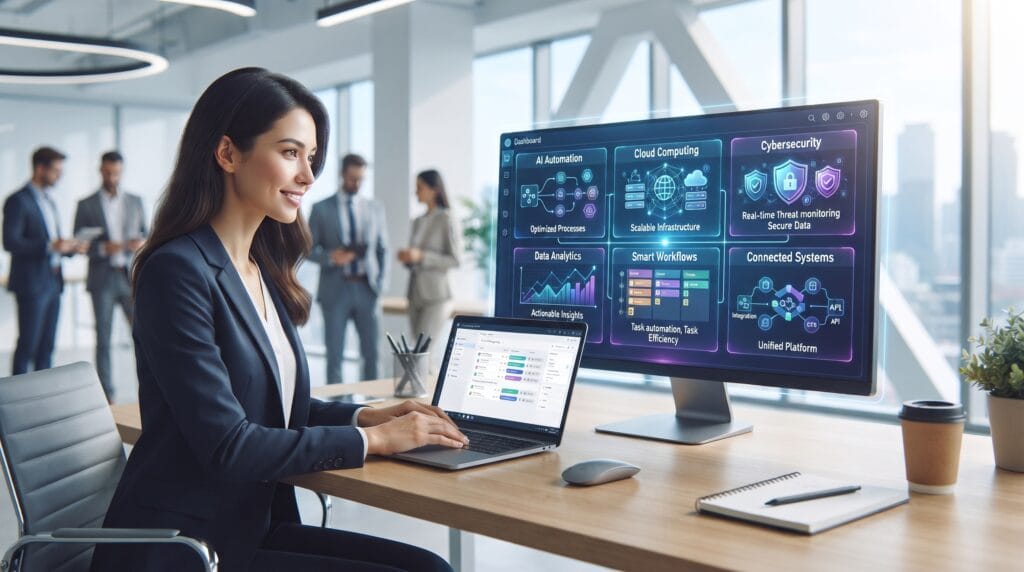
Business technology trends in 2026 are increasingly shaped by artificial intelligence, intelligent automation, stronger cybersecurity, cloud infrastructure, and connected data. For entrepreneurs, the important question is no longer whether technology will influence business operations. The more useful question is which technologies can reduce costs, improve customer experiences, accelerate decisions, and create measurable business value.
Technology investment continues to rise rapidly. Gartner forecasts worldwide IT spending will reach about $6.37 trillion in 2026, with particularly strong growth connected to AI infrastructure, cloud services, and AI-ready software.
At the same time, businesses should avoid adopting every new technology simply because it receives attention.
The strongest strategy is usually:
Understand the trend → Identify a business problem → Test a small use case → Measure the result → Scale what works
The following business technology trends are especially relevant for entrepreneurs who want to build more efficient, adaptable, and technology-enabled companies.
Business Technology Trends in Agentic AI
Generative AI initially became popular because it could create:
- Text
- Images
- Code
- Summaries
- Ideas
Agentic AI is moving toward something different.
Instead of only generating an answer, an AI agent may be designed to complete multiple steps toward a goal.
For example:
Receive customer request → Find account information → Check policy → Prepare response → Update CRM → Create follow-up task
This turns AI from a content generator into part of the workflow.
Gartner identifies multiagent systems as one of its top strategic technology trends for 2026 and notes that coordinated agents can support more complex automation.
For entrepreneurs, agentic AI could become particularly useful in areas such as:
- Customer support
- Sales operations
- Research
- Administration
- Marketing workflows
- Internal knowledge
The best starting point is usually a repetitive process with clear rules rather than a high-risk business decision.
AI Automation Becomes More Outcome-Focused
Traditional automation often follows fixed instructions.
For example:
New order → Send confirmation email
AI-powered automation can interpret less structured information before choosing what should happen.
A system might:
Read inquiry → Identify intent → Classify lead → Route to correct person
This makes automation more flexible.
Gartner says businesses are increasingly moving toward agentic workflows that can execute multistep processes across software systems, potentially changing how companies purchase and use traditional SaaS applications.
Among the most important business technology trends, this shift means entrepreneurs should begin thinking less about individual software features and more about outcomes.
Instead of asking:
Which tool has the most features?
ask:
Which system removes the most repetitive work from this process?
Business Technology Trends in AI-Native Software Development
Software development itself is also changing.
AI coding assistants have already made it easier to:
- Generate code
- Debug problems
- Explain functions
- Build prototypes
The next stage is AI-native development, where artificial intelligence becomes integrated throughout application development rather than being used only as an assistant.
Gartner lists AI-native development platforms among its major strategic trends for 2026, highlighting their potential to allow smaller teams to create software more quickly.
This could be important for entrepreneurs because smaller companies may be able to develop:
- Internal dashboards
- Customer portals
- Automation tools
- Small applications
- Prototypes
with fewer technical resources than traditional development required.
However, AI-generated software still needs:
- Testing
- Security review
- Human oversight
- Maintenance
Faster development should not mean careless development.
Business Technology Trends in Cloud-Native Platforms
Cloud computing is no longer new, but the way businesses use cloud infrastructure continues to evolve.
Modern cloud-native platforms can support:
- Applications
- Databases
- Storage
- Analytics
- AI workloads
- Remote collaboration
For growing companies, cloud systems can reduce the need to purchase and maintain large amounts of local infrastructure.
Gartner’s 2026 midsize-enterprise technology roadmap highlights cloud-native platforms as an important area for modernization and secure digital growth.
Entrepreneurs should focus on cloud flexibility rather than simply moving everything online.
Ask:
- Can systems scale with demand?
- Can important tools integrate?
- Is data backed up?
- Are access permissions managed properly?
- Can costs be monitored?
Cloud technology should make the company simpler to operate, not create another collection of disconnected services.
Smarter Data Becomes a Business Advantage
AI systems depend heavily on good information.
This makes data quality increasingly important.
Businesses may collect information from:
- Websites
- Sales
- Customers
- Inventory
- Marketing
- Support
- Finance
The challenge is turning that data into something useful.
Gartner’s 2026 data and analytics research emphasizes AI agents, semantic technologies, and converged data platforms as major trends as organizations move toward more AI-first operating models.
For small businesses, this does not require building enormous data platforms.
Start with reliable dashboards around a few important metrics.
For example:
- Sales: Revenue, conversion rate, average order value
- Marketing: Leads, customer acquisition cost, campaign performance
- Customer service: Response time, resolution rate, repeated issues
Better data can help entrepreneurs make decisions using evidence rather than instinct alone.
Business Technology Trends in Real-Time Data
Traditional business reporting often looks backward.
A company might analyze:
- Last week’s sales
- Last month’s website traffic
- Quarterly customer behavior
Real-time systems move closer to what is happening now.
Gartner identifies agentic data streaming as a growing trend because AI systems increasingly need continuously updated information to make useful decisions.
Real-time information can be valuable for:
- Inventory
- Fraud detection
- Customer service
- Logistics
- Website behavior
- Operational monitoring
Not every company needs real-time infrastructure.
Use it when delayed information creates a real business problem.
Also Read: How to Create Business Goals You Can Actually Achieve
Business Technology Trends in Cybersecurity
Digital businesses rely on more:
- Cloud services
- Accounts
- Devices
- AI systems
- Remote workers
- Third-party applications
That also creates more security risks.
Cybersecurity is therefore becoming less of an IT-only issue and more of a business-management responsibility.
Gartner’s 2026 cybersecurity trends emphasize challenges around agentic AI, identity management for machine actors, evolving regulation, AI-enabled security operations, and post-quantum preparation.
Entrepreneurs should prioritize practical fundamentals:
- Multi-factor authentication
- Password management
- Employee access controls
- Backups
- Software updates
- Security policies
- Incident plans
Sophisticated security software cannot compensate for weak access practices.
AI Security Becomes Its Own Technology Category
As companies adopt AI, they also need to secure AI itself.
AI applications may interact with:
- Customer information
- Internal documents
- Business systems
- APIs
- Proprietary data
This creates risks that traditional security tools may not fully address.
Gartner includes AI security platforms among its major 2026 strategic trends, reflecting growing demand for centralized oversight of AI applications and their risks.
Entrepreneurs should know:
- Which AI tools employees use
- Which information is uploaded
- Who has access
- How data is retained
- Which systems agents can modify
AI adoption should come with AI governance.
Business Technology Trends in Digital Provenance
As AI-generated content becomes easier to produce, identifying where digital material comes from becomes more important.
Digital provenance focuses on verifying the origin, history, and integrity of:
- Images
- Documents
- Data
- Software
- AI-generated content
Gartner includes digital provenance among its top technology trends for 2026 because organizations increasingly need ways to establish trust in digital information.
This could matter to entrepreneurs working in:
- Media
- Ecommerce
- Advertising
- Publishing
- Software
- Professional services
Brands should maintain clear internal processes for reviewing AI-generated assets before publication.
Trust may become a competitive advantage as synthetic content becomes more common.
Business Technology Trends in Edge Computing
Cloud computing centralizes processing in remote data centers.
Edge computing moves some processing closer to where the information is created.
Examples include:
- Retail stores
- Factories
- Vehicles
- Cameras
- Smart devices
Edge computing can reduce latency and allow some systems to continue working without constant communication with distant servers.
Gartner’s 2026 roadmap for midsize enterprises includes edge computing among technologies that can improve real-time data processing and customer experiences.
Entrepreneurs working with physical locations, logistics, manufacturing, or connected devices should pay particular attention to this trend.
Physical AI Moves Beyond Software
Most AI conversations focus on screens.
Physical AI connects intelligence to machines.
Examples include:
- Robots
- Drones
- Autonomous equipment
- Smart machines
Gartner identifies physical AI as one of its major 2026 strategic technology trends.
This may become particularly relevant to businesses in:
- Manufacturing
- Warehousing
- Agriculture
- Logistics
- Retail
Small companies do not need humanoid robots to participate in this trend.
Even simpler intelligent systems that automate repetitive physical tasks may create value.
Domain-Specific AI Models Gain Attention
Large general-purpose AI models can perform many tasks.
However, some industries need specialized knowledge.
Domain-specific language models are designed around narrower areas such as:
- Finance
- Healthcare
- Law
- Engineering
- Customer support
Gartner lists domain-specific language models among its 2026 strategic trends and notes that specialized models can improve accuracy and efficiency for targeted use cases.
For entrepreneurs, this means future AI adoption may not always involve choosing the biggest model.
A smaller specialized system may sometimes offer:
- Lower cost
- Better industry context
- Faster performance
- Easier compliance
Choose models based on the actual task.
Also Read: Business Plan Checklist for New and Growing Businesses
Confidential Computing Supports Sensitive Workloads
Businesses increasingly process sensitive information in cloud and AI environments.
Confidential computing is designed to help protect data while it is actively being processed, not only while stored or transmitted.
Gartner includes confidential computing among its major 2026 technology trends as organizations seek more secure foundations for AI and analytics.
This may be especially relevant for businesses handling:
- Financial records
- Healthcare information
- Proprietary data
- Sensitive customer information
Most small businesses will access these capabilities through technology providers rather than building the infrastructure themselves.
Business Technology Trends in Sustainable IT
Growing AI and cloud workloads require significant computing capacity.
Energy efficiency is therefore becoming an important technology consideration.
Businesses can reduce unnecessary consumption through:
- Efficient infrastructure
- Better workload management
- Cloud optimization
- Hardware lifecycle planning
Gartner’s 2026 midsize-enterprise roadmap includes sustainable IT among the areas companies should consider when planning future technology investment.
For entrepreneurs, efficiency can also have a direct financial benefit.
Reducing unused cloud resources and unnecessary software can lower both environmental impact and operating costs.
Technology Stacks Become More Consolidated
Businesses have spent years adding applications for every function.
Many now use separate tools for:
- CRM
- Projects
- Analytics
- Automation
- Customer support
- AI
This can create subscription overload.
Agentic technology may accelerate a shift toward systems that perform actions across several platforms instead of requiring employees to manually operate each interface. Gartner estimates that agentic AI could expose a meaningful portion of traditional enterprise application spending to new competitive pressure through 2030.
Entrepreneurs should regularly audit their technology stack.
Ask:
Are we paying for overlapping tools?
Removing unnecessary software can be as valuable as adding new technology.
How Entrepreneurs Should Evaluate Business Technology Trends
Do not follow trends because competitors mention them.
Evaluate each technology based on:
Business problem
What problem does it solve?
Potential value
Will it save money, generate revenue, improve quality, or reduce risk?
Complexity
Can your team realistically use it?
Security
What information will the system access?
Integration
Will it work with your existing tools?
Measurement
How will you know whether it worked?
This approach turns business technology trends into practical experiments instead of expensive distractions.
Business Technology Trends Checklist for 2026
Entrepreneurs should consider reviewing:
- Agentic AI
- AI-powered automation
- AI-native software development
- Cloud-native platforms
- Data quality
- Real-time analytics
- Cybersecurity
- AI security
- Digital provenance
- Edge computing
- Physical AI
- Domain-specific AI
- Confidential computing
- Sustainable IT
- Software consolidation
You do not need to adopt everything.
Choose the trends that connect directly to your business model.
Also Read: Business Strategy Framework with Examples for Better Results
Final Thoughts
Business technology trends in 2026 show a clear movement from isolated digital tools toward intelligent, connected, and increasingly autonomous business systems.
AI is moving from generating content to completing workflows.
Automation is becoming more adaptive.
Cloud infrastructure is supporting increasingly sophisticated workloads.
Real-time data is helping systems respond faster.
Cybersecurity is expanding to cover AI agents and machine identities.
Meanwhile, edge computing, physical AI, confidential computing, and digital provenance are creating new possibilities for companies operating in both digital and physical environments.
Gartner forecasts worldwide AI spending alone to reach approximately $2.59 trillion in 2026, illustrating how rapidly businesses and technology providers are investing in this shift.
However, entrepreneurs should not interpret rising technology spending as a reason to adopt everything.
The most effective approach remains practical.
Identify a real business problem.
Test one technology.
Measure whether it improves the outcome.
Then scale carefully.
The companies that benefit most from business technology trends will not necessarily be the ones using the largest number of new tools.
They will be the ones that choose technology deliberately and connect it to better customer experiences, lower operating costs, stronger security, faster decisions, and more sustainable business growth.
For high-quality fonts to boost your income, check out Letter Crafted. Our professional fonts are perfect for branding, marketing, and content creation. So, don’t miss this opportunity.