
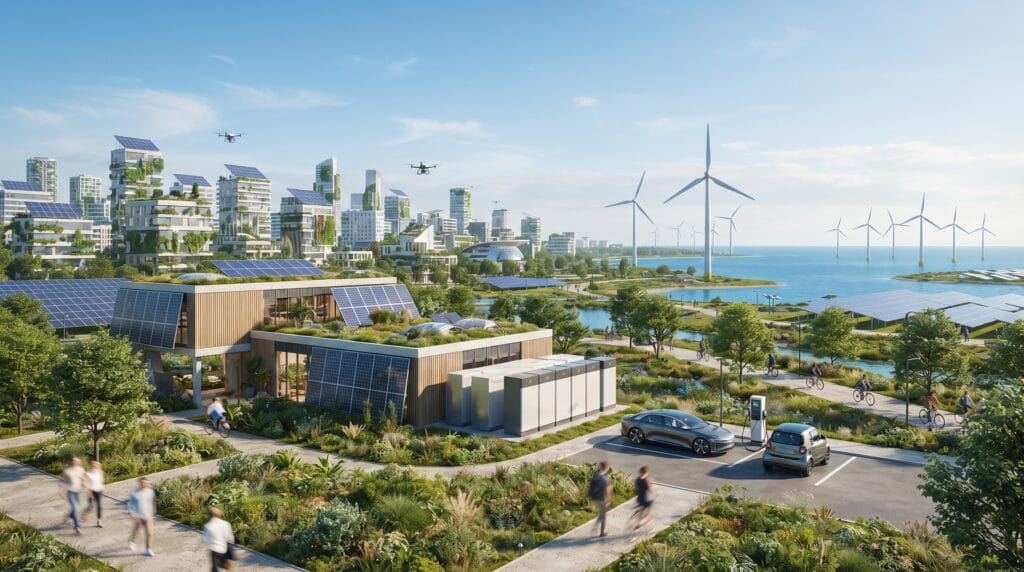
The most important green technology innovations in 2026 are changing how homes, cities, vehicles, factories, and power networks use energy. Renewable power is expanding, batteries are becoming increasingly important for electricity systems, and technologies such as green hydrogen, advanced solar cells, heat pumps, smarter electricity grids, and low-carbon industrial processes continue to develop.
This shift is no longer limited to experimental environmental projects. Clean-energy technologies have become a large global market. The International Energy Agency reports that the combined market value of major clean-energy technologies reached nearly $1.2 trillion in 2025 after growing by an average of about 20% annually over the previous decade.
Some technologies are already widely deployed, while others are still moving from demonstrations toward commercial scale.
Here are the green technology innovations worth understanding in 2026 and why they matter for a more sustainable future.
Why Green Technology Innovations Matter in 2026
Energy demand, transportation, manufacturing, and digital infrastructure continue to place pressure on electricity systems and natural resources.
Green technology attempts to reduce these pressures by improving efficiency, replacing high-emission processes, and making better use of renewable resources.
The strongest green technology innovations can contribute to:
- Lower carbon emissions
- Cleaner electricity
- Improved energy efficiency
- Reduced fossil-fuel dependence
- Better energy storage
- More efficient transportation
- Cleaner industrial production
- Improved resource management
- More resilient electricity grids
The transition is already visible in renewable deployment. Global renewable capacity additions reached a record 800 GW in 2025, with solar accounting for about 75% of that growth.
1. Advanced Solar Energy
Solar power remains one of the most important clean technologies.
Traditional crystalline-silicon panels dominate today’s market, but researchers are also developing new solar technologies designed to improve efficiency, flexibility, and manufacturing possibilities.
One particularly interesting area is perovskite solar technology.
Perovskite materials can potentially be used alongside conventional silicon cells to capture more of the solar spectrum.
The IEA reports that perovskite technologies now represent more than 70% of solar-cell patenting activity, and 2025 included a milestone involving a 33% efficiency solar cell at marketable dimensions.
Potential future applications include:
- Tandem solar panels
- Lightweight solar modules
- Building-integrated solar
- Flexible solar surfaces
- More efficient rooftop systems
Advanced photovoltaics are therefore among the most interesting green technology innovations to watch beyond conventional rooftop panels.
2. Rapidly Expanding Battery Storage
Renewable electricity is variable.
Solar panels generate electricity when sunlight is available, while wind turbines depend on wind conditions.
Battery storage helps bridge the gap between when electricity is generated and when people need it.
Battery storage became the fastest-growing power technology in 2025, with about 108 GW of new capacity added worldwide, approximately 40% more than the previous year. Lithium-iron-phosphate, or LFP, batteries represented around 90% of deployments.
Battery systems can:
- Store excess solar energy
- Support electricity grids
- Provide backup power
- Reduce renewable-energy curtailment
- Shift electricity to periods of higher demand
- Help integrate electric vehicles and other new loads
Longer-duration batteries are also becoming increasingly important as renewable penetration grows.
3. Smarter Electricity Grids
Generating clean electricity is only part of the challenge.
The electricity must also reach homes, businesses, factories, data centers, and charging stations reliably.
Existing grids were often designed for large centralized power stations rather than millions of distributed solar panels, batteries, electric vehicles, and smart devices.
Grid congestion and connection queues have consequently become major challenges in many regions. The IEA identifies grid capacity as an increasingly important bottleneck for connecting new generation, storage, and electricity demand.
Modern grids increasingly use:
- Smart meters
- Digital sensors
- Automated controls
- Demand-response systems
- Advanced forecasting
- Battery storage
- Real-time monitoring
Grid modernization may be less visible than solar panels or electric cars, but it is one of the essential green technology innovations supporting the energy transition.
4. Everything-to-Grid Energy Systems
A particularly interesting development in 2026 is the idea of connecting more energy resources directly to the grid.
Electric vehicles, homes, commercial buildings, batteries, and distributed solar systems can potentially become active components of the electricity network.
Instead of only consuming electricity, some devices can store energy and send it back when needed.
The World Economic Forum highlighted everything-to-grid energy among its emerging technologies for 2026, describing networks in which buildings, vehicles, and devices can participate more actively in balancing electricity supply and demand.
Possible examples include:
- Vehicle-to-grid systems
- Home-to-grid batteries
- Building energy storage
- Smart charging
- Flexible industrial loads
- Connected rooftop solar
This could make future electricity networks more flexible.
5. Electric Vehicles and Smarter Charging
Electric vehicles are becoming a much larger part of global transportation.
The innovation is not limited to the vehicle itself.
The surrounding charging ecosystem is also evolving.
Important areas include:
- Faster charging
- Smart charging schedules
- Vehicle-to-grid technology
- Improved battery management
- Electric buses
- Electric delivery fleets
- Charging powered by renewable energy
According to IEA analysis, electric cars accounted for around one-quarter of global car sales in 2025.
Smart charging could become especially important because millions of vehicles charging simultaneously can place significant pressure on electricity networks.
By shifting charging to periods when renewable energy is abundant or demand is lower, software can help make EV adoption more grid-friendly.
6. Heat Pumps for Efficient Buildings
Heating and cooling account for a large portion of building energy use.
Heat pumps can provide heating and cooling by moving heat rather than producing it directly through combustion.
They can be used in:
- Homes
- Offices
- Apartments
- Commercial buildings
- Industrial applications
Modern systems are becoming more efficient and capable of operating across wider temperature ranges.
Heat pumps are among the technologies the IEA identifies as benefiting from manufacturing scale and cost improvements, alongside solar PV, batteries, and electric vehicles.
For households with access to increasingly low-carbon electricity, electrified heating can reduce dependence on fossil-fuel boilers.
Also Read: Future AI Technology Trends That Will Shape the Next Decade
7. Green Hydrogen and Electrolysers
Hydrogen receives considerable attention because it may help reduce emissions in sectors that are difficult to electrify directly.
Low-emissions hydrogen can be produced by using electricity to split water through electrolysis, ideally using low-carbon electricity.
Potential uses include:
- Fertilizer production
- Steelmaking
- Shipping fuels
- Industrial processes
- Long-duration energy storage
- Synthetic fuels
This is one of the green technology innovations that remains earlier in its commercial development than solar or batteries.
Nevertheless, investment is increasing. Low-emissions hydrogen investment approached $7 billion in 2025, while installed electrolysis capacity more than doubled to above 4 GW.
Cost, infrastructure, electricity availability, and demand remain major challenges.
8. Low-Carbon Steel
Steel is essential for buildings, automobiles, infrastructure, machinery, and renewable-energy equipment.
Traditional steel production can generate substantial emissions because it frequently relies on coal.
Alternative production methods include:
- Hydrogen-based direct reduction
- Electric arc furnaces
- Increased recycled steel
- Renewable-powered processing
- Carbon capture
Near-zero-emission steel production is moving forward, although many announced projects have not yet reached final investment decisions.
The IEA reports that 105 million tonnes of near-zero-emission steel capacity has been announced since 2020, but only a relatively small share has reached final investment approval.
That makes cleaner steel an important but still developing part of green industrial technology.
9. Low-Carbon Cement and Concrete
Concrete is one of the world’s most widely used construction materials.
Producing conventional cement releases emissions through both fuel consumption and the chemical reactions used to produce clinker.
Researchers and companies are exploring alternatives such as:
- Lower-clinker cement
- Alternative binders
- Recycled construction materials
- Carbon-cured concrete
- Electrified production
- Carbon capture
These green technology innovations could reduce the environmental footprint of future buildings and infrastructure.
Unlike consumer technologies, however, industrial materials often require large manufacturing investments and lengthy testing before they can scale widely.
10. Carbon Capture, Utilisation, and Storage
Carbon capture technologies attempt to prevent carbon dioxide from reaching the atmosphere or remove it after emission.
Carbon capture, utilisation, and storage, usually shortened to CCUS, can potentially be applied to:
- Cement plants
- Chemical production
- Hydrogen production
- Industrial facilities
- Some power-generation applications
Investment is growing, although deployment remains far behind technologies such as solar and batteries.
IEA data show that annual CCUS investment had risen to more than $5 billion in 2025, but almost 90% of announced projects had not yet reached final investment decisions.
This illustrates an important distinction between emerging green technology innovations and mature technologies.
A promising technology is not necessarily one that has already achieved large-scale adoption.
11. Direct Air Capture
Direct air capture takes carbon dioxide directly from ambient air rather than capturing it from an industrial smokestack.
Captured CO2 could then be stored underground or potentially used in certain products.
The concept is attractive because it could address emissions that have already entered the atmosphere.
However, direct air capture currently faces significant challenges involving:
- Energy requirements
- Cost
- Infrastructure
- CO2 transportation
- Permanent storage
As a result, it should generally be viewed as a developing complement to emissions reduction rather than a substitute for replacing fossil fuels and improving efficiency.
12. Next-Generation Geothermal Energy
Traditional geothermal energy works best in regions with accessible underground heat resources.
Advanced geothermal technologies aim to make geothermal power available in more locations.
New approaches include improved drilling and engineered geothermal systems.
Potential advantages include:
- Continuous electricity generation
- Small surface footprints
- Low operational emissions
- Reduced dependence on weather
The IEA identified improved geothermal drilling among notable energy innovation developments in the United States during 2025.
Geothermal technology could therefore complement weather-dependent solar and wind resources.
13. Sustainable Aviation Technologies
Commercial aviation is difficult to electrify because aircraft require enormous amounts of energy while keeping weight low.
Several technologies are being explored.
These include:
- Sustainable aviation fuels
- Synthetic fuels
- Hydrogen propulsion
- More efficient aircraft
- Hybrid-electric systems
- Improved aerodynamics
Some concepts are relatively mature, while others remain experimental.
The challenge is developing alternatives that can deliver sufficient energy while remaining economical and compatible with aviation safety requirements.
Also Read: Top Technology Innovations to Watch in the Coming Years
14. AI for Energy Efficiency
Artificial intelligence can also contribute to sustainability when it is applied to energy optimization.
AI systems can analyze large volumes of data from:
- Buildings
- Factories
- Power networks
- Renewable-energy systems
- Transportation networks
Algorithms can help forecast electricity demand, predict renewable generation, optimize cooling systems, or identify equipment problems.
For example, a smart building might automatically adjust heating, cooling, and lighting based on occupancy.
However, AI itself also consumes electricity through data-center infrastructure.
Therefore, the environmental value depends on whether the efficiency gains outweigh the additional computing resources required.
15. Smart Homes and Energy Management
Green technology is also becoming more accessible to ordinary households.
Smart-home energy systems can connect:
- Solar panels
- Home batteries
- EV chargers
- Smart thermostats
- Appliances
- Heat pumps
- Smart meters
Software can decide when to consume, store, or potentially export electricity.
A household could charge its battery when solar generation is high and use stored electricity later in the evening.
As grids become increasingly interactive, these systems could become an important component of broader green technology innovations.
Green Technology Innovations Are Moving at Different Speeds
Not every green technology is at the same stage.
Some technologies already operate at enormous scale.
These include:
- Solar PV
- Wind power
- Electric vehicles
- Heat pumps
- Lithium-ion batteries
Other technologies remain relatively early in deployment.
Examples include:
- Low-emissions hydrogen
- CCUS
- Near-zero-emission steel
- Direct air capture
- New aviation technologies
Understanding this difference is important.
A technology attracting significant media attention may still require years of investment, infrastructure, regulation, and cost reductions before it becomes widely available.
What Is Driving Green Technology Innovations?
Several forces are accelerating technological development.
Falling Costs
Manufacturing at scale has significantly reduced the price of solar panels and batteries.
The IEA estimates battery prices have fallen about 75% over the past decade.
Energy Security
Countries increasingly view domestic renewable electricity, storage, and efficient technologies as tools for reducing dependence on imported fuels.
Government Policy
Tax incentives, regulations, research programs, and public investment can accelerate technology development.
Corporate Investment
Companies are investing in renewable electricity, electric fleets, energy efficiency, cleaner materials, and carbon-management technologies.
Consumer Demand
Households increasingly have access to electric cars, rooftop solar, batteries, heat pumps, and smart energy products.
Challenges Facing Green Technology in 2026
Despite rapid progress, important obstacles remain.
Electricity Grid Capacity
New renewable projects sometimes wait years for grid connections.
Critical Minerals
Batteries, electric motors, and renewable technologies depend on supply chains for lithium, copper, nickel, graphite, rare-earth elements, and other materials.
Cost
Emerging technologies can initially be much more expensive than established alternatives.
Infrastructure
Hydrogen, EVs, carbon storage, and renewable electricity all require supporting infrastructure.
Manufacturing Capacity
Rapid growth can create shortages in equipment and skilled workers.
Policy Uncertainty
Long-term investment becomes harder when regulations and incentives frequently change.
Solving these problems will be just as important as inventing new technologies.
How Green Technology Innovations Could Affect Everyday Life
Many sustainability technologies will gradually become part of ordinary life rather than remaining visible as separate environmental products.
Homes may automatically manage electricity.
Cars may communicate with electricity networks.
Buildings may generate and store their own power.
Factories may operate using cleaner electricity, hydrogen, and recycled materials.
Cities may coordinate transportation, electricity demand, and renewable-energy production using connected systems.
The most successful green technology innovations may eventually become so common that people stop thinking of them as green technologies at all.
Green Technology Innovations to Watch Beyond 2026
Several areas deserve continued attention:
- Perovskite and tandem solar cells
- Longer-duration batteries
- Sodium-ion batteries
- Vehicle-to-grid systems
- Advanced geothermal energy
- Low-carbon steel
- Low-carbon cement
- Green hydrogen
- Sustainable aviation fuels
- Carbon removal
- AI-powered energy management
- Smart electricity grids
Some will scale faster than others.
Their success will depend on cost, reliability, infrastructure, public acceptance, supply chains, and government policy.
Also Read: Smart Technology Ideas for a More Sustainable Future
Final Thoughts
The most important green technology innovations of 2026 show that sustainability is increasingly connected with mainstream energy, transportation, construction, and industrial technology.
Solar and battery storage are already expanding rapidly. Smart grids are becoming necessary to manage increasingly complex electricity networks. Electric vehicles and heat pumps continue to expand electrification, while hydrogen, low-carbon industrial materials, carbon capture, and advanced geothermal systems represent potential solutions for more difficult sectors.
There is unlikely to be one technology that solves every environmental challenge.
Instead, progress will come from combining many technologies.
Renewable generation needs storage and stronger grids. Electric vehicles need charging infrastructure. Cleaner factories need abundant low-carbon electricity. Smart buildings need digital energy management.
That interconnected approach is what makes today’s green technology innovations particularly important.
The technologies worth watching are not simply the most futuristic ideas. They are the ones that can become affordable, reliable, scalable, and useful enough to move from promising experiments into everyday infrastructure.
For high-quality fonts to boost your income, check out Letter Crafted. Our professional fonts are perfect for branding, marketing, and content creation. So, don’t miss this opportunity.