
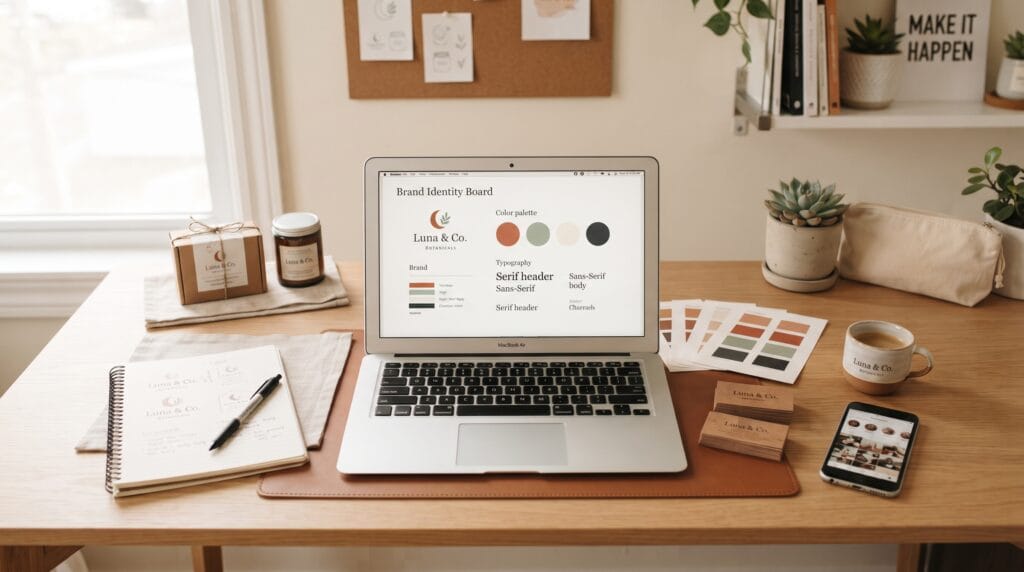
Branding on a budget does not mean creating a business that looks cheap or unprofessional. A strong brand comes from making clear, consistent decisions about how your business looks, sounds, and communicates with customers. While large companies may spend thousands of dollars on branding agencies, photography, packaging, and advertising, business owners can build a credible identity with a much smaller investment.
The key is knowing where your money matters most.
Instead of trying to create everything at once, focus first on the elements customers see repeatedly. Build a clear strategy, choose consistent visuals, create essential brand assets, and improve them gradually as your business grows.
This branding on a budget guide explains how to create a professional identity without spending money unnecessarily.
Why Branding Matters for Business Owners
Branding influences how customers recognize, remember, and evaluate your business.
Your brand includes more than a logo.
It can include:
- Business name
- Logo
- Colors
- Typography
- Photography
- Packaging
- Website
- Social media
- Tone of voice
- Customer experience
- Marketing materials
When these elements feel connected, the business becomes easier to recognize.
Strong branding can also help a smaller company appear more established.
Customers may not know how large your business is. They mainly see what you present to them.
A clear website, professional logo, consistent social media graphics, and well-written messaging can immediately create more confidence.
For that reason, branding on a budget should focus on consistency before expensive design.
1. Branding on a Budget with Define Your Brand Strategy
Before spending money on visual design, decide what your brand should represent.
Start with several basic questions:
- What does your business sell?
- Who is your ideal customer?
- What problem do you solve?
- Why should customers choose you?
- How should people describe your business?
- What makes you different from competitors?
These answers form the foundation of your brand.
For example, imagine a small skincare company targeting environmentally conscious customers.
Its brand direction might focus on:
- Simple ingredients
- Sustainable packaging
- Natural colors
- Honest communication
- Minimal visual design
Once that direction is clear, decisions about logos, packaging, photography, and marketing become easier.
Define Your Target Audience
Avoid trying to appeal to everyone.
A more specific audience helps you make better branding decisions.
Consider characteristics such as:
- Age
- Location
- Interests
- Income
- Lifestyle
- Buying habits
- Problems
- Preferences
A children’s clothing brand may need a completely different visual identity from a financial consulting company.
Knowing the audience prevents you from spending money on branding that looks attractive but does not connect with potential customers.
2. Branding on a Budget with Study Your Competitors
Competitor research is free and extremely useful.
Look at businesses serving similar customers and study:
- Logo styles
- Brand colors
- Typography
- Website design
- Packaging
- Social media
- Photography
- Pricing
- Marketing messages
The purpose is not to copy competitors.
Instead, identify patterns and opportunities.
For example, if nearly every competitor uses dark corporate colors, a warmer and more approachable identity could help your business feel different.
Likewise, if competitors rely heavily on discount messaging, your brand might focus on quality, craftsmanship, or service instead.
A successful branding on a budget strategy often begins with understanding what already exists in the market.
3. Branding on a Budget with Create a Simple Logo
A logo is important, but new businesses often spend too much time and money trying to make it perfect.
Your first logo does not need complicated illustrations or multiple effects.
Simple logos are usually easier to use across:
- Websites
- Social media
- Packaging
- Business cards
- Signs
- Email signatures
- Advertisements
A practical logo system may include:
- Primary logo
- Horizontal version
- Simple icon or symbol
- Black version
- White version
Make sure the logo remains readable at both large and small sizes.
Avoid Common Low-Cost Logo Mistakes
When creating a logo with limited resources, avoid:
- Too many colors
- Extremely detailed symbols
- Hard-to-read fonts
- Complicated gradients
- Trendy effects that may age quickly
- Copying another company’s identity
Simple does not mean boring.
A clean wordmark with good typography can be more professional than an overly complicated logo.
4. Branding on a Budget with Build a Small Color Palette
You do not need ten different brand colors.
Start with a small palette.
For example:
- One primary color
- One secondary color
- One accent color
- One dark neutral
- One light neutral
Your primary color should appear consistently across important brand materials.
The accent color can highlight:
- Buttons
- Promotions
- Links
- Important information
Neutral colors help create balance.
When choosing colors, also consider readability.
Text and backgrounds should have enough contrast to remain easy to read.
A limited palette makes branding on a budget easier because you can create many materials without constantly making new visual decisions.
Choose Affordable Brand Typography
Typography has a major influence on how professional a brand feels.
You do not necessarily need several expensive commercial fonts.
Many businesses can build a strong identity using one or two carefully selected typefaces.
A basic typography system might include:
Heading Font
Used for:
- Headlines
- Promotions
- Product names
- Important messages
Body Font
Used for:
- Website paragraphs
- Product descriptions
- Emails
- Articles
- Longer text
Choose fonts that are readable and appropriate for your brand personality.
For example, a luxury brand might use an elegant serif for headings, while a technology company might choose a clean sans serif.
Avoid using too many different fonts.
Two typefaces are usually enough for a small business.
Also Read: Brand Positioning Strategy for Better Recognition and Growth
5. Branding on a Budget with Create a Basic Brand Guide
A brand guide does not need to be a 100-page document.
For a small business, even a few pages can prevent inconsistency.
Document:
- Logo versions
- Logo spacing
- Brand colors
- Color codes
- Heading font
- Body font
- Image style
- Tone of voice
- Basic graphic style
You can also include examples showing how social media graphics, website banners, or advertisements should look.
This document becomes especially useful when working with:
- Freelancers
- Employees
- Printers
- Social media managers
- Web designers
- Marketing partners
Without a guide, each person may interpret the brand differently.
6. Branding on a Budget with Prioritize Your Website
For many businesses, the website is one of the most important branding investments.
Customers often visit a website before contacting a company or purchasing a product.
A professional website does not require complicated animation or a completely custom system.
Focus first on:
- Clear navigation
- Mobile-friendly design
- Fast loading
- Readable typography
- Consistent colors
- Professional images
- Clear contact information
- Strong calls to action
Your homepage should quickly explain:
- What your business offers
- Who it is for
- Why customers should care
- What they should do next
When branding on a budget, clarity is more valuable than unnecessary visual effects.
7. Branding on a Budget with Improve Your Social Media Identity
Social media can expose your brand to potential customers repeatedly.
Consistency makes those interactions more memorable.
Use the same:
- Profile image
- Brand colors
- Typography
- Photography style
- Tone of voice
- Graphic style
You can create several reusable templates instead of designing every post from scratch.
For example:
- Quote template
- Product template
- Educational post template
- Promotion template
- Announcement template
Reusable templates save both time and money.
Keep Social Branding Flexible
Consistency does not mean every post must look identical.
Your social feed can include:
- Photography
- Videos
- Graphics
- Behind-the-scenes content
- Customer stories
- Tutorials
The goal is to maintain enough visual connection that people recognize your business.
Use Better Photography Without a Large Budget
Professional photography can be expensive, but good images are still possible on a smaller budget.
Modern smartphones can produce strong results when used carefully.
Focus on:
- Natural light
- Simple backgrounds
- Clean composition
- Consistent editing
- Sharp images
For product photography, create a basic setup near a window and use simple backgrounds.
If your brand needs lifestyle photography, plan several scenes during one session.
One productive photography day can provide content for:
This makes photography more efficient when branding on a budget.
8. Branding on a Budget with Create Essential Marketing Materials First
Do not immediately design every possible piece of marketing collateral.
Start with materials customers actually need.
Depending on the business, these could include:
- Business cards
- Email signatures
- Social media templates
- Digital brochures
- Price lists
- Product labels
- Packaging
- Presentation templates
- Invoice templates
Ask whether each item will actually help generate sales or improve customer experience.
If not, it can probably wait.
For example, an online service business may not need printed brochures during its first year.
A local restaurant, however, may need menus, signage, takeaway packaging, and promotional flyers immediately.
Save Money With Reusable Templates
Templates are one of the easiest ways to maintain professional branding without repeatedly hiring a designer.
Create reusable templates for recurring content.
These can include:
- Instagram posts
- Pinterest graphics
- Email banners
- Proposals
- Presentations
- Advertisements
- Blog graphics
- Promotions
Once the basic template is created, you can change photos and text while keeping the overall identity consistent.
This reduces both design time and cost.
Also Read: Summer Sale Banner Colors for Ecommerce and Social Media
Affordable Tools for Branding on a Budget
Several tools can help small businesses manage branding without a large creative team.
Canva
Useful for:
- Social graphics
- Presentations
- Flyers
- Posters
- Simple brand templates
Figma
Useful for:
- Interface design
- Brand layouts
- Digital design systems
- Collaborative design work
Adobe Express
Can help create:
- Social media graphics
- Promotional materials
- Simple marketing assets
Google Docs
Helpful for writing:
- Brand guidelines
- Messaging documents
- Content plans
Google Drive
Useful for organizing:
- Logos
- Photography
- Templates
- Brand documents
- Marketing files
Tools are helpful, but consistency still depends on how you use them.
Decide Where to Spend and Where to Save
Not every branding expense has equal value.
Consider Spending More On
- Logo or visual identity if design is central to your business
- Professional website
- Important product packaging
- Core photography
- Trademark or legal work when appropriate
Consider Saving On
- Large quantities of printed materials before testing demand
- Too many social media templates
- Unnecessary branded merchandise
- Decorative website features
- Multiple logo variations you may never use
Think about which assets customers encounter most frequently.
Invest there first.
This makes branding on a budget more strategic.
Keep Branding Consistent Across Customer Touchpoints
Consistency creates recognition.
Customers should experience the same brand whether they find you through:
Check whether your:
- Logo is consistent
- Colors match
- Fonts match
- Voice sounds similar
- Photography follows the same direction
- Offers are clearly presented
Small inconsistencies are normal during growth, but large differences can make a company feel disconnected.
Common Branding on a Budget Mistakes
Trying to Look Like a Large Corporation
Small businesses do not need to imitate multinational companies.
A smaller brand can succeed by appearing personal, focused, and authentic.
Redesigning Too Frequently
Constantly changing colors, fonts, logos, and templates prevents recognition.
Give the brand time to become familiar.
Following Every Design Trend
Trends can provide inspiration, but they should not completely define your identity.
Choose elements that can remain useful for several years.
Using Too Many Visual Styles
Avoid combining unrelated fonts, colors, illustrations, photography styles, and graphic effects.
Spending Before Testing the Business
Do not order thousands of packages, signs, or printed materials before confirming that customers want your product.
Start small.
Branding on a Budget Checklist
Before considering your basic brand identity complete, check that you have:
- Defined your target audience
- Written your value proposition
- Studied key competitors
- Defined your brand personality
- Created a primary logo
- Created simple logo variations
- Selected brand colors
- Selected typography
- Defined your photography style
- Created a basic brand guide
- Built a consistent website
- Created social media templates
- Organized brand files
- Defined your tone of voice
- Created essential marketing materials
- Checked mobile presentation
- Checked visual consistency
- Created reusable templates
- Identified future branding priorities
You do not need to complete everything on the first day.
Build the system gradually.
Plan Future Branding Investments
As the business grows, you can improve areas that were initially created with limited resources.
Future investments might include:
- Professional brand strategy
- Custom typography
- Professional photography
- Packaging redesign
- Custom website development
- Illustration
- Video production
- Brand campaigns
The advantage of starting carefully is that you can invest later using real customer information.
You will know more about:
- Who buys
- What customers value
- Which products sell
- Which channels work
- How people describe your brand
That information can make later branding investments more effective.
Also Read: How to Make a Professional Brand Mood Board From Scratch
Final Thoughts
Building a memorable identity does not require unlimited money. A thoughtful branding on a budget strategy starts with understanding your audience, defining your position, and creating a small number of visual elements that work consistently together.
Begin with your strategy.
Create a simple logo, limited color palette, readable typography, and basic brand guidelines.
Then focus on the places customers see most often, such as your website, social media, packaging, and essential marketing materials.
The goal of branding on a budget is not to choose the cheapest option for everything.
Instead, spend carefully on elements that influence customer trust and recognition while avoiding unnecessary expenses.
Keep your first version practical.
Use templates.
Reuse assets.
Maintain consistency.
Observe how customers respond.
As revenue and experience grow, improve the brand where additional investment can make a meaningful difference.
When approached this way, branding on a budget can create a professional identity that supports a business from its early stages through future growth.
For high-quality fonts to boost your income, check out Letter Crafted. Our professional fonts are perfect for branding, marketing, and content creation. So, don’t miss this opportunity.