
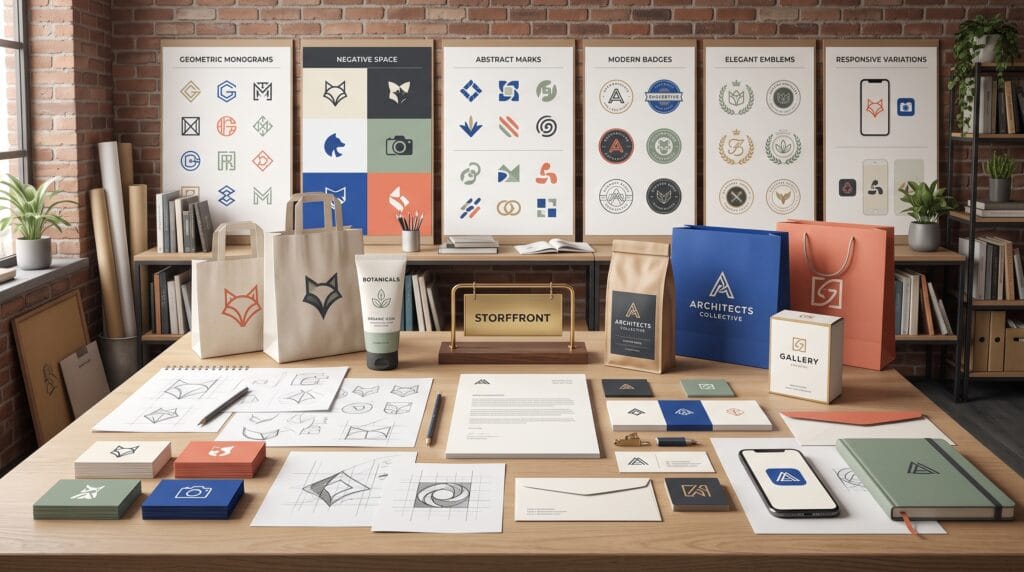
Strong creative logo concepts can transform a basic design portfolio into a memorable demonstration of strategy, craftsmanship, and visual communication. Potential clients and employers do not only want to see attractive symbols. They want evidence that you can understand a brand, solve a communication problem, develop an original idea, and apply it consistently across different formats.
A portfolio filled with similar wordmarks or generic icons may not communicate the full range of your abilities. By exploring different creative logo concepts, you can demonstrate typography, illustration, symbolism, composition, color, negative space, and brand-system thinking. Each project becomes an opportunity to show how you approach a different audience, industry, and business challenge.
The most successful logo portfolio does not need dozens of projects. A smaller selection of well-developed identities can be more impressive than a large collection of unfinished concepts. This guide explores practical logo directions that can help you create stronger case studies and present your skills professionally.
Why Creative Logo Concepts Matter in a Portfolio
A logo is often one of the smallest elements in a brand identity, but designing it requires many important decisions. You need to consider the audience, market position, personality, applications, readability, and long-term flexibility of the brand.
Developing varied creative logo concepts allows your portfolio to demonstrate that you can:
- Research different industries
- Translate ideas into visual symbols
- Select appropriate typography
- Build recognizable brand identities
- Create flexible logo variations
- Explain strategic design decisions
- Apply logos across print and digital platforms
Clients are more likely to trust a designer who can show complete thinking instead of isolated visual experiments. A strong case study should explain why the concept works, not simply display the final logo.
1. Negative Space Creative Logo Concepts
Negative space uses the empty area inside or around a shape to reveal a secondary image or message. This approach can make a logo feel clever without requiring excessive detail.
For example, a delivery company could combine a package with an arrow. A wildlife organization might hide an animal silhouette inside a letter. A construction logo could use the space between two geometric forms to suggest a building.
Negative-space creative logo concepts demonstrate your understanding of simplification and visual problem-solving.
How to Design Effective Negative Space Logos
Start with one clear primary shape. Then explore whether the surrounding or internal space can communicate a related idea.
The hidden element should be noticeable without becoming confusing. Avoid forcing several meanings into one symbol. A successful negative-space logo usually combines two simple ideas rather than many complicated ones.
Test the design in black and white to confirm that the hidden image remains visible.
2. Monogram Logo Concepts
Monograms combine initials into a unified symbol. They are ideal portfolio projects because they challenge you to work with letter structure, spacing, balance, and abstraction.
Monogram logos are suitable for:
- Fashion brands
- Architecture firms
- Creative studios
- Personal brands
- Law firms
- Photography businesses
- Luxury products
Creative monograms can use overlapping letters, mirrored forms, shared strokes, geometric construction, or decorative frames.
These creative logo concepts are especially useful for typography-focused designers because they demonstrate control over custom letterforms.
Keep Monograms Readable
A monogram should be distinctive without becoming impossible to recognize. Begin with simple sketches and explore how the letters naturally connect.
Avoid adding decorative details before the basic structure works. The initials should remain balanced at both large and small sizes.
Pair the monogram with the full business name in your presentation so viewers can understand how it functions within a complete identity.
3. Custom Wordmark Creative Logo Concepts
A wordmark turns the business name into the main logo. Although wordmarks may appear simple, they require careful typographic decisions.
You can create originality by modifying:
- Letter shapes
- Terminals
- Crossbars
- Ligatures
- Spacing
- Baselines
- Stroke widths
- Character proportions
Custom wordmarks are excellent creative logo concepts for demonstrating typography skills. They also show that you can build recognition without depending on a separate symbol.
Choose a fictional brand name with interesting letter combinations. Then create a wordmark that reflects a specific personality, such as elegant, playful, technical, organic, or bold.
Do not modify every character. One or two distinctive details are often enough to create a memorable result.
4. Geometric Logo Concepts
Geometric logos use basic shapes, grids, angles, circles, and repeated forms to create an organized visual identity.
This style works well for:
- Technology companies
- Architecture studios
- Financial services
- Construction businesses
- Consulting firms
- Digital products
Geometric creative logo concepts can communicate precision, innovation, stability, or efficiency. They also give you an opportunity to demonstrate proportion and construction.
Start with a simple grid and explore how shapes can represent an idea related to the brand. A geometric symbol should still have meaning rather than looking like a random pattern.
Include the construction grid in your portfolio case study. This helps viewers understand how the symbol was developed and shows attention to detail.
5. Hand-Drawn Logo Ideas
Hand-drawn logos can add warmth, personality, and authenticity to a portfolio. They are particularly effective for brands that want to feel personal or handmade.
Suitable industries include:
- Artisan food
- Independent cafés
- Florists
- Craft businesses
- Children’s products
- Creative services
- Natural skincare
Handcrafted creative logo concepts may feature custom lettering, simplified illustrations, uneven lines, stamps, or expressive brushwork.
The design should feel human without appearing careless. Clean the final artwork enough to maintain readability while preserving the original character of the sketch.
Show both the initial drawing and the refined vector version in your case study. This demonstrates how you transform an organic idea into a usable professional logo.
Also Read: Typography Logo Design How to Make Logos Look Expensive
6. Mascot Creative Logo Concepts
Mascot logos use a character to represent the personality of a business. They can make a brand more friendly, recognizable, and suitable for storytelling.
Mascots work well for:
- Food brands
- Pet businesses
- Sports teams
- Gaming companies
- Educational products
- Children’s services
- Entertainment brands
A strong mascot should have a clear silhouette, expressive personality, and simplified details. It should remain recognizable when reduced to a small profile image or product label.
Mascot-based creative logo concepts are valuable portfolio additions because they combine illustration and branding skills.
Consider creating several expressions or poses for the character. This shows how the mascot could support packaging, social media, stickers, merchandise, and marketing campaigns.
7. Symbolic Logo Concepts
Symbolic logos use visual metaphors to communicate the brand’s purpose or values. Instead of showing the product directly, they represent a broader idea.
For example:
- A bridge can represent connection.
- A rising shape can suggest growth.
- A compass can communicate guidance.
- Interlocking forms can represent collaboration.
- A flame can symbolize energy or transformation.
Symbolic creative logo concepts demonstrate your ability to think beyond obvious industry imagery.
Before sketching, list the brand’s main qualities and convert each one into possible visual symbols. Then explore combinations that feel original and appropriate.
Avoid using symbols simply because they are popular. The chosen metaphor should relate clearly to the brand story.
8. Nature-Inspired Creative Logo Concepts
Nature provides many shapes that can be simplified into recognizable logos. Leaves, flowers, mountains, water, sun forms, animals, and organic lines can all support different brand personalities.
Nature-inspired concepts are suitable for:
- Wellness brands
- Sustainable products
- Farms
- Garden services
- Outdoor companies
- Skincare businesses
- Home décor brands
To make these creative logo concepts feel distinctive, avoid generic leaf icons. Look for a more specific connection to the business.
A local brand might use a plant native to its region. A skincare company could build a symbol around its main ingredient. An outdoor brand might combine a landscape with the initials of the company.
Use simplified forms so the logo remains effective at small sizes.
9. Retro Logo Concepts With Modern Functionality
Retro logos can bring warmth, nostalgia, and character to your portfolio. Influences may come from vintage packaging, traditional signage, old advertisements, classic sports graphics, or historical typography.
Retro creative logo concepts are especially suitable for:
- Restaurants
- Coffee shops
- Fashion labels
- Music brands
- Barbershops
- Craft products
- Lifestyle companies
The goal is not to copy an old design exactly. Combine historical references with modern spacing, simplified details, and flexible logo variations.
Create a complete set that includes a primary badge, simplified wordmark, and small icon. This demonstrates that a nostalgic visual style can still work across modern digital applications.
10. Abstract Creative Logo Concepts
Abstract logos use shapes and visual relationships rather than literal objects. They can help a brand appear modern, original, and adaptable.
An abstract symbol might represent:
- Movement
- Connection
- Transformation
- Balance
- Speed
- Creativity
- Progress
These creative logo concepts work particularly well for technology, consulting, finance, healthcare, and digital services.
Abstract design should still have a clear explanation. A random shape may look attractive but will be difficult to defend strategically.
Describe how the forms, colors, and movement connect to the brand’s values. This explanation makes the portfolio project more convincing.
11. Dynamic and Responsive Logo Systems
A modern brand needs more than one fixed logo. It may require different versions for websites, mobile apps, social profiles, packaging, signage, and advertisements.
A responsive logo system can include:
- Primary horizontal logo
- Stacked logo
- Simplified symbol
- Monogram
- Favicon
- Black-and-white version
- Small-size version
- Animated version
Developing responsive creative logo concepts demonstrates that you understand real-world branding requirements.
Show how the logo simplifies as the available space becomes smaller. The primary version may include the full name and tagline, while the smallest version uses only the symbol.
This system-based approach is often more impressive than displaying one isolated logo.
Also Read: 3D Logo Design Trends and Examples That Stand Out
12. Logo Concepts Based on Letter Transformation
Letter transformation begins with a character from the brand name and modifies it into a meaningful symbol.
For example, a letter may become:
- A building
- An animal
- A path
- A plant
- A tool
- A product
- An arrow
- A face
These creative logo concepts combine typography and symbolism while keeping the brand name central.
Choose a letter with a shape that naturally supports the desired meaning. Avoid transformations that reduce readability or feel overly complicated.
Show the transition from the original letter to the final symbol in your presentation. This gives viewers insight into your creative thinking.
Build Fictional Brands for Your Logo Portfolio
You do not need to wait for a client project to develop a strong portfolio. Fictional brand identities can demonstrate your abilities when they are treated like real assignments.
Create a short brief that includes:
- Brand name
- Industry
- Target audience
- Brand personality
- Main competitors
- Business values
- Required logo applications
A clear brief prevents the project from becoming a purely decorative exercise.
Choose industries that allow you to demonstrate different styles. You might create identities for a sustainable skincare company, technology startup, family restaurant, architecture studio, and children’s learning platform.
This variety makes your collection of creative logo concepts more useful to potential clients.
Present Creative Logo Concepts as Case Studies
A complete portfolio project should explain how the logo was developed.
Use the following structure:
- Introduce the brand and its challenge.
- Define the target audience.
- Present key research or mood boards.
- Show selected sketches.
- Explain the chosen concept.
- Present the final logo variations.
- Display typography and colors.
- Apply the identity to relevant mockups.
- Conclude with the final brand system.
This format turns your creative logo concepts into evidence of professional problem-solving.
Include only the strongest sketches. Showing every rejected idea can make the process feel unfocused.
Choose Relevant Logo Mockups
Mockups help viewers imagine how the logo will work in the real world. However, each application should match the fictional or real business.
Useful mockups include:
- Storefront signs
- Product packaging
- Business cards
- Mobile screens
- Social media profiles
- Clothing labels
- Menus
- Delivery vehicles
- Office walls
- Shopping bags
Avoid placing every logo on the same generic wall or business card. Relevant applications strengthen the brand story and make your creative logo concepts feel more realistic.
Include some flat presentations as well. Clients should be able to evaluate the design clearly without shadows, textures, or dramatic photography.
Common Portfolio Mistakes to Avoid
Even strong logo work can appear weaker when presented poorly.
1. Including Too Many Similar Projects
A portfolio with ten minimalist technology logos may not show enough versatility. Select projects with different audiences, industries, and visual directions.
2. Showing Logos Without Context
Explain the problem, audience, and concept. A logo becomes more meaningful when viewers understand the reasoning behind it.
3. Depending Too Heavily on Mockups
Mockups add realism, but they should not hide weak typography or construction. Show the logo clearly on simple backgrounds.
4. Using Unlicensed Assets
Confirm that all fonts, illustrations, textures, and mockup files allow portfolio and commercial use.
5. Ignoring Small-Size Performance
Test each logo as a social profile image, favicon, and small printed mark.
6. Copying Popular Logo Styles
Use inspiration to learn principles, but develop original solutions that connect to the specific brand.
Creative Logo Concepts Portfolio Checklist
Before publishing a logo case study, confirm that it includes:
- A clear brand brief
- A defined audience
- An original concept
- Readable typography
- Strong black-and-white performance
- Primary and secondary variations
- Small-size testing
- Relevant mockups
- A clear explanation of the idea
- Consistent visual presentation
- Properly licensed assets
- Organized final files
This checklist helps ensure that your creative logo concepts demonstrate both creativity and professional preparation.
Also Read: 50 AI Mascot Logo Prompts for Simple Line Mascots
Final Thoughts on Creative Logo Concepts
The best creative logo concepts do more than decorate a portfolio. They show how you research, think, simplify, communicate, and build flexible visual identities.
Explore different approaches, including negative space, monograms, wordmarks, custom lettering, mascots, geometric symbols, abstract forms, and responsive logo systems. Choose concepts that reflect different industries and audiences so potential clients can see the full range of your skills.
Focus on quality rather than quantity. A few carefully developed creative logo concepts with clear strategy, professional presentation, and relevant applications can make a stronger impression than dozens of unfinished designs.
By treating each project as a complete branding challenge, you can create a portfolio that feels thoughtful, versatile, and ready to attract better creative opportunities.
For high-quality fonts to boost your income, check out Letter Crafted. Our professional fonts are perfect for branding, marketing, and content creation. So, don’t miss this opportunity.