
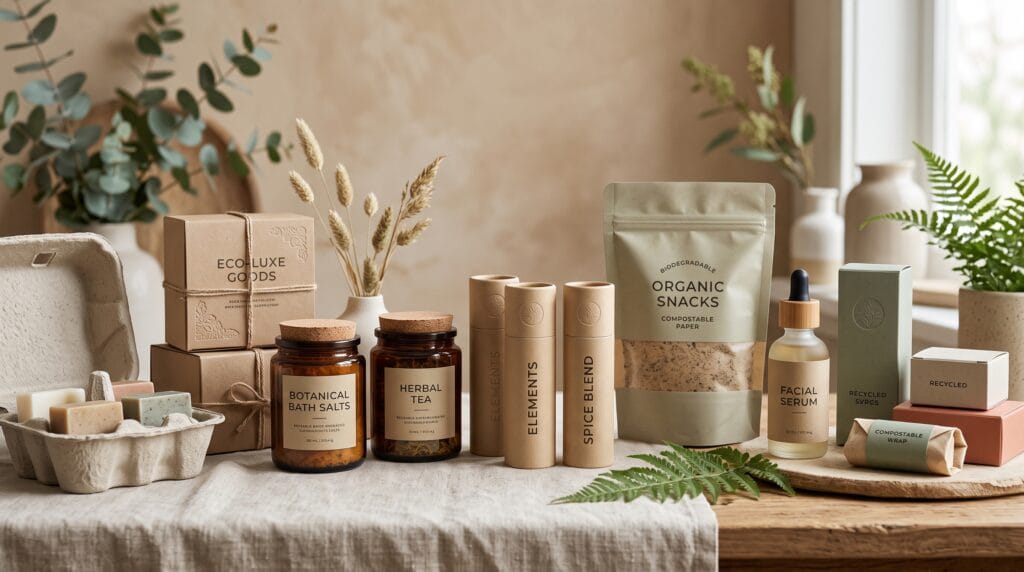
Sustainable product packaging gives businesses an opportunity to reduce unnecessary waste while building a more thoughtful and recognizable brand. Modern packaging is no longer judged only by how attractive it looks on a shelf. Customers also consider how much material it uses, whether it can be recycled or reused, how clearly it explains disposal, and whether its environmental claims appear trustworthy.
For designers and business owners, sustainability should not be treated as an extra symbol added at the end of a packaging project. It should influence the material, structure, dimensions, printing method, delivery process, and customer experience from the beginning.
When these elements work together, sustainable product packaging can strengthen brand positioning, improve usability, and create a more memorable connection with customers. This guide explores practical ideas for developing packaging that feels responsible, functional, and visually distinctive.
Why Sustainable Product Packaging Matters for Branding
Packaging is one of the most visible parts of a physical product. It communicates quality, personality, pricing, and purpose before the customer opens the item.
A well-planned package can help a brand:
- Stand out from competitors
- Communicate its values
- Protect the product efficiently
- Improve the unboxing experience
- Reduce unnecessary materials
- Encourage reuse or recycling
- Build customer trust
- Create stronger visual recognition
The most effective sustainable product packaging connects environmental responsibility with the brand’s broader identity. A natural skincare company may use soft colors, paper-based materials, and simple botanical graphics. A modern technology brand might choose compact structures, minimal ink coverage, and precise typography.
Sustainability becomes more convincing when it is visible throughout the entire experience rather than limited to one environmental claim.
Start With a Clear Packaging Strategy
Before choosing colors or illustrations, define what the packaging must accomplish.
Consider:
- What protection does the product require?
- How will it be transported?
- Where will it be displayed?
- Does it need moisture or light protection?
- Can the package be reduced in size?
- Which parts can be reused?
- How will customers dispose of it?
- What information must appear on the label?
A clear strategy prevents decorative decisions from creating unnecessary waste or production problems.
For example, an oversized box may create more visual impact, but it can increase material use, shipping volume, and the need for internal fillers. A compact structure may be more sustainable while also making the product feel more carefully designed.
1. Minimalist Sustainable Product Packaging
Minimalism is one of the most practical approaches to responsible packaging. It focuses on removing elements that do not improve protection, communication, or usability.
Minimal packaging may use:
- Fewer material layers
- Smaller boxes
- Limited ink coverage
- Simple labels
- One-color printing
- Reduced plastic components
- Direct printing instead of additional sleeves
Minimalist sustainable product packaging should still feel intentional. Reducing materials does not mean presenting a product in an unfinished or generic way.
Strong typography, thoughtful spacing, a focused color palette, and distinctive structural details can create a premium result without excessive decoration.
Avoid Decorative Overpackaging
Some packages include ribbons, plastic windows, magnetic closures, foam inserts, and additional sleeves even when those elements are not necessary.
Review every component and ask whether it protects the product, communicates essential information, or improves usability. If it does none of these things, consider removing it.
2. Recycled Paper and Cardboard Packaging
Recycled paper and cardboard are widely used for boxes, labels, sleeves, envelopes, and protective inserts.
These materials can work well for:
- Cosmetics
- Clothing
- Stationery
- Food products
- Handmade goods
- Subscription boxes
- Small electronics
- Home accessories
Natural textures and visible fibers can help communicate authenticity and craftsmanship. However, recycled materials do not always need to look rustic. Clean white board, precise printing, and modern typography can create a refined appearance.
When developing sustainable product packaging, confirm that the selected paper provides enough strength and protection. A thinner material is not helpful if it causes product damage or requires additional layers.
3. Refillable Packaging Systems
Refillable packaging allows customers to keep the primary container and purchase replacement contents separately.
This model is increasingly useful for:
- Skincare products
- Cleaning products
- Personal care items
- Candles
- Food staples
- Beverages
- Fragrances
- Cosmetics
A refill system can create a stronger long-term relationship between the customer and the brand. The primary container may be designed as a durable object, while refills use lighter and simpler packaging.
Successful refillable sustainable product packaging must be convenient. Customers should understand how to open, clean, refill, and reuse the container without creating spills or unnecessary effort.
Make Refills Easy to Recognize
Use a consistent visual system that clearly separates permanent containers from refill products.
Color coding, icons, product names, and simple instructions can help customers choose the correct refill. The design should make the process feel effortless rather than complicated.
4. Reusable Product Packaging
Reusable packaging gives the container a useful purpose after the original product has been consumed or removed.
Examples include:
- Glass jars used for storage
- Fabric bags used for shopping
- Metal tins used as organizers
- Boxes designed as desk storage
- Bottles intended for repeated refilling
- Packaging that becomes a display object
Reusable sustainable product packaging can increase perceived value and create a longer-lasting brand presence inside the customer’s home.
However, the second use should be realistic. Avoid making exaggerated claims that customers are unlikely to follow. A package is not meaningfully reusable simply because it could theoretically hold another object.
Design the second function intentionally and explain it clearly.
5. Compostable Packaging Materials
Compostable packaging can be suitable for certain food products, takeaway items, mailers, and short-life applications.
Possible materials include:
- Plant-fiber containers
- Compostable films
- Molded fiber
- Paper-based wraps
- Agricultural-waste materials
The design must clearly explain how and where the material can be composted. Some materials require industrial composting conditions, while others may be suitable for home composting.
Vague instructions can confuse customers and reduce the value of the environmental feature.
When using compostable materials in sustainable product packaging, include specific and readable disposal guidance rather than relying on a small icon alone.
Also Read: 12 Most Sustainable Packaging Materials for a Greener Future
6. Mono-Material Packaging Design
Packaging becomes difficult to recycle when several materials are permanently combined. A paper box with a plastic window, metallic coating, foam insert, and laminated label may require customers to separate multiple components.
Mono-material packaging uses one primary material or components that belong to the same recycling stream.
This can make disposal simpler and reduce confusion.
Examples include:
- All-paper boxes and inserts
- Single-material plastic containers
- Paper labels compatible with paper packaging
- Closures made from the same material as the bottle
Mono-material sustainable product packaging requires coordination between structural design, material selection, printing, adhesives, and production.
The package should still protect the product effectively while making its disposal process easier to understand.
7. Lightweight Packaging Structures
Reducing packaging weight can decrease material consumption and make transportation more efficient.
Designers can explore:
- Thinner but stronger board
- Smaller closures
- Reduced wall thickness
- Compact folding structures
- Lightweight protective inserts
- Smaller shipping dimensions
Lightweight packaging should never compromise product safety. Damaged products create waste, replacement shipments, and customer dissatisfaction.
The goal is optimization rather than simply using the least material possible.
Testing prototypes under realistic transportation and storage conditions is essential before approving a lightweight structure.
8. Packaging Designed for Efficient Shipping
A beautiful package can still be inefficient when its shape leaves large amounts of unused space during transportation.
Shipping-efficient sustainable product packaging may use:
- Stackable shapes
- Flat-pack structures
- Compact dimensions
- Standardized box sizes
- Reduced empty space
- Minimal protective filler
- Lightweight materials
Efficient packaging can also reduce business costs because more products may fit inside storage areas, delivery vehicles, or shipping cartons.
Structural designers should consider the complete journey of the product, not only its appearance on the retail shelf.
9. Plastic-Free Packaging Concepts
Plastic-free packaging can be an appropriate goal for products that can be safely protected with paper, cardboard, glass, metal, or fiber-based materials.
Common alternatives include:
- Paper sleeves
- Molded pulp inserts
- Cardboard trays
- Glass containers
- Metal tins
- Fabric wraps
- Paper-based mailers
However, replacing plastic should not be treated as an automatic solution. Alternative materials may be heavier, more fragile, or require more energy during transportation.
The best sustainable product packaging evaluates the entire function of the package and selects materials based on the product’s actual requirements.
10. Low-Ink and One-Color Packaging
Printing choices can influence the appearance, cost, and complexity of packaging.
A limited printing approach may include:
- One-color artwork
- Uncoated paper
- Natural material colors
- Small printed areas
- Embossing without additional ink
- Simple stamps
- Direct labels
Low-ink packaging can create a distinctive minimalist identity while allowing the natural material to become part of the visual design.
One-color sustainable product packaging does not need to look basic. Bold typography, custom illustrations, patterns, and strong composition can create an engaging result.
Building a Sustainable Packaging Brand Identity
Sustainable branding should extend beyond the material. The typography, colors, illustrations, messaging, and photography should create a consistent personality.
A natural appearance is not the only option. Sustainable brands can look:
- Minimal and modern
- Bright and playful
- Premium and elegant
- Handmade and artistic
- Technical and innovative
- Warm and community-focused
Avoid relying entirely on green colors, leaf icons, and recycled-paper textures. These visual elements are common and may make different brands look similar.
Instead, identify what makes the company unique. Build the visual identity around its products, audience, origin, purpose, and personality.
Also Read: Creative Packaging Design Examples for Better Branding
Communicating Sustainability Without Greenwashing
Customers need clear information about what makes a package more responsible.
Avoid broad statements such as:
- Completely eco-friendly
- Good for the planet
- Zero environmental impact
- Fully sustainable
- Guilt-free packaging
These claims may be difficult to verify and can create distrust.
Use specific language instead. Explain whether the package:
- Uses recycled content
- Contains fewer components
- Can be refilled
- Is designed for reuse
- Uses a smaller amount of material
- Can be recycled in a particular system
- Requires industrial composting
Honest communication makes sustainable product packaging more credible. It also helps customers understand their role after using the product.
Add Clear Disposal Instructions
Customers should not have to guess what to do with a package.
Useful disposal instructions may explain:
- Which components should be separated
- Which parts can be recycled
- Whether labels should be removed
- Whether the package must be cleaned
- Where refills can be purchased
- Whether composting facilities are required
Place these instructions where customers can easily find them. Small text hidden underneath the package is less effective than a simple visual guide.
QR codes may provide additional information, but essential instructions should still appear directly on the package whenever space allows.
Use Sustainable Product Packaging to Improve Unboxing
Reducing packaging does not mean eliminating the customer experience. A thoughtful unboxing moment can be created through structure, messaging, and organization rather than excessive layers.
Consider using:
- A well-designed opening mechanism
- A message printed inside the lid
- A reusable container
- A simple product arrangement
- One informative card
- A memorable interior color
- A package that unfolds creatively
Every component should have a clear purpose. A restrained unboxing experience can feel more sophisticated than one filled with unnecessary paper, plastic, and decorative items.
Sustainable Product Packaging Mistakes to Avoid
Brands should avoid several common mistakes when redesigning packaging.
1. Choosing Materials Before Understanding the Product
The material must provide appropriate protection and meet storage requirements.
2. Making Disposal Instructions Unclear
Customers cannot follow a sustainability system they do not understand.
3. Adding Too Many Environmental Symbols
A crowded collection of icons can make the package confusing and visually weak.
4. Sacrificing Product Protection
Reduced packaging is ineffective when damaged products must be replaced.
5. Using Generic Nature-Inspired Branding
Leaves and green colors do not automatically create a credible sustainable identity.
6. Making Unsupported Claims
Environmental messaging should be specific, measurable, and honest.
7. Ignoring the Supply Chain
The complete system includes production, transportation, storage, customer use, and end-of-life disposal.
Sustainable Product Packaging Design Process
A practical design process can follow these steps:
- Define the product’s protection requirements.
- Study its transportation and storage journey.
- Audit the existing package for unnecessary components.
- Research available local materials and production methods.
- Explore smaller and lighter structures.
- Create several physical prototypes.
- Test durability and usability.
- Develop clear disposal instructions.
- Apply the brand identity.
- Collect customer and production feedback.
- Refine the package before full manufacturing.
This process helps balance environmental goals with cost, protection, usability, and branding.
Sustainable Product Packaging Checklist
Before approving a packaging design, ask:
- Does it protect the product properly?
- Can the structure use less material?
- Is the package appropriately sized?
- Are all components necessary?
- Can customers reuse, refill, recycle, or compost it?
- Are disposal instructions clear?
- Are environmental claims specific?
- Does the packaging match the brand identity?
- Can it be transported efficiently?
- Has the design been physically tested?
- Does it create a positive customer experience?
- Can the system scale with the business?
A checklist makes it easier to evaluate sustainable product packaging as a complete system rather than a visual style.
Also Read: Packaging Design Tips You Should Know for Better Results
Final Thoughts on Sustainable Product Packaging
Effective sustainable product packaging combines responsible material choices, efficient structures, strong product protection, clear communication, and memorable branding. It should not depend on vague environmental claims or decorative green imagery.
Start by understanding the product, its supply chain, and the customer’s disposal options. Then reduce unnecessary components, explore reusable or refillable systems, improve shipping efficiency, and communicate each environmental feature honestly.
The best sustainable product packaging feels natural to the brand and convenient for the customer. When sustainability is integrated into both the structure and visual identity, packaging can reduce waste while making the product more recognizable, trustworthy, and valuable.
By treating packaging as part of a complete brand experience, businesses can create designs that inspire better purchasing decisions, stronger customer loyalty, and more responsible long-term growth.
For high-quality fonts to boost your income, check out Letter Crafted. Our professional fonts are perfect for branding, marketing, and content creation. So, don’t miss this opportunity.