
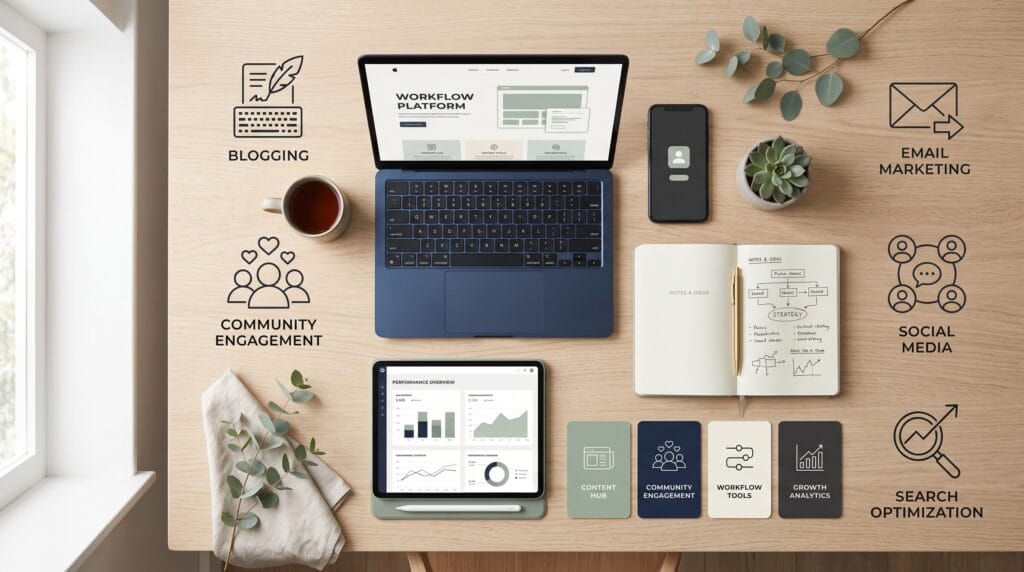
Learning how to promote digital products without a large advertising budget is one of the most useful skills a creator can develop. Fonts, templates, ebooks, printables, presets, mockups, courses, and digital downloads can all generate income, but only when the right people discover them. A strong product can still struggle if its marketing depends entirely on paid ads or occasional social media posts.
Low-budget marketing does not mean weak marketing. It means using time, positioning, content, customer relationships, and consistent promotion more strategically. Sellers who understand their audience can often build steady visibility through search, email, partnerships, useful content, and repeat customers.
The goal is not to appear everywhere. A better approach is to choose a few channels, create useful marketing assets, and repeat the process long enough to learn what attracts clicks and sales.
This guide explains how to promote digital products with practical strategies that work for independent creators, small businesses, designers, and online sellers.
Why You Do Not Need a Huge Budget to Promote Digital Products
Digital products have several marketing advantages. They can be demonstrated online, delivered instantly, shared globally, and updated without manufacturing new physical inventory.
Creators can market them through:
- Blog articles
- Search engines
- Social media
- Email newsletters
- Tutorials
- Video demonstrations
- Free samples
- Affiliate partnerships
- Online communities
- Customer referrals
Many of these channels require more consistency than money.
A small seller may not be able to compete with a large company’s advertising budget, but they can often compete through specialization. A product designed for a specific audience can be easier to explain and easier to market than a generic product meant for everyone.
For example, “social media templates” is broad. “Instagram templates for independent coffee shops” gives the seller a clearer audience, stronger keywords, and more focused promotional content.
Start With a Product People Understand
Before trying to promote digital products, make sure the offer is easy to understand.
Customers should immediately know:
- What the product is
- Who it is for
- What problem it solves
- What files are included
- How it is used
- What software is required
- What license is included
- What result they can expect
Confusing products are difficult to market because customers need too much explanation before buying.
A clear product promise is more effective than a long list of features.
Instead of saying:
“Includes 40 editable layouts in multiple formats.”
Try:
“Create a month of professional Instagram content for your beauty business without designing every post from scratch.”
The second version focuses on the result.
Define a Specific Target Customer
One of the least expensive ways to improve marketing is to become more specific.
Ask:
- Who needs this product most?
- What work are they trying to complete?
- What frustrates them?
- Which platforms do they use?
- What language do they use to describe the problem?
- What alternatives are they already using?
- What would make them trust the product?
A font creator might target wedding designers, logo designers, crafters, or small business owners. Each group may value different features.
Wedding designers may care about elegant alternates and invitations. Logo designers may care about licensing and distinctive letterforms. Crafters may need SVG compatibility and simple installation instructions.
The more clearly you define the customer, the easier it becomes to promote digital products with useful content and relevant examples.
Improve Your Product Listing Before Promoting It
Marketing brings visitors to the product page. The page must then convince them to buy.
A strong listing should include:
- A clear title
- Benefit-focused description
- High-quality previews
- Product contents
- File formats
- Software requirements
- Usage examples
- License information
- Frequently asked questions
- Simple purchase instructions
Use Strong Preview Images
Digital products cannot be examined physically, so previews carry much of the sales responsibility.
Show:
- The complete product
- Close-up details
- Before-and-after examples
- Realistic applications
- Included variations
- File organization
- How the product looks in use
A template product should show several finished layouts. A font should show uppercase, lowercase, numerals, ligatures, and realistic branding examples. A mockup should demonstrate how easily artwork can be replaced.
Strong previews make it easier to promote digital products because the marketing visuals already explain the value.
Use SEO to Promote Digital Products Long Term
Search engine optimization can attract visitors without paying for every click.
SEO begins with understanding what potential customers search for.
Useful keyword formats include:
- Best (product type) for (audience)
- (Product type) for beginners
- How to use (product type)
- (Style) font for logos
- Canva templates for (industry)
- Printable (product) for (occasion)
- Mockups for (design category)
- Digital planner for (specific need)
Use your main keyword naturally in:
- Product title
- Page URL
- Product description
- Image ALT text
- Headings
- Meta description
- Related blog posts
Avoid forcing the same phrase into every sentence. Write for clarity first.
Create Supporting Blog Content
Blog articles can attract people before they are ready to purchase.
A seller offering brand templates could publish:
- How to create consistent social media branding
- Best color palettes for small businesses
- What to include in a brand guideline
- Common logo presentation mistakes
- How to prepare a client brand package
Each article can naturally introduce the relevant product.
This creates a long-term system in which educational content helps promote digital products while also building trust.
Promote Digital Products With Helpful Tutorials
Tutorials are one of the most effective low-cost marketing tools because they show customers how the product solves a problem.
Tutorial formats include:
- Blog posts
- Short videos
- Screen recordings
- Carousels
- Email lessons
- Downloadable guides
- Live demonstrations
For example, a font creator could show how to install a font, access ligatures, create a logo, or combine the typeface with another font.
A Canva template seller could show how to change colors, replace photographs, and export a finished post.
Tutorials work because they reduce uncertainty. Customers can see that the product is practical, accessible, and relevant to their work.
Use Social Media Without Posting Everywhere
You do not need to promote on every platform. Choose the places where your target audience already spends time.
Different content types work well on different channels:
- Pinterest for searchable visual inspiration
- Instagram for portfolios, reels, and carousels
- TikTok for quick demonstrations
- YouTube for deeper tutorials
- LinkedIn for professional and B2B products
- Facebook groups for niche communities
Choose one primary platform and one supporting platform.
For example, a template creator may use Pinterest for long-term discovery and Instagram for community engagement. A course creator may use YouTube for tutorials and email for sales.
Consistency on two channels is usually more effective than irregular posting on six.
Turn One Product Into Multiple Content Ideas
Content creation becomes easier when one product supports several posts.
A font release could generate:
- A design process video
- A character preview carousel
- A font-pairing post
- A logo demonstration
- A licensing explanation
- A customer project
- A free sample
- A behind-the-scenes sketch
- A comparison of different styles
- A launch announcement
This approach helps you promote digital products without creating completely new marketing ideas every day.
One product can often provide several weeks of content.
Also Read: Marketing for Small Business How to Measure What Works
Build an Email List Early
Social platforms can change, but an email list gives sellers a direct way to reach interested customers.
Encourage visitors to subscribe by offering:
- A free sample
- Discount code
- Mini template
- Checklist
- Font pairing guide
- Prompt collection
- Printable
- Short email course
The free resource should connect naturally to the paid product.
For example, a seller offering a full logo template kit might provide one free logo presentation page. A font creator might offer a demo font or printable type specimen.
Use a Simple Welcome Sequence
A basic welcome sequence can include:
- Delivery of the free resource
- Helpful instructions
- A related tutorial
- The paid product
- A customer example
- A limited introductory offer
Email allows you to promote digital products repeatedly without depending entirely on algorithms.
Offer a Useful Free Sample
Free samples reduce purchase risk and give customers direct experience with the product.
Good samples include:
- One template from a larger pack
- A limited character font demo
- A small icon set
- One mockup
- A short ebook chapter
- A mini preset pack
- A printable worksheet
The sample should be useful on its own but clearly connected to the full product.
Do not make the free version so complete that customers have no reason to upgrade. At the same time, avoid offering something so limited that it creates a poor impression.
A strong sample demonstrates quality and encourages trust.
Use Customer Reviews and Social Proof
People are more comfortable buying when they see that others have used the product successfully.
Useful social proof includes:
- Customer reviews
- Ratings
- Testimonials
- Screenshots
- Finished projects
- Sales milestones
- Customer photographs
- Case studies
Ask customers for feedback after they have had enough time to use the product.
You might send a short message such as:
“Have you used the template yet? I would love to hear what worked well and see anything you created.”
Always request permission before sharing customer work publicly.
Social proof helps promote digital products because it replaces self-promotion with real evidence.
Partner With Small Creators
Partnerships can introduce your product to a relevant audience without requiring a large advertising budget.
Potential partners include:
- Bloggers
- YouTubers
- Newsletter writers
- Designers
- Coaches
- Small business educators
- Niche influencers
- Marketplace curators
Partnership ideas include:
- Product reviews
- Tutorials
- Bundle collaborations
- Guest posts
- Giveaways
- Affiliate commissions
- Shared email campaigns
A smaller creator with a focused audience may generate better results than a larger account with weak relevance.
Choose partners whose followers genuinely need the product.
Start a Simple Affiliate Program
Affiliate marketing allows other creators to earn a commission when they refer a sale.
This can be useful for:
- Courses
- Templates
- Fonts
- Ebooks
- Memberships
- Software resources
- Creative bundles
Provide affiliates with:
- Product information
- Preview images
- Example captions
- Tracking links
- Commission details
- Promotional guidelines
The product must already have a strong sales page. Affiliates can bring visitors, but they cannot fix a confusing offer.
Join Relevant Online Communities
Niche communities can help sellers understand customer needs and build relationships.
These may include:
- Facebook groups
- Reddit communities
- Design forums
- Discord groups
- Professional networks
- Marketplace communities
Avoid joining only to post links.
Instead:
- Answer questions
- Share helpful advice
- Review relevant tools
- Provide feedback
- Participate consistently
- Mention your product only when it solves the problem
Trust takes time. Helpful participation can eventually make it easier to promote digital products without sounding overly promotional.
Use Pinterest for Evergreen Discovery
Pinterest works more like a visual search engine than a traditional social feed. This makes it useful for products related to design, planning, education, weddings, home décor, crafts, and business.
Create pins that link to:
- Product pages
- Blog posts
- Tutorials
- Free resources
- Comparison guides
- Seasonal collections
Use clear titles and readable text on pin graphics.
A template seller might create pins such as:
- Instagram templates for coaches
- Minimal Canva templates for small businesses
- Social media branding ideas
- How to create a consistent Instagram feed
Each pin can lead readers toward the product.
Create Product Bundles
Bundles can make the offer feel more valuable while reducing the need to find new customers for every separate product.
Possible bundles include:
- Font family plus logo templates
- Social templates plus caption prompts
- Mockups plus brand presentation templates
- Planner plus printable stickers
- Ebook plus worksheets
- Presets plus editing guide
Bundles can also support seasonal promotions, launches, and collaborations.
Make sure the products solve related problems. Random collections may appear large but feel less useful.
Also Read: How to Promote a T-Shirt Business Without a Big Budget
Use Limited Promotions Carefully
Discounts can attract attention, but constant sales may train customers to wait for lower prices.
Useful promotional occasions include:
- Product launch
- Seasonal event
- Store anniversary
- Bundle release
- Customer appreciation campaign
- Short email promotion
Keep the deadline and terms clear.
Instead of discounting every product, consider adding a bonus, upgrade, or bundle. This can preserve the product’s value while still creating urgency.
Repurpose Customer Questions Into Marketing Content
Customer questions reveal what buyers need to understand.
Turn repeated questions into:
- FAQ sections
- Blog posts
- Social carousels
- Video tutorials
- Email content
- Product updates
Questions might include:
- How do I install this font?
- Can I use this template commercially?
- Does this work in Canva Free?
- Can I edit the colors?
- Which files are included?
- Is this compatible with my software?
Answering these questions publicly helps promote digital products while reducing customer support work.
Improve Customer Retention
Existing customers are often easier to reach than completely new buyers.
Encourage repeat purchases through:
- Product update emails
- Related recommendations
- Loyalty discounts
- Customer-only bundles
- New release previews
- Educational content
- Upgrade options
A font customer may later need matching monograms, ornaments, or an extended license. A template customer may need another collection for a different campaign.
Create logical product paths so customers know what to purchase next.
Track What Produces Sales
Low-budget marketing still needs measurement.
Track:
- Product page visits
- Conversion rate
- Email signups
- Email clicks
- Search traffic
- Social referrals
- Best-performing content
- Affiliate sales
- Repeat purchases
- Refund requests
Use simple tracking before investing in advanced systems.
Ask which channels bring people who actually purchase, not only people who like or view content.
A platform may generate high engagement but few sales. Another may bring fewer visitors with stronger buying intent.
Common Mistakes When Promoting Digital Products
1. Promoting Before Improving the Product Page
More traffic will not help if visitors cannot understand the offer.
2. Targeting Everyone
Broad marketing usually creates weak messaging. Choose a specific audience.
3. Posting Only Sales Messages
Educational and inspirational content often builds more trust than constant promotion.
4. Depending on One Platform
Build more than one source of discovery, such as SEO plus email.
5. Ignoring Customer Feedback
Reviews and questions can reveal opportunities to improve both the product and its marketing.
6. Giving Up Too Quickly
Search, content, and email marketing require consistency. Results may grow gradually.
7. Copying Competitors
Study the market, but create a distinct position, visual style, and product promise.
A Simple Low-Budget Promotion Plan
Use this weekly plan to promote digital products consistently:
Monday
Publish one useful social post connected to the product.
Tuesday
Improve one product image, description, or FAQ.
Wednesday
Create one Pinterest pin or short tutorial.
Thursday
Send a helpful email or prepare one for your next campaign.
Friday
Contact one potential partner or customer.
Weekend
Review traffic, clicks, sales, and customer questions.
This simple routine helps maintain momentum without requiring constant promotion.
Digital Product Promotion Checklist
Before launching a campaign, confirm that:
- The target customer is clear.
- The product solves a specific problem.
- The title explains what the product is.
- Preview images show important features.
- The description focuses on benefits.
- File formats are clearly listed.
- License terms are easy to understand.
- The product page works on mobile.
- A free sample or lead magnet is available.
- Email follow-up is prepared.
- Supporting content is ready.
- Tracking links are working.
- Customer questions are answered.
- The promotional schedule is realistic.
Also Read: Passive Income Ideas for New and Experienced Entrepreneurs
Final Thoughts on Promote Digital Products
You do not need a large advertising budget to promote digital products successfully. Clear positioning, useful content, strong previews, SEO, email marketing, customer proof, and relevant partnerships can create consistent visibility over time.
Start by improving the product page and defining one specific customer. Then select a small number of channels where that customer already spends time.
Create tutorials, answer common questions, offer a useful sample, and build an email list. Reuse each product across several content formats rather than constantly creating new offers.
The most effective low-budget marketing is consistent, helpful, and focused. By using these strategies to promote digital products, sellers and creators can build trust, attract qualified customers, and grow sales without depending entirely on paid advertising.
For high-quality fonts to boost your income, check out Letter Crafted. Our professional fonts are perfect for branding, marketing, and content creation. So, don’t miss this opportunity.