
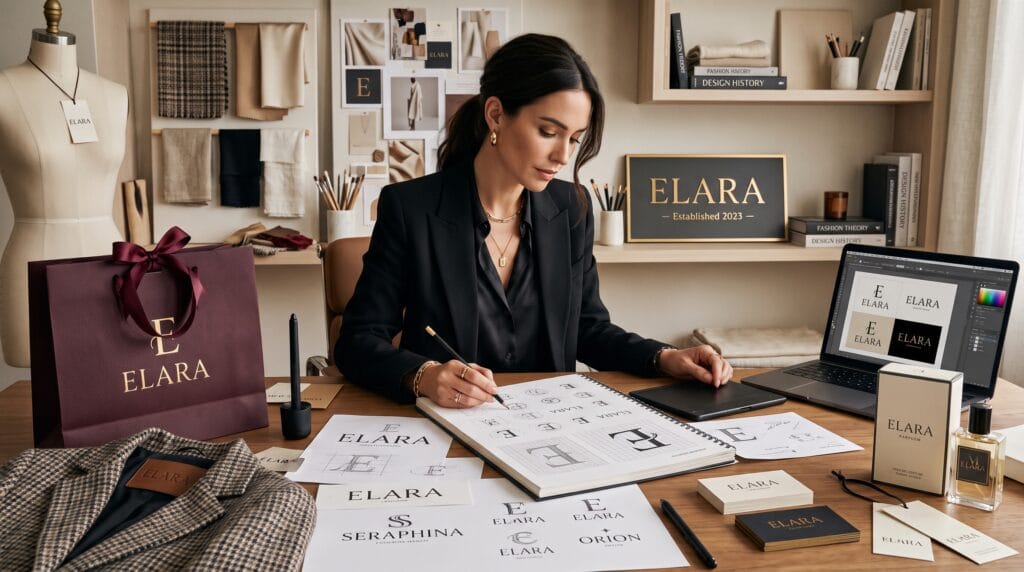
A successful fashion logo design gives a clothing brand a recognizable identity and communicates its personality before customers explore the collection. It appears on garment labels, packaging, websites, shopping bags, social media, advertisements, and storefronts. Because the logo must work across many applications, it needs to be distinctive, flexible, and easy to recognize.
Fashion businesses operate in a visually competitive market. Many brands use similar serif wordmarks, minimalist monograms, or handwritten signatures. Following familiar styles can help customers understand the brand category, but copying competitors too closely may make a new label feel generic.
The strongest fashion logo design begins with strategy rather than decoration. Designers must understand the customer, product category, price level, personality, and long-term direction of the brand. This guide explains how to create a fashion logo that stands out while remaining practical across clothing, packaging, digital platforms, and future collections.
Why Fashion Logo Design Matters
A fashion logo is often one of the first details customers notice. It can influence whether a brand feels premium, casual, experimental, sustainable, traditional, or trend-focused.
Strong fashion logo design can help a business:
- Build visual recognition
- Communicate its market position
- Differentiate itself from competitors
- Create consistency across collections
- Strengthen packaging and labels
- Improve social media presentation
- Support premium pricing
- Build customer trust
- Create a professional storefront
- Remain memorable after purchase
A logo cannot carry the entire brand alone. It should work with photography, typography, colors, packaging, styling, and brand voice. However, it provides an important visual foundation for the complete identity.
Start Fashion Logo Design With Brand Strategy
Before drawing symbols or choosing fonts, define what the fashion brand represents.
Ask:
- Who is the ideal customer?
- What type of clothing or accessories does the brand sell?
- Is the brand affordable, premium, or luxury?
- Does it focus on streetwear, formalwear, activewear, modest fashion, or handmade products?
- What makes the collection different?
- Which emotions should the identity communicate?
- Where will customers see the logo most often?
- How might the brand expand in the future?
A luxury eveningwear label may need an elegant and restrained identity. A youth streetwear business may prefer bold lettering, strong contrast, and an adaptable symbol. A sustainable clothing company could use a calm, contemporary identity without relying on predictable leaf imagery.
Clear positioning helps every fashion logo design decision feel intentional.
Research Competing Fashion Brands
Competitor research helps designers identify common patterns and opportunities for differentiation.
Review competing brands and document:
- Logo styles
- Typeface categories
- Monograms
- Color palettes
- Symbol choices
- Packaging
- Clothing labels
- Website headers
- Social profile icons
Look for repeated visual conventions. Luxury labels often use high-contrast serif typography or widely spaced capitals. Streetwear brands may use condensed lettering, bold sans serif fonts, custom scripts, or graphic symbols.
The goal is not to reject every industry convention. Familiar visual cues can help customers understand the brand. The challenge is finding a distinctive detail that prevents the fashion logo design from becoming interchangeable with competitors.
Choose the Right Fashion Logo Style
Different logo formats suit different fashion businesses.
Wordmark Fashion Logo Design
A wordmark uses the brand name as the complete logo. This is one of the most popular approaches in fashion because it builds name recognition.
Wordmarks work well for:
- Designer labels
- Boutiques
- Clothing brands
- Accessories
- Beauty and fashion businesses
- Online stores
A successful wordmark depends on typography, spacing, and custom details. Even a simple name can feel distinctive when letterforms are refined carefully.
Monogram Fashion Logo Design
A monogram combines one or more initials into a compact symbol.
Monograms are useful for:
- Garment labels
- Buttons
- Embroidery
- Zippers
- Social avatars
- Pattern systems
- Packaging seals
A monogram should remain readable and balanced. Avoid forcing letters together in ways that create awkward shapes or confusing negative spaces.
Symbol and Wordmark Combination
A combination logo includes a brand name and a separate icon.
The full version may appear on websites and packaging, while the symbol can be used for smaller applications.
This approach gives the fashion logo design more flexibility as the brand grows.
Signature Logo
A handwritten or signature-style logo can communicate individuality, creativity, or personal craftsmanship.
It works well for:
- Personal designer labels
- Bridal brands
- Handmade accessories
- Fashion illustrators
- Boutique collections
The lettering must remain readable. An overly complex signature can become unclear when embroidered or printed at a small size.
Emblem and Badge Logo
Emblems place text and symbols inside a structured shape.
They can suit:
- Heritage brands
- Outdoor clothing
- Workwear
- Vintage fashion
- Athletic labels
- Community-focused brands
Keep the internal details simple enough for clothing tags and small merchandise applications.
Typography for Fashion Logo Design
Typography often becomes the central feature of a fashion identity.
A typeface can make the brand feel:
- Refined
- Modern
- Rebellious
- Romantic
- Minimal
- Athletic
- Experimental
- Handmade
Serif Fonts for Luxury and Heritage
Serif typography can communicate elegance, editorial quality, and tradition.
High-contrast serifs often suit luxury fashion, while sturdier serif designs may support heritage or handcrafted brands.
Sans Serif Fonts for Modern Fashion
Sans serif fonts can feel clean, direct, and adaptable.
Geometric styles may suit contemporary labels, while condensed sans serif fonts can create a stronger streetwear or editorial effect.
Script Fonts for Personal Style
Script fonts communicate movement and individuality. Use them carefully because decorative forms may be difficult to reproduce on small labels.
Customize the Lettering
A standard font can be a starting point, but custom adjustments make the fashion logo design more distinctive.
Consider modifying:
- Letter spacing
- Selected terminals
- Crossbars
- Ligatures
- Character width
- Baseline
- Capitalization
- One memorable letter
Do not modify every character. One or two recognizable details are often enough.
Also Read: Ecommerce Logo Design That Make Your Brand Look Professional
Build a Distinctive Fashion Monogram
Monograms can become powerful brand assets when they are simple and recognizable.
Start by sketching the initials in several arrangements:
- Overlapping
- Interlocking
- Mirrored
- Stacked
- Enclosed in a frame
- Sharing one stroke
- Built from negative space
Evaluate whether the design remains clear without the full brand name.
The monogram should work in:
- One color
- Embroidery
- Foil stamping
- Small labels
- Metal accessories
- Social profile images
- Repeating patterns
A detailed monogram may look impressive at large size but fail during production. Practical testing is essential.
Select a Fashion Brand Color Palette
Many fashion logos are designed primarily in black and white because these colors work across clothing, labels, packaging, and photography.
However, a broader color system can help the identity feel more distinctive.
Black and White
This timeless combination feels flexible, confident, and editorial. It works well for luxury, minimalist, and contemporary labels.
Neutral Earth Tones
Beige, brown, cream, olive, and charcoal can suit sustainable fashion, natural textiles, handmade clothing, and relaxed lifestyle brands.
Bold High-Contrast Colors
Red, electric blue, neon green, or bright orange can support streetwear, sportswear, youth fashion, and experimental brands.
Soft Romantic Colors
Blush, burgundy, lavender, cream, and muted gold can suit bridal collections, feminine fashion, accessories, and boutique labels.
The logo must still work in one color. A strong fashion logo design should not depend entirely on its palette for recognition.
Keep Fashion Logo Design Simple and Scalable
Fashion logos appear at dramatically different sizes. A logo may fill a storefront sign or appear as a tiny mark inside a garment.
Test the logo on:
- Woven labels
- Printed neck labels
- Buttons
- Embroidery
- Zippers
- Website headers
- Mobile screens
- Social avatars
- Business cards
- Shopping bags
Fine lines, small text, and intricate illustrations may disappear during embroidery or small-scale printing.
Create simplified versions when necessary. The primary logo can include the full name, while a compact symbol or monogram can handle smaller applications.
Create a Responsive Fashion Logo System
One logo arrangement rarely works everywhere.
A flexible system may include:
- Primary horizontal logo
- Secondary stacked logo
- Monogram
- Compact symbol
- Small-size wordmark
- Black version
- White version
- Seasonal color variation
This system allows the identity to adapt without losing consistency.
For example, the complete fashion logo design might appear on a website, while the monogram appears on buttons and social media. A simplified wordmark may work better on a narrow garment label.
Document when each variation should be used.
Test the Logo on Clothing and Packaging
Mockups help designers understand how the logo behaves in realistic settings.
Test it on:
- T-shirts
- Hoodies
- Jackets
- Dresses
- Caps
- Tote bags
- Shoe boxes
- Hang tags
- Tissue paper
- Shopping bags
- Mailing boxes
Pay attention to scale, materials, and production methods.
A thin serif logo may look elegant on a website but become difficult to embroider. A large symbol may work on a hoodie but feel excessive on a luxury garment label.
Mockups should support practical evaluation, not simply make the project look attractive.
Also Read: 3D Logo Design Trends and Examples That Stand Out
Fashion Logo Design for Digital Platforms
Fashion brands rely heavily on websites and social media. The logo must remain clear in digital environments.
Test it as:
- Instagram profile image
- Website favicon
- Mobile header
- Email logo
- Online store banner
- Video watermark
- Digital advertisement
A horizontal wordmark may become unreadable inside a circular profile image. This is why a compact monogram or symbol is valuable.
The digital version of a fashion logo design should load quickly, remain sharp, and provide sufficient contrast against different backgrounds.
Add Personality Without Following Every Trend
Fashion branding changes quickly, but the main logo should have enough longevity to support several collections.
Trends such as stretched typography, unusual serifs, retro scripts, distortion, and experimental letter spacing can create fresh concepts. However, using a trend without strategic relevance may cause the identity to feel outdated quickly.
Use trends as inspiration rather than complete solutions.
Ask:
- Does this style match the brand personality?
- Will customers still recognize it in several years?
- Can it work across production methods?
- Is the design different from current competitors?
- Can the brand grow without replacing it?
A timeless foundation can still support more experimental seasonal campaigns.
Common Fashion Logo Design Mistakes
1. Copying Luxury Brand Wordmarks
Using a similar high-contrast serif and wide spacing does not automatically create luxury. The result may feel generic.
2. Using Too Many Details
Complex symbols and decorative lettering often fail on garment labels and embroidery.
3. Ignoring the Target Customer
The designer’s personal taste should not replace audience research.
4. Choosing an Unlicensed Font
Confirm that the typeface license permits logo, commercial, web, packaging, and merchandise use.
5. Depending Only on Mockups
Show the logo clearly on plain backgrounds so clients can evaluate its actual construction.
6. Skipping Black-and-White Testing
The logo should remain recognizable without color.
7. Creating Only One Version
A complete identity needs responsive variations for different spaces.
8. Ignoring Production Limitations
Always consider printing, embroidery, engraving, weaving, and foil stamping before final approval.
Helpful Fashion Logo Design Tools
Several tools can support the design process.
1. Adobe Illustrator
Useful for vector logo construction, custom lettering, monograms, and production-ready files.
2. Affinity Designer
A strong alternative for professional vector design and logo development.
3. Figma
Helpful for collaborative exploration, brand presentations, and digital applications.
4. Procreate
Useful for sketching, custom lettering, signature concepts, and hand-drawn symbols.
5. Canva
Practical for early mood boards, simple concept testing, social previews, and brand presentation templates.
6. Adobe Photoshop
Useful for garment, packaging, and retail mockups.
The tool matters less than the quality of the concept, construction, and testing.
Fashion Logo Design Checklist
Before approving the final logo, confirm that it:
- Reflects the brand strategy
- Appeals to the target customer
- Looks different from competitors
- Remains readable at small sizes
- Works in black and white
- Includes responsive variations
- Performs well on garment labels
- Can be embroidered or printed
- Works on websites and social media
- Uses licensed fonts and assets
- Includes organized vector files
- Supports future collections
- Has clear usage guidelines
- Feels memorable without being overly complex
Also Read: Startup Logo Ideas for Payments Apps: Simple and Secure
Final Thoughts on Fashion Logo Design
A strong fashion logo design combines brand strategy, typography, simplicity, flexibility, and production awareness. It should communicate the personality of the clothing label while remaining recognizable across garments, packaging, websites, advertisements, and social media.
Begin by understanding the customer and market position. Then explore wordmarks, monograms, symbols, signatures, or emblems that match the brand’s direction. Refine the typography, test the design in one color, and create several responsive versions.
Avoid copying familiar luxury identities or following trends without purpose. The best logo is not necessarily the most decorative option. It is the one that customers can recognize, the brand can reproduce reliably, and the business can continue using as it grows.
By approaching fashion logo design as part of a complete visual system, designers can create identities that stand out, support stronger branding, and remain useful across future fashion collections.
For high-quality fonts to boost your income, check out Letter Crafted. Our professional fonts are perfect for branding, marketing, and content creation. So, don’t miss this opportunity.