
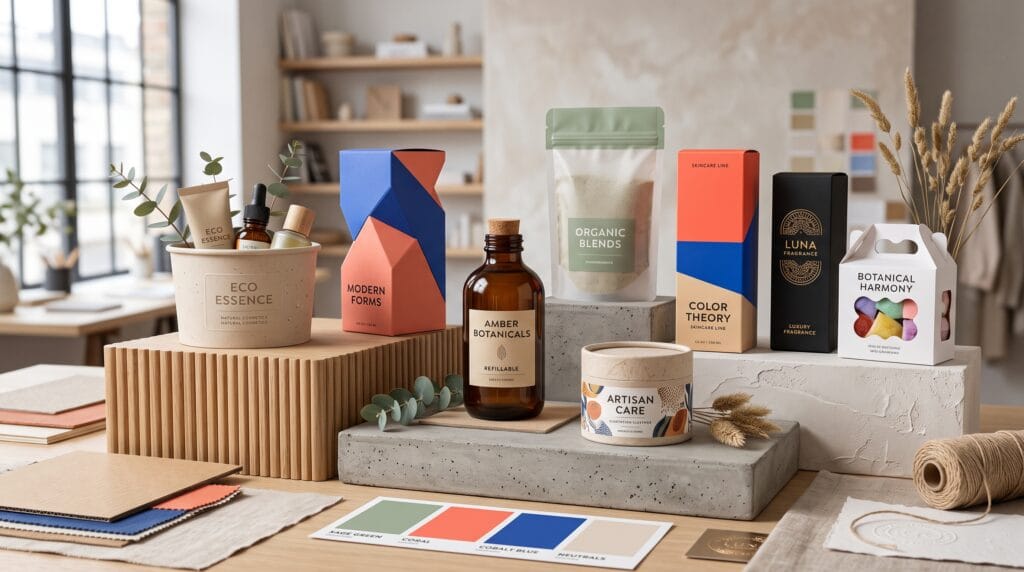
Creative product packaging trends are changing how brands attract attention, communicate value, and build memorable customer experiences. Packaging is no longer viewed only as a protective container. It has become an important branding tool that can influence purchasing decisions, improve product recognition, and create stronger emotional connections with customers.
From minimalist layouts and bold typography to sustainable materials and interactive digital features, modern packaging combines visual appeal with function. Designers must now consider how a package looks on a retail shelf, appears in an ecommerce thumbnail, performs during shipping, and feels during an unboxing experience.
Understanding creative product packaging trends helps designers, creators, and brand owners develop packaging that feels current without losing clarity or long-term relevance. The most effective trends are not simply decorative. They improve communication, support the brand story, and help customers understand why a product deserves their attention.
Why Creative Product Packaging Trends Matter
Customers often encounter packaging before they experience the product itself. A well-designed package can immediately communicate quality, purpose, personality, and price positioning.
Studying creative product packaging trends helps creative professionals:
- Improve shelf visibility
- Strengthen brand recognition
- Communicate product benefits
- Create memorable unboxing moments
- Support premium positioning
- Differentiate products from competitors
- Adapt packaging for online retail
- Explore sustainable production methods
Packaging trends also reflect changes in customer expectations. Today’s buyers often value transparency, convenience, environmental responsibility, and meaningful storytelling.
However, designers should avoid following trends without strategy. A packaging concept should always suit the product, audience, materials, production method, and brand identity.
1. Minimalist Creative Product Packaging Trends
Minimalism remains one of the strongest approaches in contemporary packaging. It reduces visual clutter and directs attention toward essential information.
Minimalist packaging often includes:
- Generous negative space
- Limited color palettes
- Simple typography
- Small logos
- Clear product names
- Restrained illustration
- Structured layouts
This style works especially well for skincare, food, wellness, technology, and luxury products.
Why Minimal Packaging Works
A clean package can feel confident because it does not need excessive decoration to attract attention. Minimal layouts also make product details easier to scan.
When applying minimalist creative product packaging trends, every element should have a clear purpose. Removing unnecessary content can strengthen hierarchy, but designers must still ensure the brand feels distinctive.
Minimalism should not mean generic. Custom typography, thoughtful color choices, unusual materials, or a recognizable symbol can give simple packaging a unique identity.
2. Bold Typography Packaging Trends
Typography is becoming a primary visual feature rather than a supporting detail.
Modern packaging frequently uses:
- Oversized product names
- Condensed fonts
- Custom lettering
- High-contrast type
- Rotated text
- Variable fonts
- Expressive wordmarks
- Typography that wraps around the package
Bold lettering can make products easier to recognize from a distance or in small online images.
Using Type to Build Personality
Typography can communicate whether a product feels playful, natural, clinical, luxurious, handmade, or experimental.
For example, a clean sans-serif may suit a modern skincare line, while expressive lettering may help an artisan beverage feel more approachable.
Typography-focused creative product packaging trends work best when readability remains strong. Designers should test labels at actual size and avoid complex fonts for ingredients, instructions, or legal information.
3. Sustainable Creative Product Packaging Trends
Environmental responsibility is now a major influence on packaging decisions.
Sustainable approaches may involve:
- Recycled paper
- Compostable materials
- Refillable containers
- Reduced plastic
- Lightweight structures
- Water-based inks
- Reusable packaging
- Smaller shipping formats
Sustainable packaging is not only about using green colors or leaf symbols. It requires genuine changes to materials, construction, printing, or the product lifecycle.
Communicating Sustainability Clearly
Customers should be able to understand how to reuse, recycle, or dispose of the package.
Designers can support this through:
- Simple recycling instructions
- Material labels
- Clear sustainability claims
- QR codes for additional information
- Reduced printed decoration
- Honest messaging
The strongest sustainable creative product packaging trends combine environmental responsibility with attractive and practical design.
4. Tactile and Textured Packaging Design
Digital shopping has increased interest in packaging that feels special when customers receive it.
Tactile design may use:
- Embossing
- Debossing
- Soft-touch coatings
- Uncoated paper
- Textured labels
- Raised varnish
- Foil stamping
- Die-cut surfaces
Texture creates a physical experience that cannot be fully communicated through a screen.
Creating Premium Sensory Experiences
Tactile features can make simple packaging feel more valuable. A minimal box with embossed lettering may feel more luxurious than a heavily printed design.
Designers should use special finishes carefully because they can increase production costs and affect recyclability.
Among modern creative product packaging trends, tactile details work best when they reinforce the product positioning rather than being added only for decoration.
5. Transparent Packaging Trends
Transparency helps customers see the actual product and can build trust.
This approach is common in:
- Food packaging
- Beauty products
- Household goods
- Toys
- Artisan products
- Fashion accessories
Transparent windows can reveal freshness, texture, color, or quantity.
Balancing Visibility and Branding
A transparent section should be integrated into the layout instead of feeling like an empty gap.
Designers can use unusual window shapes, partial sleeves, clear labels, or printed patterns to combine product visibility with strong branding.
Transparent creative product packaging trends are especially useful when the appearance of the product is an important selling point.
Also Read: Creative Packaging Design Examples for Better Branding
6. Illustration-Based Product Packaging
Custom illustration helps brands create distinctive visual stories.
Popular approaches include:
- Hand-drawn characters
- Botanical illustrations
- Editorial artwork
- Abstract patterns
- Line drawings
- Collage
- Vintage-inspired graphics
- Product storytelling scenes
Illustration can make complex ideas easier to understand and help small brands compete with larger companies.
Building a Consistent Illustration System
A professional illustration system should define:
- Color palette
- Line thickness
- Shape language
- Texture
- Character style
- Level of detail
- Composition rules
Illustration-led creative product packaging trends are especially effective for food, beverages, cosmetics, children’s products, and lifestyle brands.
7. Retro and Nostalgic Packaging Trends
Retro design continues to influence product packaging because it creates familiarity and emotional connection.
Popular references include:
- Mid-century labels
- 1970s typography
- Vintage grocery packaging
- 1980s color palettes
- 1990s graphics
- Traditional badges
- Halftone textures
- Hand-painted signs
Nostalgia can help new products feel established or familiar.
Modernizing Vintage Inspiration
Designers should adapt retro references rather than copying old packaging directly.
A successful concept may combine vintage typography with modern materials, clean information hierarchy, and contemporary production standards.
Retro creative product packaging trends work particularly well for snacks, beverages, coffee, grooming products, and limited-edition collections.
8. Interactive Creative Product Packaging Trends
Packaging can now connect physical products with digital experiences.
Interactive features include:
- QR codes
- Augmented reality
- Product tutorials
- Ingredient information
- Loyalty programs
- Digital games
- Personalized messages
- Traceability tools
These features allow brands to provide more information without overcrowding the printed package.
Designing Useful Interactions
A QR code should have a clear purpose. Customers are more likely to scan it when the package explains what they will receive.
Examples include:
- Watch the product tutorial
- Meet the maker
- Verify authenticity
- Explore recipes
- Unlock a discount
- Learn how to recycle
Interactive creative product packaging trends become valuable when they improve customer experience rather than functioning as a temporary novelty.
9. Personalized Packaging Design
Personalization helps products feel more relevant and collectible.
Brands can personalize packaging through:
- Customer names
- Regional graphics
- Limited-edition colors
- Seasonal messages
- Variable illustrations
- Personalized labels
- Numbered collections
- Custom gift packaging
Digital printing makes it easier to produce multiple versions without changing the complete manufacturing process.
Encouraging Social Sharing
Personalized packaging often creates stronger social media engagement because customers enjoy sharing products that feel unique.
This approach works well for gifts, beverages, beauty products, subscription boxes, and event-based campaigns.
Personalization is one of the most engaging creative product packaging trends, but it should still maintain a recognizable brand system.
10. Unconventional Packaging Structures
Structural innovation can make a product stand out before any graphics are added.
Creative structures may include:
- Unusual opening systems
- Modular boxes
- Reusable containers
- Foldable displays
- Transformable packaging
- Geometric cartons
- Multi-purpose packages
- Compact shipping designs
A distinctive shape can improve product recognition and create a memorable unboxing experience.
Function Must Come First
Unusual structures should remain easy to manufacture, transport, open, store, and recycle.
A package that looks impressive but frustrates customers may damage the brand experience.
Structural creative product packaging trends should balance originality with usability and production efficiency.
11. Color-Coded Product Systems
Brands with multiple products need visual systems that help customers identify categories quickly.
Color coding can distinguish:
- Flavors
- Ingredients
- Product strengths
- Sizes
- Skin types
- Fragrances
- Product families
The system should be consistent enough to build recognition but flexible enough to support future products.
Improving Product Navigation
A skincare company might use blue for hydration, green for calming, and orange for brightening. A food brand could assign different colors to each flavor.
Color-coded creative product packaging trends improve shelf navigation while creating a cohesive product family.
Designers should also consider accessibility and avoid relying only on color to communicate essential differences.
Also Read: Luxury Packaging Design for Better Marketing Results
12. Packaging Designed for Ecommerce
Ecommerce has changed how packaging is designed and evaluated.
Products must now perform well:
- In small thumbnails
- On mobile screens
- During shipping
- In unboxing videos
- In customer photos
- On social media
A package may need a stronger logo, simpler composition, or more recognizable color system to remain clear online.
Creating Better Unboxing Experiences
Ecommerce packaging can include:
- Branded tissue paper
- Interior messages
- Insert cards
- Product instructions
- Reusable storage
- Easy-return features
- Personalized notes
Ecommerce-focused creative product packaging trends combine protection, brand recognition, and shareable presentation.
13. Honest and Transparent Brand Messaging
Customers increasingly expect brands to communicate clearly.
Modern packaging often highlights:
- Ingredient origins
- Product benefits
- Manufacturing methods
- Certifications
- Environmental impact
- Usage instructions
- Brand values
Clear language can build trust more effectively than exaggerated marketing claims.
Simplifying Product Information
Designers should work with writers and brand teams to prioritize essential content.
A strong hierarchy might present information in this order:
- Brand name
- Product name
- Primary benefit
- Key ingredient
- Supporting details
- Instructions and legal information
Transparent messaging supports many creative product packaging trends because it combines visual design with customer trust.
How to Apply Creative Product Packaging Trends
Before using a trend, evaluate whether it suits the project.
Ask:
- Does it support the brand personality?
- Is it appropriate for the target customer?
- Can it be manufactured affordably?
- Does it improve communication?
- Will it remain practical during shipping?
- Is it accessible?
- Can it scale across a product family?
- Does it support environmental goals?
- Will it look effective online and offline?
Designers should use trends selectively. Combining too many ideas can weaken clarity and make packaging feel temporary.
Common Packaging Design Mistakes
Avoid these frequent problems:
- Following trends without strategy
- Using too many fonts
- Weak product hierarchy
- Poor contrast
- Overcrowded labels
- Generic illustrations
- Unclear sustainability claims
- Complicated opening systems
- Tiny legal information
- Inconsistent product variations
- Ignoring ecommerce thumbnails
- Forgetting print and manufacturing limits
Strong packaging should communicate quickly and function reliably.
Best Tools for Creative Product Packaging Trends
1. Adobe Illustrator
Adobe Illustrator is widely used for creating packaging layouts, labels, logos, illustrations, and production-ready vector artwork.
Best for:
- Dielines
- Label design
- Typography
- Vector illustration
- Print preparation
2. Adobe Photoshop
Adobe Photoshop helps designers edit product photography, create textures, and produce realistic packaging mockups.
Best for:
- Image editing
- Mockups
- Material textures
- Product presentations
- Campaign visuals
3. Adobe InDesign
Adobe InDesign is useful for packaging guidelines, product catalogs, and layouts containing large amounts of structured text.
Best for:
- Brand guidelines
- Packaging manuals
- Multi-page presentations
- Product catalogs
- Print documents
4. Figma
Figma allows teams to collaborate on brand systems, concept boards, and packaging presentations.
Best for:
- Team reviews
- Brand systems
- Concept exploration
- Client presentations
- Digital packaging extensions
5. Canva
Canva is helpful for simple labels, concept presentations, social media graphics, and branded inserts.
Best for:
- Beginners
- Small businesses
- Quick label concepts
- Marketing assets
- Insert cards
6. Esko Studio
Esko Studio is designed for realistic three-dimensional packaging visualization and professional preproduction workflows.
Best for:
- 3D package previews
- Label positioning
- Structural visualization
- Client approval
- Production checking
7. ArtiosCAD
ArtiosCAD supports structural packaging design, carton development, and dieline engineering.
Best for:
- Folding cartons
- Box construction
- Structural prototypes
- Manufacturing preparation
- Production files
8. Blender
Blender is a free tool for three-dimensional modeling, rendering, and packaging animation.
Best for:
- Product renders
- Ecommerce visuals
- Packaging animation
- Concept visualization
- Promotional content
9. Procreate
Procreate is useful for developing hand-drawn illustrations, lettering, textures, and packaging artwork.
Best for:
- Custom illustration
- Hand lettering
- Sketching
- Texture creation
- Early concepts
10. Coolors
Coolors helps designers generate, compare, and organize color palettes for product families.
Best for:
- Color-coded packaging
- Brand palettes
- Product variations
- Palette exploration
- Visual consistency
A Practical Packaging Design Workflow
Follow this process when exploring new packaging ideas:
- Research the target market.
- Study competitor packaging.
- Clarify brand positioning.
- Define the information hierarchy.
- Select appropriate trends.
- Explore structural options.
- Build typography and color systems.
- Create initial layouts.
- Apply the design to dielines.
- Produce realistic mockups.
- Test physical prototypes.
- Review readability and usability.
- Confirm print requirements.
- Evaluate sustainability.
- Prepare production-ready files.
This process helps designers transform inspiration into packaging that can perform successfully in real-world conditions.
Also Read: 12 Most Sustainable Packaging Materials for a Greener Future
Final Thoughts on Creative Product Packaging Trends
Creative product packaging trends show that successful packaging requires more than attractive graphics. Strong design combines visual hierarchy, clear messaging, memorable branding, useful structure, and thoughtful material choices.
Minimal layouts can improve clarity, bold typography can increase shelf visibility, and custom illustrations can create a distinctive personality. Sustainable materials, interactive features, personalized designs, and ecommerce-focused packaging also offer new ways to connect with customers.
However, trends should always support the product rather than distract from it. Designers must consider manufacturing, shipping, accessibility, sustainability, and long-term brand consistency.
By applying creative product packaging trends strategically, creators can develop packaging that looks contemporary while remaining practical, recognizable, and meaningful. The strongest packaging does not simply follow what is popular. It transforms useful ideas into a complete brand experience that customers can see, understand, remember, and enjoy.
For high-quality fonts to boost your income, check out Letter Crafted. Our professional fonts are perfect for branding, marketing, and content creation. So, don’t miss this opportunity.