
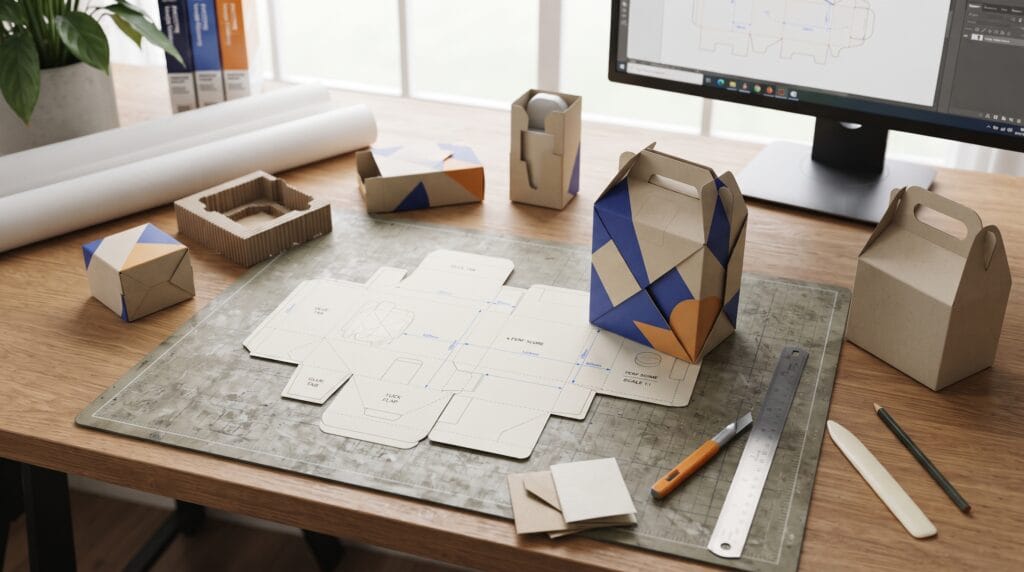
Packaging structure design determines how a package protects, contains, presents, stores, transports, and delivers a product. While graphics attract attention, the physical structure determines whether the package actually works. A beautiful box can still create a poor customer experience if it is difficult to open, wastes material, damages easily, or fails to hold the product securely.
For packaging designers, structure should be considered from the beginning of the project rather than after the visual identity is complete.
A package may need to:
- Protect the product
- Prevent movement
- Survive transportation
- Stack efficiently
- Open easily
- Close securely
- Display well
- Use materials efficiently
- Support branding
- Reduce waste
Strong packaging structure design balances these requirements while remaining realistic to manufacture.
The best structure is not always the most complicated one.
Often, a simple solution with thoughtful folds, tabs, dimensions, and material choices performs better than an elaborate package with unnecessary parts.
Why Packaging Structure Design Matters
Packaging structure affects almost every stage of the product journey.
It influences:
- Manufacturing
- Assembly
- Shipping
- Warehousing
- Retail display
- Customer use
- Disposal
If the structure is inefficient, costs can increase quickly.
A box that is slightly too large may require more:
- Board
- Shipping space
- Filling material
- Storage space
Likewise, weak structural decisions may lead to damaged products or poor presentation.
Good packaging structure design considers the complete lifecycle of the package instead of focusing only on how it looks when photographed.
Start Packaging Structure Design With the Product
Before designing a box, study the product carefully.
Measure:
- Width
- Height
- Depth
- Weight
- Shape
Also consider whether the product is:
- Fragile
- Flexible
- Heavy
- Sharp
- Moisture-sensitive
- Easily scratched
A glass bottle requires different structural support from a folded shirt.
A small electronic device may require precise inserts.
A food product may have additional barrier or hygiene requirements.
The structure should respond directly to the needs of the product.
Define the Function Before Choosing the Structure
Ask what the package needs to accomplish.
Possible functions include:
- Retail display
- Ecommerce shipping
- Gift presentation
- Product protection
- Refill storage
- Sample packaging
- Multi-product organization
A retail carton may prioritize shelf efficiency and visual presentation.
An ecommerce package may prioritize shipping strength and protection.
A gift box may focus more heavily on opening experience.
Clear functional priorities make packaging structure design easier because they reduce unnecessary options.
Choose the Right Packaging Structure
Common structural formats include:
Folding Cartons
Folding cartons are useful for:
- Beauty products
- Food
- Supplements
- Small electronics
- Personal care
They are often lightweight and efficient to ship flat before assembly.
Corrugated Boxes
Corrugated structures provide stronger protection.
They work well for:
- Ecommerce
- Shipping
- Heavy products
- Product sets
Rigid Boxes
Rigid boxes provide a more premium presentation.
They are commonly used for:
- Luxury products
- Gifts
- Electronics
- Premium accessories
Sleeves
Sleeves can wrap around:
- Trays
- Boxes
- Bottles
- Product bundles
They may provide branding without requiring a complete secondary box.
The best packaging structure design format depends on the product, budget, shipping method, and customer experience.
Packaging Structure Design and Material Selection
The structure and material should be developed together.
Different materials behave differently when:
- Folded
- Creased
- Cut
- Printed
- Glued
Common options include:
- Paperboard
- Corrugated board
- Kraft board
- Recycled board
- Rigid chipboard
Material thickness affects structural strength.
A heavier product may require thicker board or reinforced construction.
However, increasing thickness unnecessarily can increase cost and material use.
Select materials based on actual performance requirements.
Understand Grain Direction
Paperboard has a grain direction created during manufacturing.
This can influence how the material:
- Folds
- Curves
- Cracks
- Maintains shape
Ignoring grain direction may cause poorly formed folds or visible cracking.
For professional packaging structure design, work with production partners to understand how the chosen stock behaves before finalizing the dieline.
Material testing is especially important when using:
- Thick board
- Specialty paper
- Laminated stock
- Recycled material
Packaging Structure Design With Dielines
A dieline represents the flat structure before the package is assembled.
It usually includes:
- Cut lines
- Fold lines
- Glue areas
- Tabs
- Flaps
The dieline becomes the foundation for both structural development and graphic artwork.
Designers should clearly distinguish between:
- Cut: Material is separated.
- Fold: Material remains connected but bends.
- Glue: Surface is used for assembly.
Errors in the dieline can cause serious production problems.
Always review dimensions before creating final artwork.
Design Tabs and Closures Carefully
Tabs help packages:
- Close
- Lock
- Connect
- Maintain shape
Common closure solutions include:
- Tuck flaps
- Lock tabs
- Snap locks
- Friction closures
- Adhesive closures
The closure should match how often the package will be opened.
A disposable retail carton may only need to open once.
A reusable box should survive repeated opening and closing.
Small changes to tabs can significantly affect usability.
This is why functional testing is essential in packaging structure design.
Also Read: 12 Most Sustainable Packaging Materials for a Greener Future
Use Inserts for Better Product Protection
Inserts keep products positioned correctly inside the package.
They may be made from:
- Folded paperboard
- Corrugated board
- Molded pulp
- Foam
- Other protective materials
An insert can prevent:
- Movement
- Scratching
- Impact damage
- Misalignment
It can also improve presentation.
For example, a product held neatly in the center of a box can feel more premium than one moving freely inside.
However, unnecessary inserts increase:
- Material use
- Cost
- Assembly time
Use them only when they provide real value.
Packaging Structure Design for Easy Opening
Packaging should be easy to understand.
Customers should not need to struggle with:
- Hidden tabs
- Excessive tape
- Difficult locking systems
- Unclear opening directions
Good structural design makes the opening point obvious.
Possible features include:
- Pull tabs
- Tear strips
- Finger notches
- Lift-up flaps
A simple opening experience can make the product feel more professional.
When evaluating packaging structure design, test the package with people who have never seen it before.
Their behavior may reveal problems the design team missed.
Create a Better Unboxing Experience
Unboxing does not always require complicated packaging.
Small details can improve the experience.
For example: Outer flap → Product reveal → Organized insert → Supporting information
This creates a logical sequence.
Consider what the customer sees first.
Then decide what should appear next.
A carefully planned reveal can support:
- Brand storytelling
- Premium positioning
- Product education
The experience should feel intentional rather than overly theatrical.
Packaging Structure Design for Shipping
A package may look excellent in a studio but fail during transportation.
Shipping can expose packaging to:
- Compression
- Impact
- Vibration
- Stacking
- Moisture
- Rough handling
For ecommerce products, structural strength becomes especially important.
Consider:
- Empty internal space
- Product movement
- Corner protection
- Box strength
- Closure security
Reducing empty space can also improve shipping efficiency.
A smaller package may reduce both material use and transportation volume.
Design for Efficient Storage and Stacking
Packaging is often stored before and after filling.
Ask whether the package can:
- Ship flat
- Stack securely
- Fit standard cartons
- Use warehouse space efficiently
Folding cartons can be particularly efficient because they may arrive flat and be assembled later.
Rigid packages require more storage space because they usually remain assembled.
Strong packaging structure design considers operational efficiency as well as customer-facing presentation.
Packaging Structure Design for Retail Display
Retail environments create different requirements.
Packages may need to:
- Stand upright
- Hang from hooks
- Stack
- Fit shelf systems
- Display the front panel clearly
The physical structure should help the product remain stable.
An unstable carton can lean or fall.
This reduces shelf presentation quality.
Designers should also consider how several packages look when placed side by side.
A consistent structural system can strengthen brand recognition across a product range.
Build Physical Prototypes Early
Digital mockups are useful, but they cannot fully replace physical prototypes.
Print the dieline on simple paper or board.
Then:
- Cut it
- Fold it
- Assemble it
- Insert the product
This immediately reveals problems.
You may discover:
- Tight dimensions
- Weak tabs
- Awkward openings
- Unbalanced proportions
- Poor product fit
Prototyping early can prevent expensive changes later.
Professional packaging structure design usually improves through several versions rather than one final attempt.
Test the Product Fit
A package should hold the product securely without creating unnecessary pressure.
Allow appropriate tolerances.
If the structure is too tight:
- Assembly becomes difficult
- Products may become damaged
If it is too loose:
- Products move
- Presentation feels less controlled
Create several prototypes with slightly different dimensions when needed.
Small dimensional adjustments can dramatically improve performance.
Also Read: Packaging Design Process Guide for Better Results
Test Packaging Structure Design Before Production
Testing should reflect realistic conditions.
Possible tests include:
- Opening
- Closing
- Stacking
- Dropping
- Shipping
- Repeated use
Observe whether:
- Corners collapse
- Tabs release
- Inserts move
- Products shift
- Surfaces become damaged
Testing helps identify structural weaknesses before large production quantities are manufactured.
Consider Production Efficiency
A structure should be efficient to manufacture and assemble.
Complicated packages may require:
- More die cuts
- More glue
- Hand assembly
- Additional parts
Every extra production step may increase cost.
Ask whether the same function can be achieved with fewer:
- Panels
- Inserts
- Materials
- Assembly operations
Smart packaging structure design improves function without creating unnecessary manufacturing complexity.
Packaging Structure Design and Sustainability
Structural design can reduce environmental impact by using materials more efficiently.
Possible strategies include:
- Smaller package dimensions
- Fewer components
- Recyclable materials
- Reduced inserts
- Minimal glue
- Flat shipping
A sustainable structure should begin with reducing unnecessary material.
A package does not automatically become sustainable because it uses kraft paper or green graphics.
The structural system itself matters.
Balance Branding and Function
Graphic design should work with the package structure.
Important elements should not be placed across:
- Fold lines
- Glue tabs
- Hidden panels
Instead, use the structure to guide visual hierarchy.
For example:
- Front: Brand and product name
- Side: Benefits or features
- Back: Detailed information
- Interior: Brand message or instructions
When structure and artwork support each other, the finished package feels more intentional.
Helpful Packaging Structure Design Tools
Designers may use several tools during development.
Adobe Illustrator
Useful for:
- Dielines
- Vector artwork
- Measurements
- Print-ready files
Esko ArtiosCAD
Useful for more advanced packaging engineering and structural development.
Pacdora
Helpful for dielines, packaging templates, and quick 3D visualization.
Blender
Useful for custom 3D packaging scenes and presentations.
Digital tools are valuable, but always combine them with physical prototyping.
Common Packaging Structure Design Mistakes
Designing the Graphics First
Understand the physical package before final artwork.
Ignoring Product Weight
Heavy products need sufficient structural strength.
Using Too Much Empty Space
Oversized packaging wastes material and shipping space.
Creating Complicated Closures
Customers should understand how to open the package.
Adding Unnecessary Inserts
Every component should serve a purpose.
Skipping Prototypes
Digital renders cannot reveal every functional problem.
Ignoring Production Limitations
Always confirm materials, tolerances, and manufacturing requirements.
Packaging Structure Design Checklist
Before approving the structure, confirm:
- Product dimensions are accurate
- Product weight is considered
- Structure matches the product
- Material is appropriate
- Dieline dimensions are correct
- Tabs and closures work
- Product fits securely
- Inserts are necessary
- Opening is intuitive
- Structure survives handling
- Package stacks properly
- Shipping efficiency is considered
- Retail display is stable
- Material use is controlled
- Physical prototype has been tested
- Production method is realistic
A checklist can prevent small structural problems from becoming expensive production mistakes.
Also Read: How to Keep Packaging Design Consistency Across Product Lines
Final Thoughts
Packaging structure design is the foundation that allows packaging to function correctly.
A successful package should protect the product, support branding, simplify shipping, improve presentation, and create a comfortable customer experience.
- Start by understanding the product.
- Measure it accurately.
- Choose the right structure and material.
- Develop the dieline carefully.
- Test tabs, closures, inserts, and openings.
- Then build physical prototypes.
- Evaluate how the package performs during storage, shipping, retail display, and customer use.
- Avoid adding complexity without purpose.
The best packaging structure design is often surprisingly simple.
Every fold, panel, tab, and material choice should have a clear function.
When designers combine structural thinking with visual communication, packaging becomes more than a decorated container.
It becomes an efficient system that protects the product, presents the brand professionally, and supports the complete customer experience.
By developing and testing packaging structure design carefully before production, packaging designers can create solutions that look better, function more reliably, use materials more efficiently, and perform successfully from manufacturing to final use.
For high-quality fonts to boost your income, check out Letter Crafted. Our professional fonts are perfect for branding, marketing, and content creation. So, don’t miss this opportunity.